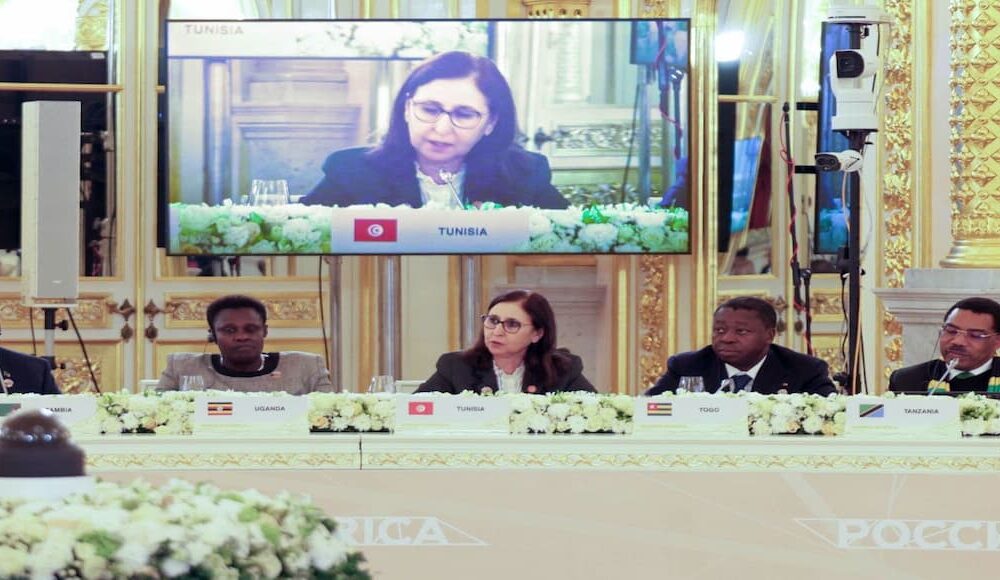
The head of the Tunisian government stated, during her intervention on behalf of Tunisia at the opening of the Russia-Africa summit, that the international peace and security system is undergoing a crisis of confidence, marked by an unprecedented decline in its effectiveness and credibility.
According to the presidency of the government, she highlighted that the international community today stands at a decisive turning point, as international decisions are increasingly subjected to narrow geopolitical calculations and the rules of international law are applied selectively, according to a logic of “two weights, two measures.”
She argued that the United Nations’ inability to put an end to what she described as “historic injustice and genocide” suffered by the Palestinian people, as well as to curb colonization policies and food deprivation, constitutes the most manifest illustration of a structural malfunction threatening the very foundations of the system of collective security.
Tunisia Reaffirms Its Commitment to Multilateralism
In the same context, the head of government affirmed that Tunisia’s deep commitment to international cooperation and multilateralism has never been a choice dictated by circumstances, but is part of the continuity of a historical struggle, deeply rooted in the fight for national liberation and the completion of sovereignty.
According to the same source, she insisted that peace and security cannot be established by imposing power relations, but require a genuine restoration of justice and equity, as well as a sincere commitment to all the principles and objectives enshrined in the United Nations Charter.
A Call for a Deep Reform of the United Nations
In this regard, the head of government reaffirmed Tunisia’s position on the need to accelerate a comprehensive and profound reform of the United Nations system.
This reform should, according to her, take into account the transformations the world is undergoing, help restore full prominence to collective action, and promote the establishment of a more just, more equitable, and more balanced world order.
She also stressed the importance of ensuring fair representation of the African continent and developing countries within international bodies.
Strengthening Russo-African Cooperation at the Heart of the Summit
The head of government furthermore stated that this summit is taking place in a particularly complex international context, marked by an acceleration of geopolitical evolutions and a multiplication of crises, tensions, and armed conflicts.
She also mentioned economic and energy disruptions, health threats, as well as climate change risks.
According to her, these challenges are no longer limited to specific geographic areas, but now have interdependent international dimensions, requiring global approaches and effective international solidarity.
In this framework, she considered that the willingness of the African and Russian sides to organize this summit reflects a renewed determination to continue strengthening their cooperation, to consolidate the gains already achieved, and to elevate their partnership to higher, more ambitious, and more effective levels.
She finally stressed the need to develop this cooperation in a spirit of mutual respect and pursuit of the common interest, based on a clear vision of the future, an affirmed political will, and mechanisms that enable turning common commitments into concrete achievements.