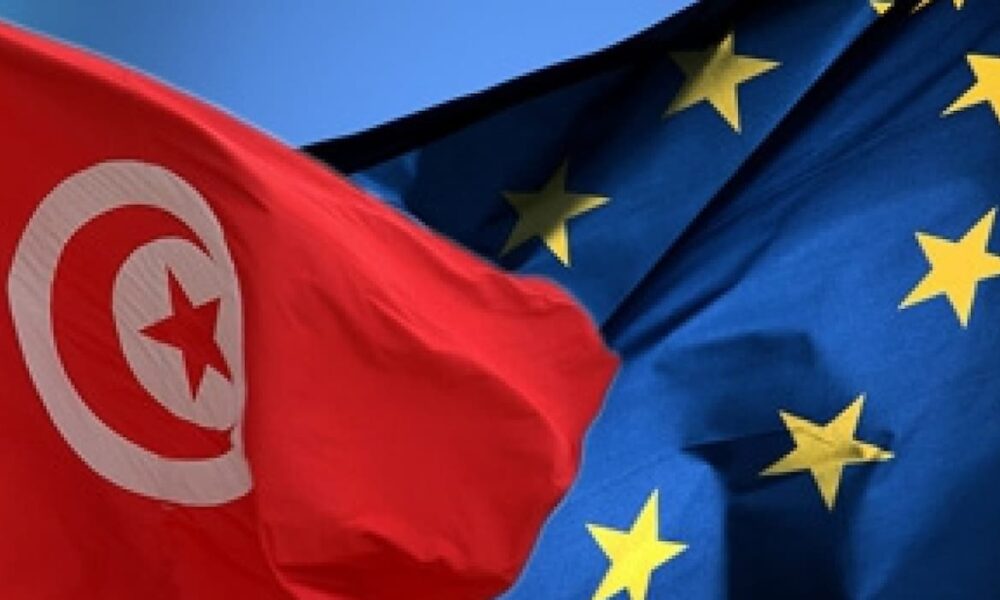
The European Union has reiterated its commitment to continue its partnership with Tunisia and to strengthen cooperation between the two parties, through initiatives aimed at addressing common challenges, supporting development, promoting investment and economic cooperation, and fostering the creation of new opportunities.
This approach is part of a communication campaign under the slogan: “The European Union by your side.”
In a post published on its official Facebook page, accompanied by posters outlining the main milestones of Tunisia-EU relations, the European Union emphasizes that the partnership between the two parties is not limited to agreements or projects. It is also based on ongoing dialogue, exchanges between peoples, and the strengthening of ties between Tunisians and Europeans.
Relations between Tunisia and the European Union date back to 1969, the year of the signing of the first trade agreement between Tunisia and the European Economic Community (EEC), before the opening, in 1979, of a European Commission delegation in Tunisia.
The signing of the Association Agreement, on 17 May 1995, constituted a decisive milestone in the evolution of bilateral relations. Tunisia was then the first country on the southern shore of the Mediterranean to conclude an agreement of this nature with the European Union, opening thus the way to a framework of cooperation broadened to the political, economic, social and cultural domains, according to the publication.
Biliteral relations experienced a new momentum following the 2011 revolution. In 2012, the two parties agreed to grant Tunisia the status of “privileged partner,” thereby widening the fields of cooperation and intensifying political and economic dialogue.
The European Union remains Tunisia’s main trading partner and also a major source of foreign investment. Cooperation between the two parties covers several sectors, including trade, investment, tourism and energy, but also education, training, scientific research and innovation.
On 16 July 2023, the two parties signed a Memorandum of Understanding relating to the “Strategic and Global Partnership,” with the aim of giving a new impetus to their bilateral relations and broadening the areas of cooperation. This agreement notably covers macroeconomic stability, the economy, trade, the green energy transition, exchanges between peoples as well as migration and mobility issues.
In the academic and cultural spheres, Tunisia participates in several European programs, including “Erasmus+,” “Creative Europe” and various cooperation programs in the fields of research and innovation. These schemes offer opportunities for university exchanges, foster the development of research projects and contribute to strengthening ties between the two shores of the Mediterranean.
Through this retrospective, the European Union highlights the diversity and scope of its partnership with Tunisia, which encompasses both economic cooperation and investments as well as academic and cultural exchanges, not to mention dialogue and the rapprochement between peoples.