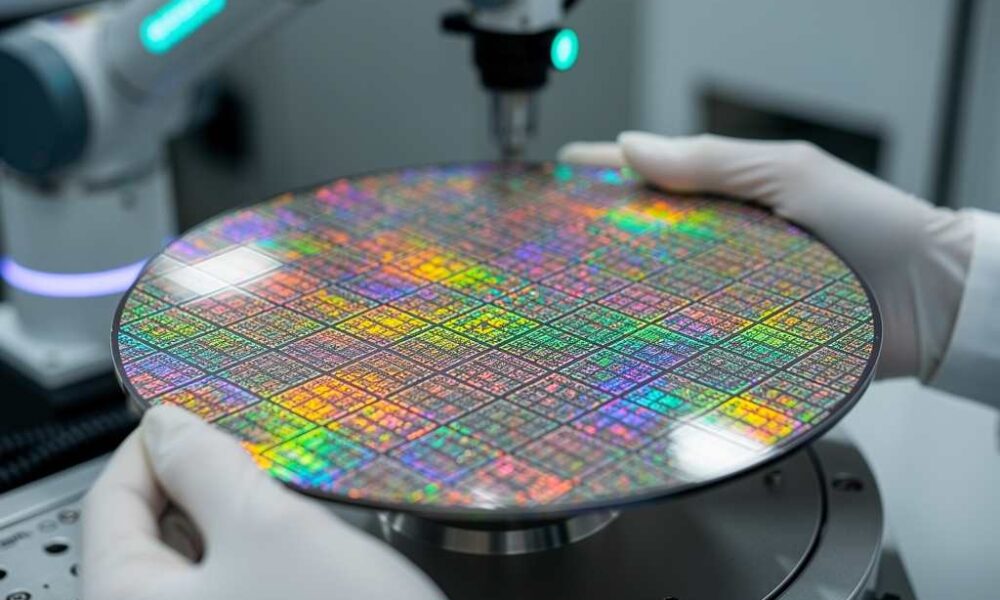
The global race for artificial intelligence no longer depends solely on the ability to manufacture the most advanced processors. Another link has become strategic: advanced packaging, the step that enables assembling multiple components, notably processors and memory, into a single high-performance module. According to Yole Group, revenues from this segment are expected to surpass those of traditional packaging for the first time in 2026, with investments approaching $28 billion.
Why it matters
• AI requires extremely fast exchanges between processors and memory.
• TSMC currently dominates the most advanced technologies, notably CoWoS.
• Investments in advanced packaging could approach $28 billion in 2026.
• Nvidia, AMD, Broadcom and the major cloud operators are seeking to secure more capacity.
Packaging Is No Longer Just a Finishing Step
For decades, semiconductor packaging consisted mainly of protecting the chips and establishing their electrical connections with the printed circuit board. The rise of AI is profoundly changing this function.
Modern systems now bring together several silicon elements in a single ensemble: graphics processors, specialized accelerators, and ultra-high-speed memories. This proximity reduces the distances data must travel and greatly increases performance.
Why AI Accelerates This Change
Large AI models must transfer enormous volumes of data between computing units and memory. The faster these transfers, the more training and execution of models can be accelerated.
At the same time, improving performance solely by shrinking transistor sizes becomes harder and more expensive. The industry is therefore seeking further gains by combining multiple specialized chips in a single package.
TSMC Dominates with CoWoS Technology
TSMC, the world’s leading foundry, currently dominates the most sophisticated advanced packaging technologies. Its CoWoS solution, for Chip-on-Wafer-on-Substrate, enables connecting several components on a common base and making them run as a high-speed, unified system.
This technology is used by Nvidia, AMD and Broadcom, as well as cloud groups that design their own AI accelerators.
The Challenge Becomes Available Capacity
Yet the success of CoWoS has created intense pressure on production capacities. According to Reuters, Nvidia is providing several billions of dollars in financing to expand the CoWoS capacity of Siliconware Precision Industries, a subsidiary of ASE Technology.
The president of Powertech Technology summed up the new challenge: customers are now seeking additional solutions so as not to depend on a single supplier. Powertech is working with AMD and Broadcom on a packaging technology that uses large rectangular panels rather than circular wafers.
$400 Million in Singapore, More Than $10 Billion in Taiwan
Powertech plans to invest $400 million in an advanced packaging joint venture with Broadcom in Singapore. Production could begin in 2028.
AMD, for its part, has announced more than $10 billion in investments in the Taiwanese semiconductor ecosystem, including partnerships with ASE, SPIL and Powertech in advanced packaging.
TSMC Is Already Preparing the Next Generation
TSMC is also developing a technology that uses panels, named CoPoS, for Chip-on-Panel-on-Substrate. A pilot line has been built and production could begin in the coming years. CoWoS remains, at this stage, its main AI-focused technology.
A $28 Billion Industry of Investments by 2026
According to Yole Group cited by Reuters, revenues from advanced packaging are expected to surpass traditional packaging for the first time in 2026. Investment spending dedicated to these technologies could approach $28 billion this year.
The trend also attracts equipment manufacturers. Suppliers that historically focused mainly on the early stages of chip manufacturing are now investing more in the machines needed for advanced assembly.
After the Chips, a New Industrial Battle
The potential shortage therefore no longer affects only the processors themselves. A chip that cannot be packaged with its memory and complementary components cannot be delivered as a complete system.
For AI players, securing packaging capacity thus becomes almost as strategic as reserving wafers from the foundries. This evolution could redistribute part of the global semiconductor value chain in the coming years.