Google strengthens its offensive on the AI infrastructure market. The group unveiled, on Monday, November 9, 2026, the TPU 8tx and TPU 8i Max systems, two new configurations designed to protect sensitive data and to handle increasingly demanding computing loads. The announcement intensifies its competition with Nvidia.
The essentials
Two new systems, TPU 8tx and 8i Max, within the eighth generation. Google Cloud posted $30.71 billion in revenue for Q3 2026, up 103% year over year.
Specialized systems, rather than two new chip architectures
Google stresses a technical distinction: its novelties are not two semiconductor architectures created from scratch. These are TPU system configurations, combining chips from the existing generation with memory, networking, host processors, and security features adapted to specific needs.
TPU stands for Tensor Processing Unit, a family of accelerators designed by Google for machine-learning computations. After the TPU 8t and 8i introduced in April, the group increases to four the number of eighth-generation systems announced this year.
TPU 8tx: protecting data during processing
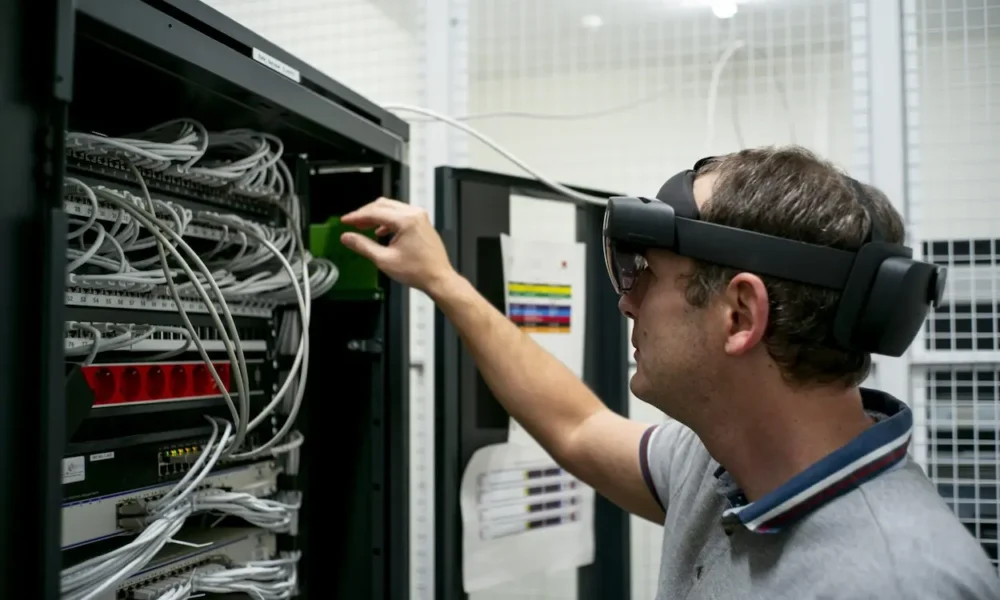
The TPU 8tx is notably aimed at government agencies and regulated-sector companies seeking to use AI models containing confidential information. It rests on the same silicon as the TPU 8t and pairs fifth-generation AMD EPYC host processors with hardware-protection mechanisms.
According to Google, the device maintains isolation and encryption of data and model parameters during their use. The company also claims latency can be reduced by a factor of two compared with the TPU 8t, without significant performance penalties under the described conditions. These gains are manufacturer-disclosed results and should not be taken as an independent comparison with all competing products.
TPU 8i Max: more compute and memory for AI agents
The TPU 8i Max addresses another constraint: AI applications that manipulate large document databases, long codebases, or extended contexts. Google bundles two TPU 8i chips in a single enclosure.
According to the company, this configuration doubles compute capacity, integrated SRAM memory, and the bandwidth of HBM memory compared with the TPU 8i. The aim is to process more information without multiplying inter-component communications to the same extent. Programming assistants, mathematical reasoning, and certain scientific research are among the use cases highlighted.
Nvidia under pressure in a rapidly expanding market
TPUs have historically been used for Google services and models, notably Gemini. The group is now seeking to broaden their deployment among professional Google Cloud customers, as Nvidia dominates a large portion of the AI accelerator market.
The financial context explains the importance of this strategy. According to Alphabet’s results released on October 28, Google Cloud revenue reached $30.709 billion in Q3 2026, up from $15.157 billion a year earlier, an increase of about 103%. Alphabet notes that TPU system sales contributed significantly to this activity, without detailing the exact amount.
What this evolution means for businesses?
For Tunisian companies developing AI services, the challenge is not simply to have faster chips. The diversification of infrastructures offered by major providers could, in the long term, broaden choices in terms of cost, privacy, hosting, and software compatibility.
However, it remains necessary to compare actual offers, access conditions, regional availability, operating costs, and data-sovereignty requirements. Google notably highlights better PyTorch support to facilitate porting applications already developed for other environments.