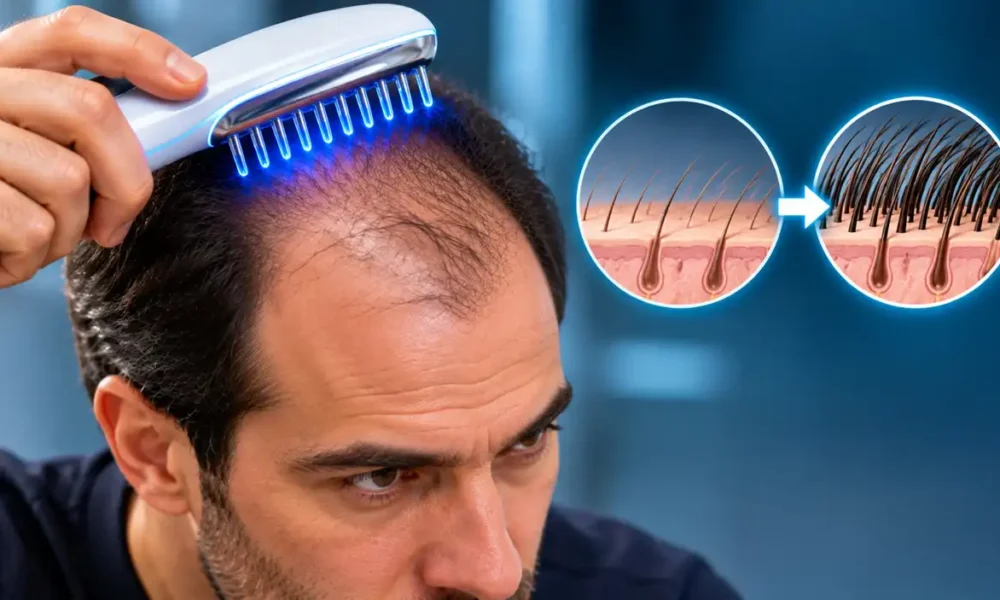
What if a comb could one day help fight baldness?
A team of Chinese researchers has presented an experimental device named Detangle, capable of stimulating hair follicles while delivering two molecules. In a study on male mice, this device achieved 97.85% hair coverage on a treated area after 28 days, a result higher than those observed with the comparison treatments.
But this discovery, as promising as it is, does not yet constitute an effective treatment demonstrated in humans.
The results were published on November 3, 2026 in the scientific journal Nature Communications, by a team notably including Beihang University in Beijing and several Chinese medical institutions. The figures were picked up by the international press, sometimes under a sensational formulation: “nearly 100% regrowth.”
This expression requires precision: the measure concerns the surface area of an experimental zone covered with hair on the mouse, and not the proportion of people cured of baldness.
The essentials
Device name: Detangle.
Principle: electrical stimulation and targeted delivery of two experimental molecules.
Result: 97.85% hair coverage after 28 days on a mouse back area.
An electric comb not quite like the others
At first glance, Detangle looks like a comb. But its teeth contain teeth of different heights, paired with small modules capable of depositing substances onto the skin. The device’s passage produces pulsed electric fields that locally stimulate the hair follicles and facilitate the transfer of molecules into the tissues.
This architecture constitutes the main novelty. The researchers report an electric field about 2.63 times stronger than that obtained with aligned electrodes, and a penetration reaching up to approximately nine times deeper toward the follicular regions than some conventional external application configurations. These are experimental measurements of the device, not a guaranteed depth of penetration on a human scalp.
The comb therefore does not simply massage the scalp or emit light. It combines a bioelectric action with a method of administering molecules specially studied to act on hair regrowth.
Two molecules to act on hair follicles
The researchers combined electrical stimulation with two experimental agents. The first is a VEGFA plasmid, designed to promote the expression of a factor associated with the formation of small blood vessels around the follicles. The aim is to improve their local environment.
The second is a small interfering RNA targeting SRD5A2, an enzyme involved in the production of dihydrotestosterone (DHT). This hormone plays an important role in androgenetic alopecia, by participating in the progressive miniaturization of certain follicles.
The intended effect relies on the complementarity of the mechanisms: better irrigating the follicular area, locally reducing a hormonal pathway associated with baldness, and stimulating cell activity with electrical impulses. These substances are not ingredients of an ordinary cosmetic comb.
97.85% after 28 days: exactly what does the study show?
The experiment used male mice whose backs had been shaved and hair loss induced by testosterone application, in order to reproduce certain characteristics of androgenetic alopecia. The researchers then compared several treatment modalities over 28 days.
The Detangle protocol involved application every three days, whereas the minoxidil and finasteride in the comparison groups were administered daily, according to the modalities appropriate to the animal model. The researchers measured the portion of the experimental area that had regrown hair.
| Treatment tested in mice | Hair coverage after 28 days |
| No active treatment | About 1% |
| Electrical stimulation alone | 39.52% |
| Oral finasteride | About 50% |
| Topical minoxidil | About 70% |
| Detangle + two molecules | 97.85% |
This is the percentage of hair-covered surface on a mouse back experimental zone. The “about” values are rounded from the animal model, not success rates in patients.
The highest result was obtained when both molecules were administered together using the comb. Electrical stimulation alone reached about 40% coverage: therefore the figure of 97.85% should not be attributed to electricity alone.
The researchers also observed, in the examined tissues, more follicles and more favorable indicators of local circulation in the groups receiving the combined treatment. These results strengthen the scientific interest of the approach, without proving that it could durably restore hair in humans.
Why the results do not yet prove a cure for baldness
A mouse is not a patient suffering from baldness. Its skin, hair growth cycles, and the experimental conditions differ from those of the human scalp. Moreover, the hair loss was artificially induced in the laboratory and followed for a relatively short period.
It remains to determine whether Detangle could act on human follicles already miniaturized for several years, what would be the effect of repeated applications, how long any potential improvement could last, and which categories of patients could benefit.
The researchers did not report major anomalies in certain skin, inflammatory, or neurological markers in their mouse tests. This observation is not sufficient to establish long-term safety in humans, especially when it comes to locally delivering molecules that modulate gene expression.
Beware the figure of 97.85%
This percentage does not correspond to 97.85% of patients cured, nor to a 97.85% increase in the number of hairs on a human head. It represents the hair coverage of an experimental area in treated mice under laboratory conditions.
Where is it sold? Beware combs marketed as equivalents
The Detangle described in the study is a research prototype. Scientific publications and available information do not mention an authorized commercial manufacturer, nor the opening of sales in China, Tunisia, or another country.
There are already on the Internet laser combs, LED brushes, vibrating devices and scalp massage devices. Some may be marketed at very varying prices. But they are not the Detangle comb and do not necessarily contain the specific electrodes or the molecular-delivery system studied by the Chinese researchers.
A seller who would attach the figure of 97.85% to a standard electric comb should therefore present evidence showing that it is indeed the experimental device, as well as relevant clinical data. Buying a device resembling the prototype offers no guarantee of obtaining the results observed in the mouse.
And the treatments currently used against baldness?
For human androgenetic alopecia, the options discussed with a dermatologist include notably minoxidil, finasteride where indicated, as well as certain hair grafting techniques. Their effectiveness varies depending on the type and stage of hair loss; each treatment has its indications, constraints, and risks.
The results of minoxidil and finasteride presented in the Detangle study concern only the mice in this experiment. They should not be used to directly compare the chances of success of these treatments in patients.
Hair loss can also have causes other than androgenetic alopecia. A dermatological diagnosis is therefore necessary before choosing a treatment. Neither an online-sold electric comb nor an untested human prototype can replace this approach.
When could this comb be available?
No timeline for human clinical trials or market release was announced in the November 3, 2026 study. Before any possible commercialization, it would be necessary to demonstrate the safety and effectiveness of the device and the associated molecules in human volunteers, and then satisfy the applicable regulatory requirements.
The discovery thus represents primarily a scientific concept proof: it shows that the combination of electrical stimulation and targeted administration of molecules can produce remarkable results in an animal model. The leap from the laboratory to the pharmacy, the clinical setting, or commerce remains a separate step, whose duration and outcome are unknown.