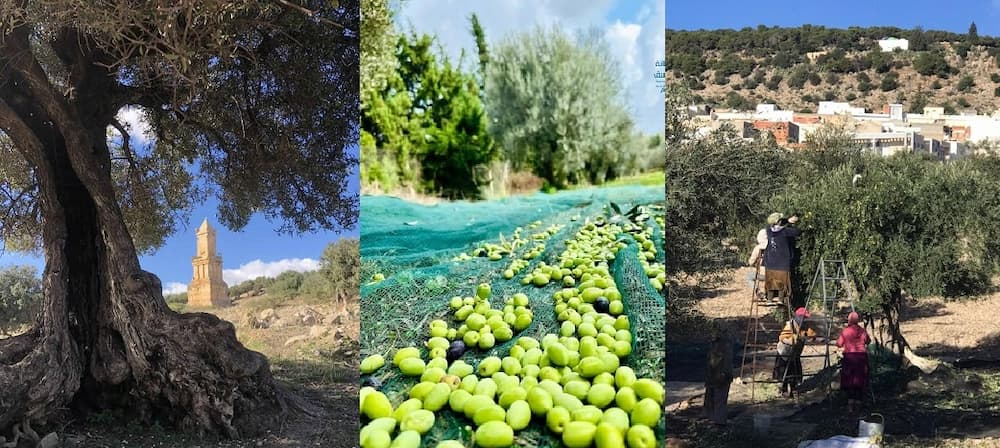
Tunisia closes the 2025/2026 olive campaign with a strong rise in its olive oil exports. Exported quantities reached 413,100 tonnes, generating revenues of 5,208.5 million dinars, representing a 39% increase compared with the previous campaign.
If these performances attest to the economic weight of Tunisia’s olive sector, they also highlight a major challenge: adding value to domestic production through the development of packaged olive oil exports.
The Essentials
- +47.4% : the growth in exported volumes.
- 5,208.5 MD : export revenues.
- 84.3% : the share of bulk in exported volumes.
- Nearly 41% : the gap in average export price between packaged and bulk (TN calculation).
- 70.2% : the combined share of Spain, the United States, and Italy in volumes exported.
An Increase of Nearly 1.5 Billion Dinars in Revenues
According to data from the National Agricultural Observatory (ONAGRI), as of the end of October 2026, Tunisian olive oil exports reached 413,100 tonnes during the 2025/2026 campaign, up from 280,300 tonnes in the previous campaign, i.e. a rise of 47.4%.
In value terms, revenues rose from 3,745.9 million dinars to 5,208.5 million dinars, a 39% increase.
Tunisia thus exported an additional 132,800 tonnes and earned 1,462.6 million dinars in extra receipts in a single campaign (TN calculation).
| Indicator | 2024/2025 | 2025/2026 | Evolution |
|---|---|---|---|
| Exported volumes (tonnes) | 280,300 | 413,100 | +47.4 % |
| Receipts (MD) | 3,745.9 | 5,208.5 | +39.0 % |
| Packaged oil (tonnes) | 42,200 | 64,900 | +53.7 % |
| Estimated average price (DT/kg)* | 13.36 | 12.61 | –5.7 %** |
Source : ONAGRI. MD : millions of dinars. *Average prices reconstructed from volumes and revenues (TN calculation). **Evolution provided by ONAGRI.
Packaged Oil Grows Faster Than Overall Exports
Exports of packaged olive oil recorded a rise of 53.7%, moving from 42,200 tonnes to 64,900 tonnes between the two campaigns.
Despite this progress, packaged oil represents only 15.7% of total exported quantities, while bulk retains a dominant share of 84.3%.
In terms of quality, the extra virgin category alone accounts for 83.4% of the total exported volume.
However, the packaged category contributes to revenues more than its share in volumes: this category generates 20.8% of the total value of Tunisia’s olive oil exports.
Bulk and Packaged: What Tunisia Numérique’s Calculations Reveal
Crossing exported volumes and their respective shares in the revenues reported by ONAGRI, Tunisia Numérique reconstructed the average export value per kilogram of olive oil for bulk and packaged forms.
The results highlight a valuation gap of nearly 41% between the two marketing modes.
| Indicator | Bulk | Packaged |
|---|---|---|
| Volume (tonnes) | 348,200 | 64,900 |
| Share of volumes | 84.3 % | 15.7 % |
| Estimated receipts (MD) | 4,125.1 | 1,083.4 |
| Share of receipts | 79.2 % | 20.8 % |
| Estimated average value (DT/kg) | 11.85 | 16.69 |
Source : ONAGRI, campaign 2025/2026. Revenues by category and estimated average values: TN calculations based on the rounded data from the source.
+40.9 %
The average export value of packaged olive oil exceeds that of bulk by about 4.84 dinars per kilogram, according to Tunisia Numérique’s estimates.
This valuation gap, however, does not necessarily measure the profitability of packaging. Costs related to packaging, marketing, logistics, and distribution are not included in these calculations. Differences in quality and destination markets can also contribute to the observed gaps.
Prices Start Rising Again in October 2026
Despite the revenue increase, the average export price of Tunisian olive oil fell by 5.7% over the entire 2025/2026 campaign.
October 2026, however, was marked by the opposite trend. The average price rose by 10.1% compared with October 2025, from 12.60 to 13.87 dinars per kilogram.
According to the exported olive oil categories, the average prices recorded in October 2026 ranged from 10.68 to 17.40 dinars per kilogram.
The European Union Takes Over More Than Half of Exports
By the end of October 2026, Tunisian olive oil had been exported to more than 98 countries. Despite this wide geographic reach, exports remain concentrated on a few major international markets.
The European Union remains Tunisia’s primary outlet, with 54.8% of exported volumes, ahead of North America (25.9%), Asia (11.9%), and Africa (3.5%).
Geographic distribution of exports by volume
European Union — 54.8%
North America — 25.9%
Asia — 11.9%
Africa — 3.5%
Other destinations — 3.9%
Source : ONAGRI. Share of other destinations obtained by difference (TN calculation).
Three Countries Concentrate More Than 70% of Export Volumes
Spain remains Tunisia’s main destination for olive oil among the countries cited by ONAGRI, with a 30.2% share of exported volumes, ahead of the United States (20.3%) and Italy (19.7%).
These three destinations alone absorb 70.2% of Tunisia’s exported quantities, i.e., about 290,000 tonnes during the 2025/2026 campaign (TN calculation).
| Country | Share of exports | Estimated volume (tonnes) |
|---|---|---|
| Spain | 30.2 % | 124,800 |
| United States | 20.3 % | 83,900 |
| Italy | 19.7 % | 81,400 |
| Saudi Arabia | 5.6 % | 23,100 |
| Canada | 5.5 % | 22,700 |
| Egypt | 2.9 % | 12,000 |
| Jordan | 2.8 % | 11,600 |
| Total of the seven countries | 87.0 % | 359,400 |
Source : ONAGRI. Volumes estimated from published market shares and rounded to the hundred of tonnes (TN calculation). The total is calculated before rounding of individual volumes.
The seven countries cited thus concentrate 87% of Tunisia’s olive oil exports. Presence on many international markets is therefore accompanied by a high geographic concentration of the volumes traded.
Organic Olive Oil Generates Nearly 795 Million Dinars
Exports of organic olive oil reached 60,600 tonnes during the 2025/2026 campaign, for a value of about 794.9 million dinars.
This segment thus accounts for 14.7% of volumes and 15.3% of total Tunisian olive oil export revenues, according to Tunisia Numérique’s calculations.
Packaging remains less widespread in the organic segment than in the overall sector. Only 6.4% of organic olive oil volumes are exported in packaged form, compared with 15.7% for all exports.
| Indicator | 2025/2026 |
|---|---|
| Export volume | 60,600 tonnes |
| Receipts | 794.9 MD |
| Share in total volumes* | 14.7 % |
| Share in total revenues* | 15.3 % |
| Share of packaged | 6.4 % |
| Average price | 13.11 DT/kg |
| Average bulk price | 12.87 DT/kg |
| Average packaged price | 16.72 DT/kg |
| Value added by packaging* | +29.9 % |
Source : ONAGRI. *TN calculations.
Italy, Leading Destination for Organic Olive Oil
While Spain plays a dominant role in overall Tunisian olive oil exports, Italy leads the list of importing countries for organic olive oil.
It absorbs 38% of quantities exported in this segment, ahead of the United States (27%), Spain (23%), and France (8%).
Main destinations of Tunisian organic olive oil
Italy — 38 %
United States — 27 %
Spain — 23 %
France — 8 %
Other countries — 4 %
Source : ONAGRI. Share of other destinations obtained by difference (TN calculation).
These four markets alone account for 96% of Tunisia’s organic olive oil volumes exported, illustrating an even stronger geographic concentration in this segment.
How Much Would 10,000 More Tonnes of Packaged Oil Bring?
To measure the economic stakes of valorizing exports, Tunisia Numérique conducted a simulation based on the estimated average export values for the 2025/2026 campaign.
Assuming total volume and average prices, transferring a portion of exports from bulk to packaged would produce the following theoretical revenue gaps:
| Volume transferred to packaged | Estimated gross additional revenues |
|---|---|
| 10,000 tonnes | 48.4 MD |
| 25,000 tonnes | 121.0 MD |
| 50,000 tonnes | 242.0 MD |
| 100,000 tonnes | 484.0 MD |
TN simulation based on an average rounded differential of 4.84 DT/kg between bulk and packaged. These scenarios are purely illustrative and do not constitute forecasts or profit estimates. They do not take into account additional costs, packaging capacities, international demand, or price fluctuations.
Beyond Volumes, the Valorization Challenge
The tally of the 2025/2026 olive campaign confirms the economic importance of Tunisia’s olive oil exports, whose revenues now exceed 5.2 billion dinars.
The growth of packaged oil, the predominance of extra virgin oil, and the weight of the organic segment are all elements to consider in the perspectives for valorizing national production.
Beyond increasing exported volumes, one of the main challenges for the Tunisian sector remains its ability to better valorize its olive oil, to develop its brands, and to diversify its outlets on international markets.