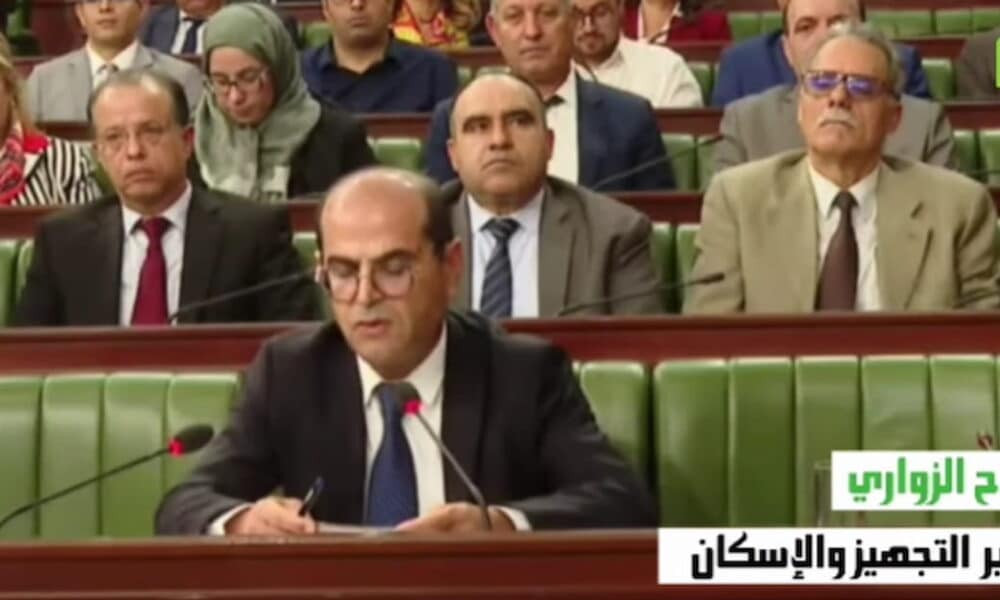
The minister responsible for managing the affairs of the Ministry of Industry, Mines and Energy, Slah Zouari, announced the establishment of a three-month emergency plan, which will extend to January 2027, in order to mobilize the necessary funding for the Gafsa Phosphate Company (CPG) and the Tunisian Chemical Group (GCT). This initiative aims to help the two companies regain their operating pace and honor their commitments to their partners.
In response to the interventions of the deputies, during the joint plenary session of the Assembly of the Representatives of the People and the National Council of Regions and Districts, held this Sunday to review the budget of the Ministry of Industry, Mines and Energy for the coming year, the minister specified that this plan had allowed the mobilization of state-guaranteed credits amounting to approximately 500 million dinars. These funds have started to be used to settle the debts of several companies. Moreover, investments of about 240 million dinars have been allocated under this program, and their implementation has already begun, in order to promote the gradual resumption of activity and improve the performance of the concerned entities.
These measures are part of a phosphate sector revival plan, aimed at restoring the pace of extraction, transport and processing, with the objective of bringing commercial phosphate production to 4.3 million tonnes in 2027, against a projected production of 2.8 million tonnes for the entire year 2026.
Slah Zouari stressed that achieving this objective required establishing the financial and logistical conditions indispensable for the resumption of all links in the phosphate value chain. He recalled that the sector’s difficulties did not concern production and extraction alone, but also affected transportation, processing, and the settlement of debts with partner companies of the public sector companies.
He added that mobilizing these funds would help restore the confidence of suppliers and companies involved in the phosphate chain, while guaranteeing the resumption of services related to production, transport and processing.
Regarding processing projects, the minister indicated that the Mdhilla 2 plant, known as ‘TIFERT’, should come back into operation during 2027, with a production capacity of around 700,000 tonnes. The resumption of its activity will constitute, in his view, an important lever to support national phosphate production and its derivatives.
The minister also clarified that the sector revival program is part of a strategy with a horizon to 2035. This plan provides for the rehabilitation of production units and processing plants, the completion of projects whose works are still ongoing, as well as the acquisition of the necessary equipment and machinery.
The plan also covers the development of the phosphate transport system, notably by hydraulic means, and the restructuring of the Tunisian Company for the Transport of Minerals. It also provides for addressing the difficulties faced by several production and processing units, whose availability rate sometimes reaches 90%, yet remain underutilized due to a lack of additional funding necessary to complete their rehabilitation.
Slah Zouari also stressed that the program includes environmental and social components, noting that reviving the sector requires a comprehensive approach to the various issues affecting it, beyond solely productive and financial dimensions.
Regarding the monitoring of the plan’s implementation, the minister announced that it would be ensured at two levels: meetings would be organized every two weeks at the Presidency of the Government, while a daily follow-up would be carried out by the minister, the team handling the file, and representatives of the Gafsa Phosphate Company and the Tunisian Chemical Group.
Finally, he reaffirmed that the objective was to progressively restore the production pace from 2027 and to enable the sector to regain its economic role, by generating additional resources for the State and strengthening the added value of Tunisian phosphate.