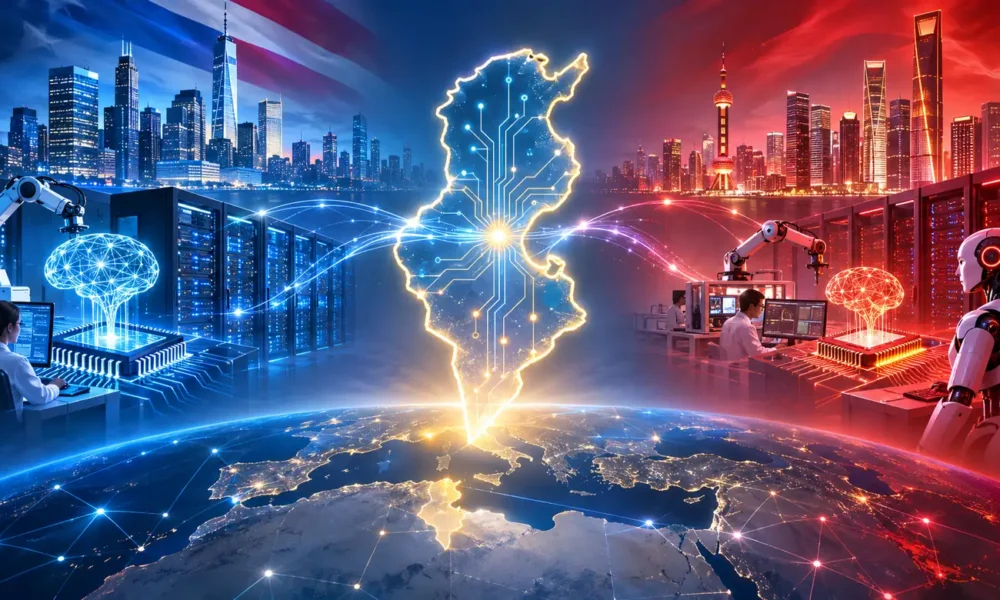
Artificial intelligence is making its mark in businesses, administrations, schools, and hospitals. But behind this technological revolution, two powers concentrate a large share of the resources needed for its development: the United States and China. For countries like Tunisia, the question becomes strategic: how to benefit from AI without being entirely dependent on decisions made in Washington or Beijing?
In an analysis published on November 21, 2026 by the American magazine TIME, Aditya Vashistha, associate professor at Cornell University, warns about the consequences of a global artificial intelligence ecosystem dominated by two powers.
His finding is worrying: the countries that use AI massively are not necessarily those that decide how it works, its rules, or the languages it prioritizes.
Two countries concentrate the bulk of technological resources
The figures illustrate this concentration.
According to estimates from the Epoch AI research center, for all new computing capacities intended for artificial intelligence between 2022 and June 2026:
- 72 % were directed toward the United States.
- 10 % toward China.
- 18 % toward all other countries.
These estimates refer to capacities related to AI chips delivered or produced, and not to the total equipment actually in operation.
In other words, the first two powers account for about 82 % of these new computing capacities.
This dominance is reflected in scientific research and infrastructures. According to data cited by TIME, the United States and China accounted for about 70 % of the electricity consumed by global data centers in 2024.
The competition notably concerns semiconductors, data centers, AI models, and the researchers capable of developing them.
A dependence that goes beyond economic questions
The problem is not only about who owns the most powerful computers.
Major American and Chinese companies develop systems that are subsequently used around the world.
These systems progressively intervene in handling professional data, drafting documents, medical analysis, education, and administrative decisions.
Yet access conditions, pricing, and certain operating rules depend on the companies that market them and on the regulations of their country of origin.
A decision taken in the United States or in China can thus have consequences for companies and institutions in other countries.
This situation raises a sovereignty question: how far can a state entrust essential functions to technologies it does not control?
The risk of artificial intelligence that ignores local cultures
The TIME article also highlights a less visible problem: linguistic and cultural domination.
AI models are trained from enormous volumes of text, a large share of which comes from English-language content.
According to the data cited by the author, the majority of the roughly 7,000 languages spoken worldwide remain inadequately supported by these technologies.
Research conducted in India even shows that the use of AI assistants can gradually influence how users express themselves, bringing their style closer to certain American norms.
For Tunisia, the issue is particularly important.
An AI can perfectly draft a text in Classical Arabic or French without properly understanding Tunisian dialect, national administrative realities, or the country’s social and cultural particularities.
The risk is to become merely a consumer of technologies designed for other societies.
Tunisia has strengths, but must accelerate
Tunisia does not start from zero.
It has engineers, researchers, universities, startups, and companies specialized in digital technologies.
The government presented, in 2026, the main orientations of a national artificial intelligence strategy for the period 2026-2030.
This strategy aims notably to foster innovation, protect personal data, and strengthen digital sovereignty.
The challenge remains to turn these orientations into operational projects, equipped with funding, infrastructure, and measurable objectives.
A report on AI governance in Africa, published in 2026, notes that Tunisia has a strategic vision, but gaps persist in implementation, evaluation, and regulatory framework.
Meanwhile, the white paper “TunisIA,” presented in July 2026 by the Association of Tunisians from Grandes Écoles (ATUGE), proposes 41 recommendations to develop AI tailored to the country’s means and needs.
Should we create a Tunisian ChatGPT?
Not necessarily.
Developing a giant model comparable to the most advanced systems requires substantial investments in hardware, energy, data, and skills.
Tunisia could favor a more targeted approach: adapt existing models to national needs.
Several domains offer concrete possibilities :
- Administration: streamline procedures and improve services to citizens.
- Health: assist professionals in certain tasks, under human oversight.
- Education: develop tools adapted to Tunisian curricula and the languages used by students.
- Enterprises: improve productivity and create exportable digital services.
- Language and culture: develop systems that better understand Tunisian spoken language and local realities.
A further avenue would be to pool certain infrastructures with African, European, and Arab partners.
This approach would help spread costs and reduce certain technological dependencies.
The real challenge: not becoming a mere market for AI giants
The rivalry between Washington and Beijing could gradually organize the world around two large technology ecosystems.
For Tunisia, the danger would be having to choose between foreign solutions without the capacity to adapt, control, or change them.
The answer is not necessarily to pursue complete technological independence, which is difficult to achieve for a small economy.
It is rather to preserve real freedom of choice: diversify suppliers, protect sensitive data, develop local skills, and support Tunisian companies capable of creating value through AI.
Tunisia does not need to win the global AI race. It should mainly avoid becoming merely a spectator.
For in the coming years, the real digital divide could no longer separate those who have Internet access from those who do not, but those who master artificial intelligence from those who merely use it.