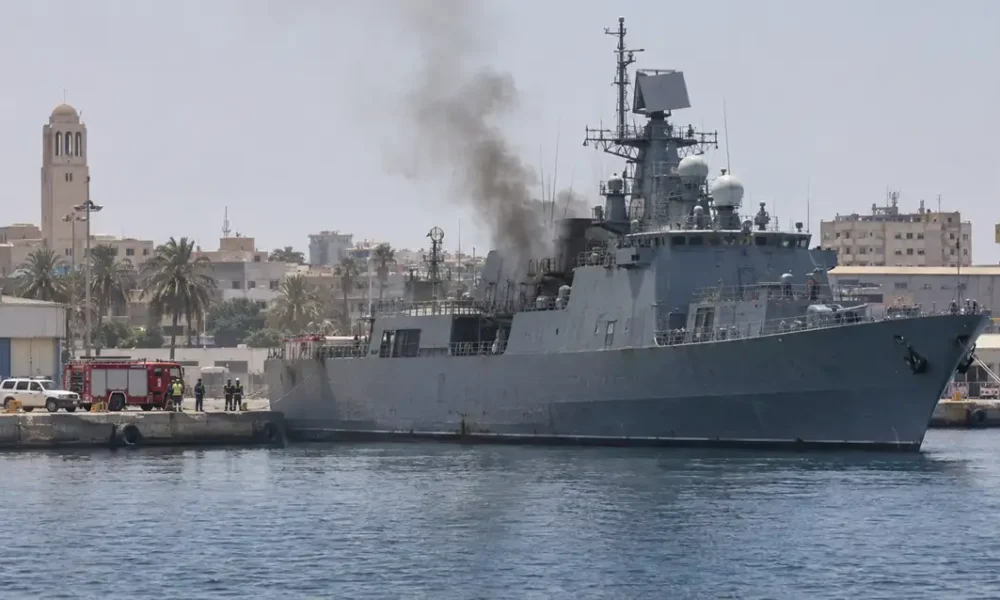
A powerful explosion, followed by a fire, struck on Sunday, November 22, 2026, a Russian warship stationed at the Benghazi naval base in eastern Libya. Local authorities suspect a drone attack.
According to Libyan military officials cited by the Associated Press, the target would be the Russian corvette Merkury, a warship commissioned in 2023.
The possibility of a Ukrainian operation is being discussed by these sources, who say that devices may have departed from western Libya. But neither Kyiv nor Moscow had confirmed this attribution and no organization had claimed the attack at the time of the initial dispatches.
If Ukraine’s involvement were proven, this operation would illustrate an extension of the Russo-Ukrainian confrontation to the Mediterranean ports, with significant consequences for a Libya that is already divided.
The Essentials
Benghazi, November 22: explosion and fire on a Russian warship at the quay, suspected drone attack. Ship: Merkury corvette according to Libyan officials cited by the AP, identification still provisional.
Six drones mentioned: four would have been intercepted and two would have reached the vessel, according to these sources.
Casualties: injuries reported by Reuters, no deaths confirmed in its initial reports.
Responsibility: not officially established.
An early-morning explosion at the Benghazi naval base
Initial alerts spoke of a fire in the naval base area. The authorities in eastern Libya later stated that the explosion occurred on board a Russian ship present in the port.
According to the government based in the east of the country, the vessel was making a stopover to refuel and resupply, on its way back to Russia, as part of maritime cooperation agreements with the local authorities.
The fire was brought under control and the port installations, warehouses and the base itself remained operational, according to the local government. Activities were said to have resumed once the area was secured.
Two medical sources questioned by Reuters reported injuries, with no deaths reported. Neither their number nor their nationalities were established. This provisional tally therefore does not allow concluding the absence of victims or further damage.
The Merkury corvette, a recent vessel of the Russian fleet
The Associated Press, relying on Libyan military officials, identifies the ship as the Merkury (“Mercury”), a Steregushchiy-class missile corvette, corresponding to the Russian Project 20380. The authorities in eastern Libya did not officially name the vessel in their initial communiqué.
Built at the Severnaya Verf shipyard in Saint Petersburg, the Merkury was delivered to the Russian Navy in May 2023. This type of vessel is intended for anti-surface and anti-submarine warfare, as well as escort and coastal protection missions. It carries detection systems, air- and sea-defense capabilities, and can host a helicopter.
Its presence in Benghazi is another notable element: a vessel associated with the Black Sea Fleet was making a port call in a Libyan port, far from the usual combat zones in Ukraine.
Six naval drones, two hits: a version that remains to be confirmed
According to information gathered by the Associated Press from Libyan military officials, six naval drones were reportedly deployed against the ship. Four would have been intercepted and two would have managed to strike the corvette.
These same sources say the devices were launched from a facility in western Libya used by Ukrainian forces. These are allegations reported by Libyan officials: the number of drones, their exact starting point, and the identity of the operators have not been independently confirmed.
A naval drone is an unmanned surface craft capable of navigating toward a target. Ukraine has already used such means against Russian ships in the Black Sea. Their possible use from the Libyan coast would mark a different geographic dimension, but this hypothesis awaits conclusive evidence.
Confirmed facts and elements still uncertain
Stated by Libyan authorities: an explosion occurred aboard a Russian ship in the port of Benghazi and a drone attack is suspected.
Reported by the AP: the Merkury name, six drones and a possible launch from western Libya.
Not officially confirmed: the identity of the attackers and the ship’s definitive damage assessment. These different levels of information should not be confused.
Has the ship been destroyed?
Images of the fire and satellite imagery analyses fueled speculation about the loss of the vessel. Naval expert H. I. Sutton, cited by Sky News and several trade outlets, estimates that the corvette would very likely have been destroyed.
However, this assessment is not, at this stage, an official damage tally. It was not publicly established whether the ship had sunk at its berth, remained afloat but severely damaged by fire, or whether part of its equipment could be salvaged.
Thus, the value and number of weapons potentially lost cannot be seriously quantified on the basis of the initial images alone.
Why is Ukraine suspected of acting from Libya?
AP had already reported, in March 2026, the claims by Libyan officials regarding Ukrainian drone specialists present in the west of the country, notably around Misrata, but also in facilities in Tripoli and Zaouïa. The agency cited discreet cooperation with local actors.
Libya remains politically and militarily divided between a government based in Tripoli, internationally recognized, and rival authorities controlling the east with the backing of the forces of Marshal Khalifa Haftar. Russia has for several years maintained close ties with the authorities and forces in the east.
In such a context, the alleged presence of Ukrainian operators in the west and a Russian military ship in Benghazi raises questions about the use of Libyan territory in a foreign rivalry. This does not demonstrate that either Libyan authority ordered or authorized the November 22 attack.
A precedent in March: the Russian LNG carrier Arctic Metagaz
The Mediterranean had already witnessed a similar episode in March 2026. The Russian LNG carrier Arctic Metagaz caught fire after explosions, then sank in waters between Libya and Malta.
On March 4, 2026, Reuters reported that Moscow accused Ukraine of launching naval drones from the Libyan coast. The 30 crew members were reported safe and sound. Ukraine had not confirmed responsibility.
The Benghazi incident thus constitutes a new episode in a series of operations attributed to Ukraine against Russian maritime interests, but the operational link between these cases has not been established by publicly released investigations.
The reaction of Libyan authorities: sovereignty and port security
The government of eastern Libya, supported by Khalifa Haftar, condemned what it sees as a grave affront to the country’s sovereignty and to navigation security. It announced the opening of a joint investigation with Russia to determine the origin of the attack and the identity of those responsible.
The authorities recalled that Libya is not a party to the Russia-Ukraine war and must not become a space where external conflicts are settled. They are considering diplomatic and legal steps against those identified if possible.
This stance reflects concern over the possible use of a Libyan port for military operations targeting a foreign vessel. It does not, in itself, prove the identity of the attackers.
Drones against Russian ships also in the Baltic Sea
At the same time, another Russian vessel, the cargo Sparta II, was hit by a drone attack in the eastern Baltic Sea, near Finnish waters. Reuters reported on November 22 that the 16 crew members had been evacuated and one lightly injured.
The two incidents involve Russian ships, but in different regions and circumstances. There is no public evidence to present them as two operations belonging to a single coordinated plan.
Why this attack interests the entire Mediterranean
Libya occupies a strategic position between North Africa, Southern Europe and the eastern Mediterranean. Its ports, oil infrastructure and the sea routes that skirt it play a significant economic role.
An attack on a military ship at berth can fuel political tensions and complicate the security of port calls. The risk also includes new operations or reprisals, with possible consequences for port activities and navigation.
For Tunisia, a neighboring country, developments in Libya deserve particular attention due to geographic proximity, economic ties and cross-border movements. No direct impact on Tunisian ports or Tunisian trade, however, has been established at this stage.
The decisive question: who struck, and for what purpose?
The reality of an explosion aboard a Russian ship is hardly in doubt. Yet several essential elements still await confirmation: the exact nature of the drones, their starting point, the identity of their operators, the irreparable damage suffered by the vessel, and the conclusions of the Libyan-Russian investigation.
If the Ukrainian track were confirmed, the operation would demonstrate Kyiv’s ability to threaten Russian military assets well beyond the Black Sea. But attributing an attack requires more than spectacular footage or anonymous statements.
In Benghazi, this Sunday, November 22, the Russia-Ukraine war enters at least into suspicions and investigations.
The question now is whether the information gathered will confirm a Ukrainian attack carried out in the Mediterranean, and how Libya intends to protect its ports from a confrontation that does not stem from its internal conflict.