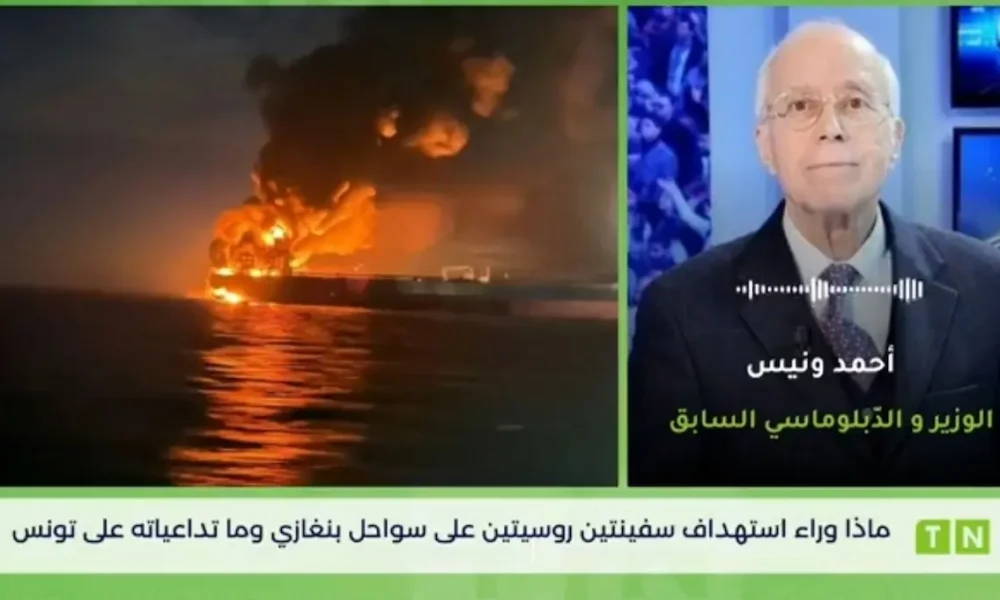
The attack on two Russian vessels off the Libyan coast raises questions about a possible extension of the conflict between Russia and Ukraine to the Mediterranean region, as well as the security and strategic repercussions that this development could have for the countries of the region, notably Tunisia, given its geographic position and its proximity to Libya.
Ukraine claimed, on Monday, November 23, 2026, responsibility for the attack on the two Russian ships off the Libyan coast, just hours after a United Nations call to open an investigation into the attacks off Benghazi.
This development raises questions about the nature of the international conflict playing out in the region, the links between the Libyan situation and the rivalries among the great powers, as well as the potential consequences for regional security and Tunisian interests.
In this context, the diplomat and former Foreign Minister, Ahmed Ounaies, explained, in an exclusive statement to Tunisie Numérique, that Tunisia does not constitute, in his view, a direct target of the powers involved in the international rivalries. He believes that the events observed in the region fit into broader strategic transformations that go beyond the framework of the Russo-Ukrainian conflict.
Ahmed Ounaies: Tunisia Is Not a Direct Target of the Great Powers
Ahmed Ounaies considers that Tunisia’s position on the global strategic chessboard does not necessarily make it a center of interest for rival international powers. He stresses the need to distinguish the repercussions of regional and international developments from direct and deliberate targeting.
He explains that the rivalry among the great powers can extend to different geographical zones without the countries located near these confrontations becoming targets in themselves.
In this framework, he emphasizes the importance of approaching current geopolitical transformations with realism and not overestimating Tunisia’s place in the strategic calculations of competing international powers.
He also calls for preserving traditional mechanisms of strategic cooperation in the defense domain and for developing a regional vision that goes beyond the current confrontation on the European continent, while taking into account the transformations underway in the Mediterranean space.
Libya at the Heart of International Rivalries
In his analysis of the Libyan situation, the former Foreign Minister believes that the state of fragility and division that Libya has endured for more than a decade has made it particularly vulnerable to the consequences of international conflicts and the interventions of foreign powers.
He emphasizes that the persistence of the Libyan crisis, coupled with the country’s significant natural resources, has contributed to making Libya a battleground for rivalry among international actors seeking to defend their own interests.
According to Ahmed Ounaies, the fundamental problem lies in the inability of the various Libyan parties to overcome their internal divisions and to put national interest above the calculations of the great powers.
He explains that the continuation of this situation weakens Libya’s ability to manage the evolution of its own crisis, in a context marked by the intertwining of local, regional, and international interests.
A Confrontation That Now Extends Beyond European Borders
Ahmed Ounaies asserts that the rivalry among the great powers is no longer limited to the European theater, but now reflects a global confrontation, extending to several regions around the world.
He specifies that this international competition touches European, Asian, and Mediterranean spaces, where the strategic, economic, and military interests of the major powers intersect.
According to him, the great powers act essentially according to their own calculations and interests, without necessarily giving priority to the concerns of the countries and regions where the confrontations take place.
In this perspective, the Tunisian diplomat believes that understanding developments in Libya requires placing them back in the global strategic context, rather than treating them as isolated events within the great international rivalries.
What Potential Consequences for Tunisia?
Regarding Tunisia’s position in the face of these developments, Ahmed Ounaies emphasizes that the country does not constitute, according to his analysis, a direct target in the confrontation between the great powers.
Nonetheless, he stresses the importance of recognizing the nature of the current international period, which requires preserving existing strategic arrangements and deepening reflection on regional security.
According to him, Tunisia must approach international shifts from a perspective that goes beyond episodic events, taking into account its national interests and long-term regional balances.
This analysis highlights the need to distinguish the risks associated with the widening of international rivalries in the region from the existence of a direct threat against Tunisia, which the attack on the two ships does not by itself establish.
Toward a New World Order Dominated by the Interests of the Great Powers
In his assessment of international transformations, Ahmed Ounaies believes that the world has entered a phase of profound mutation of the international order, different from the system established after the adoption of the United Nations Charter.
He explains that international relations are undergoing deep upheavals, in which the interests of the great powers exert growing influence over conflict management and the distribution of spheres of influence.
According to his analysis, countries and regions that become theaters of confrontation see their own interests insufficiently taken into account by rival powers, which prioritize their strategic calculations.
Ahmed Ounaies considers that this evolution signals a transition toward a new international order, marked by increased competition among the great powers for influence and the defense of their interests, whether in Europe, in Asia, or in the Mediterranean basin.
The statements of the former Foreign Minister thus highlight a reading suggesting that the recent events off the Libyan coast should be placed in a broader international context, while avoiding conclusions that Tunisia could become a target of these confrontations.