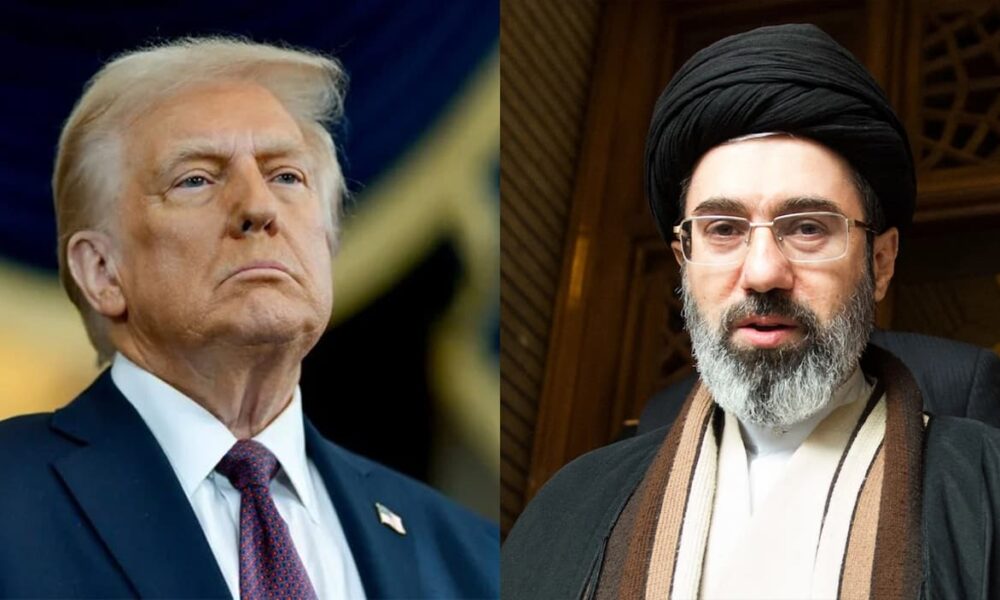
This Saturday, November 28, 2026, 164 days after the signing of the memorandum between Washington and Tehran and 273 days after the outbreak of the war, the Strait of Hormuz remains at the heart of the confrontation.
The Islamic Revolutionary Guard Corps (IRGC) announced the explosion of two oil tankers, while the American command denied an Iranian attack on the aircraft carrier Abraham Lincoln. Donald Trump maintains pressure on the Iranian nuclear program.
The Essentials
- Hormuz : two tanker explosions announced by the IRGC, with no independent confirmation of their account.
- Abraham Lincoln : CENTCOM denies any Iranian strike against the carrier group and says it returned to the United States in October.
- Navigation : Washington also denies the existence of a $2.5 million passage fee.
- Blockade : the United States announces the immobilization of the merchant ship Pacific Archer, flying the Palau flag.
- Oil : Brent closed Friday at $95.44 per barrel, up about 3% for the week.
Two tankers reportedly exploded near the Strait of Hormuz
The Navy of the Islamic Revolutionary Guard Corps announced, according to the Iranian agency Fars, that two oil tankers had exploded before catching fire. One was located at the entrance to the Omani port of Khasab, the other to the east of the strait, on a route that Tehran considers unauthorized.
Iranian authorities contend that the ships were attempting an illicit passage and claim that sea mines are present in the area. They warn that American protection does not guarantee the safety of vessels.
An Iranian communiqué dated November 26 already reported two tankers hit near Khasab. According to this Iranian version, one of them carried more than two million barrels of crude. Nothing at this stage allows confirming that these are two new distinct incidents.
The identities of the ships mentioned by the IRGC, the exact circumstances of the explosions, the status of their crews, and any environmental consequences have not been independently established.
Maritime reports calling for caution
Security advisories published by UK Maritime Trade Operations (UKMTO) confirm ongoing incidents in the region. On November 25, the British agency reported that a tanker had been hit by an unidentified projectile in waters near Khasab. Its crew was complete, and no environmental impact had been reported at that time.
On the same day, UKMTO reported an explosion near another tanker off Dubai, with no damage to the vessel. On November 26, it issued a notice regarding an incident between a cargo ship and military forces in the Gulf of Oman. These separate reports are not sufficient to confirm the Iranian version of the two explosions.
CENTCOM denies an attack on the Abraham Lincoln
The U.S. Central Command (CENTCOM) rejected statements by the Iranian navy commander, Shahram Irani, that Iran had struck the USS Abraham Lincoln at the outset of the war, forcing American forces to seek help from regional countries to evacuate personnel.
In a statement carried by Iran International on November 28, CENTCOM says that the American carrier strike group was not hit by Iran and that it returned to the United States in October after its deployment to the Middle East. Washington also denies the Iranian account of recovering two tankers seized by American forces.
Another denial: CENTCOM rejects the claim that the United States would charge ships transiting Hormuz 2.5 million dollars. It asserts control of the strait with its regional partners and says that thousands of ships carrying billions of barrels of crude oil have been able to transit under American protection, without a passage fee. These American claims do not constitute independent verification of the actual freedom of navigation.
Washington immobilizes the Pacific Archer
The United States continues its blockade of Iranian ports. CENTCOM announced on Friday that it had immobilized the Pacific Archer, a merchant vessel flying the Palau flag, after departing Bandar Abbas port. According to the U.S. command, the vessel was struck in the Gulf of Oman, its propulsion was disabled, and its civilian crew was not injured.
This marks at least the fifteenth publicly disclosed vessel immobilization since the blockade began in the spring, and the sixth since its restart in July. The command also says it has diverted 158 merchant ships since the restart.
Tehran promises to break the blockade
Shahram Irani stated that Iranian naval forces continued their efforts to break the American blockade. He asserts that the country’s ports remain operational and that escort missions for ships continue.
The army spokesman, Brigadier General Mohammad Akrami, said that the navy controls the zone from the eastern end of the Strait of Hormuz to the northern Indian Ocean as part of the conflict. The Iranian command claims its naval forces are ready to respond to any threat to national security and says it has repelled the opposing fleet at a distance. These are statements from the Iranian side, whose operational reach cannot be independently confirmed.
The deputy chief of staff of the Iranian Armed Forces also warned that any location from which an attack on Iran could be launched could become a target according to Tehran. He rejected the deadlines set by Donald Trump. For its part, the Iranian Defense Ministry told Tasnim that its ministry was working to equip the naval forces with advanced systems as part of strengthening their capabilities and ongoing support.
Trump keeps up pressure into early 2027
On the diplomatic front, Donald Trump said he discussed the Iran dossier with Israeli Prime Minister Benjamin Netanyahu. Washington intends to keep open a possibility of resuming negotiations on the Iranian nuclear program until the start of next year, while maintaining its military presence.
The American president again spoke of a possible strike against Pickaxe Mountain, an underground complex associated with the Iranian nuclear program near Natanz, if military operations resume. He had previously told Axios that he did not want to rush his decision before the start of 2027.
Hormuz: no Iran-Oman agreement notified to the IMO
Arsenio Dominguez, the secretary-general of the International Maritime Organization (IMO), said he had not received official information about a possible agreement between Iran and the sultanate of Oman regulating maritime traffic through Hormuz. This does not mean that no negotiations have taken place.
Oman’s Foreign Ministry had announced on August 25 that Muscat and Tehran were discussing a gradual framework to secure navigation and carry out a mine-clearing project. The realization of a durable agreement for managing the strait remains uncertain.
Brent regains upward momentum for the week
Maritime tensions keep concerns about the global oil supply alive. At the close of Friday, November 27, Brent settled at 95.44 dollars per barrel, down 1.2% on the session but up about 3% for the week. U.S. WTI closed at 83.08 dollars, down 0.7% from Wednesday’s close, due to the market being closed on Thanksgiving Thursday. It had fallen 0.9% for the week, according to Reuters.
Oil at the close on November 27
| Brut | USD/barrel | Week |
| Brent | 95.44 | ≈ +3 % |
| WTI | 83.08 | −0.9 % |
Source : close of Friday 27 November 2026.
According to Rystad Energy data cited by AP, regional oil flows fell by about 20% in the first half of November compared with October, to around 13 million barrels per day. A sustained reduction in supplies could keep price pressure on, without a sustained break above $100 per barrel being guaranteed.
For Tunisia, the risk of renewed energy pressure
Tunisia remains exposed to fluctuations in international hydrocarbon prices. According to the INS external trade bulletin at the end of October 2026, the energy trade deficit reached 12 026,1 million dinars over the first ten months of the year, versus 9 181,5 million in the same period of 2025, i.e., an increase of about 31%. It represents around 51.1% of the total trade deficit of 23 547,2 million dinars.
A sustained rise in crude could raise the cost of energy imports, weigh on foreign currency needs and increase budgetary pressures related to subsidies. The magnitude of these effects will depend on the price Tunisia actually pays, the imported volumes, the exchange rate, and public policy decisions. The incidents announced in recent days do not in themselves allow quantifying an additional cost for the country.
On the 164th day of the Islamabad memorandum, the outcome of the confrontation remains uncertain: the resumption of negotiations, crew safety and freedom of navigation remain at the center of the stakes.
Also read: Iran–United States (Day 163): Trump threatens a nuclear site, Tehran denies any Kuwait involvement; Tunisia: the trade deficit widens to 23.5 billion dinars by end-October 2026.