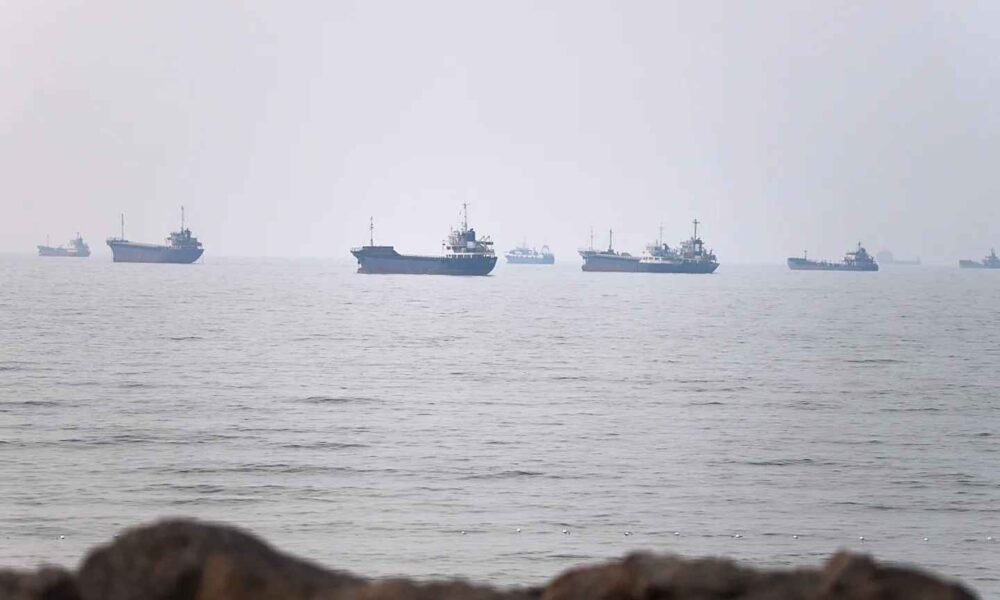
To the east of the Arabian Peninsula, Hormuz controls the export of a substantial share of Gulf oil. To the west, Bab el-Mandeb opens the sea route from the Red Sea to the Suez Canal.
The intensification of fighting in Yemen, attacks targeting Saudi Arabia, and a Brent crude near $115 a barrel place these two passages at the center of concern.
Their simultaneous blockage is not established. But the threat is enough to complicate the choices of shipowners, importers, and insurers, even on Mediterranean markets.
Three benchmarks to understand
- Around 20 million barrels per day passed through Hormuz in 2025, accounting for nearly a quarter of the oil traded by sea worldwide.
- 1,215 merchant ships passed through Bab el-Mandeb in September 2026, traffic still down 47% from its pre-crisis level.
- TD 10.48 billion: this is Tunisia’s energy trade deficit for the first nine months of 2026, already recorded before developments of this late October.
Two Straits, Two Different Roles
The map alone explains part of the concern. Between Iran and Oman, Hormuz connects the Persian Gulf to the Gulf of Oman. It is the maritime outlet for the exports of several major hydrocarbon producers, including Saudi Arabia, Iraq, Kuwait, Qatar and the United Arab Emirates.
On the other side of the Arabian Peninsula, Bab el-Mandeb connects the Gulf of Aden to the Red Sea. Ships going from the Indian Ocean to the Suez Canal typically must pass through it. Their routes then continue to the Mediterranean and European ports.
The two passages do not carry exactly the same goods and do not fulfill the same function. Some oil cargoes from the Gulf may sequentially use Hormuz then Bab el-Mandeb. Others use different routes.
Conversely, ships that circumvent Africa avoid Bab el-Mandeb and Suez, but do not necessarily have a solution to exit the Gulf if Hormuz is itself inaccessible.
At Hormuz, the threat weighs primarily on energy supply
Before the 2026 escalation, volumes traversing Hormuz represented about 20 million barrels per day of oil and oil products in 2025, accounting for nearly 25% of global maritime crude oil trade. A large portion of these exports was destined for Asia. The strait also plays a decisive role for LNG exported by Qatar and the United Arab Emirates.
This figure describes the reference traffic for 2025: it should not be confused with throughput actually observed during the current war. Since the start of the conflict, navigation and exports have been disrupted, which limits the scope of comparisons with a normal year.
Land routes can circumvent Hormuz. Saudi Arabia notably has an east-west oil pipeline discharging into the Red Sea, while the Emirates can ship oil via the Fujairah port, located outside the Persian Gulf. But these infrastructures have their own capacity and security limits. Before the current crisis, available alternative capacities were estimated at about 3.5 to 5.5 million barrels per day, far below Hormuz’s usual flows.
Hence, the case for substitution routes is real, without guaranteeing replacement of all exports. And when activity along Saudi Arabia’s Red Sea coast is also threatened, part of the bypass strategy loses its simplicity.
At Bab el-Mandeb, ship traffic recovery remains fragile
The news around the strait is not that of a total closure. It is about traffic trying to rebound after nearly three years of upheaval. In September 2026, 1,215 merchant ship transits were recorded at Bab el-Mandeb, up from 1,170 in August. The rise represented about a 4% month-on-month increase, but traffic remained 47% below pre-crisis levels.
In the Suez Canal, in the same month, 1,228 transits were counted. This was 21% higher than in September 2025, but still 39% lower than before attacks on Red Sea navigation. The figures refer to ship passages, not the total value of goods transported.
| Maritime indicator | September 2026 | Difference vs pre-crisis |
| Bab el-Mandeb | 1 215 passages | −47 % |
| Suez Canal | 1 228 passages | −39 % |
Data monitoring merchant ships over 10,000 gross tons. Comparisons are based on a pre-crisis reference, not September 2025.
This partial rebound makes the new escalation particularly sensitive: some companies had begun scheduling certain services via the Red Sea route, saving time on routes via the Cape of Good Hope. Their decision now depends as much on security assessments as on distance savings.
In Yemen, fighting rekindle a risk already known to shipowners
In September, the advance of the Houthis toward Perim Island, located at the entrance of Bab el-Mandeb, marked a new stage in the conflict. Yemeni forces supported by Saudi Arabia later announced that they had retaken several coastal areas. These military developments, reported by sources sometimes at odds, do not allow one to claim that any side currently exercises total and uncontested control of the strait.
Attacks on Saudi infrastructure and airports have also resumed. On Thursday, October 22, Reuters reported, citing several people familiar with the decision, that Saudi Aramco had requested the evacuation of its Dhahran headquarters and remote work. The company had not immediately responded to the agency’s request for comment.
A navigation incident reported on October 7 against a container carrier operated by a Chinese firm, south of the Red Sea, reminds that risks affect more than just oil tankers. In this case, no Houthis claim had been reported.
What shipowners fear, therefore, is not only the physical blockage of a passage. A deterioration in security conditions can lead to higher insurance premiums, escort requirements, changes to port calls, or temporary abandonment of certain routes.
Detour via Africa: ten more days on some routes
Going around the southern tip of Africa avoids Bab el-Mandeb and Suez, but at the cost of a longer crossing. A documented example on the Shenzhen–Rotterdam axis increases the journey from about 10,000 to 13,000 nautical miles, and its theoretical duration from 31 to 41 days. That corresponds to roughly 3,000 additional miles and ten days in this scenario.
This extra time should not be applied indiscriminately to connections to Tunisia: the starting point, the arrival port, the vessel’s speed, and the stopovers alter the outcome. However, the mechanism is the same. Longer routes immobilize ships longer, consume more fuel, and can disrupt delivery schedules.
The cost of a container does not automatically rise by a uniform percentage. It depends on the carrier, the route, the cargo type, the booking date, and the division of costs between seller and buyer. Some companies may also choose to maintain a route while raising the guarantees demanded.
Why Tunisia must follow these two straits
For Tunisia, the first transmission channel is energy. In the first nine months of 2026, the total trade deficit reached TD 20.997 billion, of which TD 10.480 billion for energy products. This item thus represents 49.9% of the total deficit, according to calculations based on official data. In the same period, imports of energy products rose by 32% in value compared with a year earlier.
These figures do not measure the specific impact of this week’s fighting: they go up to September 30, 2026. They do, however, illustrate Tunisia’s economy’s sensitivity to global energy prices, to the dinar level, and to transport costs.
The second channel is trade. In the first nine months of 2026, Tunisian imports totaled TD 71.397 billion. They come from diverse suppliers, including China, India, Turkey, and European countries. Not all of these goods cross Hormuz or Bab el-Mandeb, but global supply chains can transmit disruptions beyond the routes directly affected.
The operation of Tunisian ports measures the scale of this issue: in the first half of 2026, commercial seaports handled 14.795 million tonnes of goods, up 7.28% year on year, as well as 280,691 TEUs, up 9.87%.
These volumes attest to port activity; they do not prove congestion or local disruption attributable to the current crisis.
What could change for a Tunisian business
- An importer of Asian goods : less predictable shipping times, revision of freight terms and stock requirements.
- An industry using energy products : exposure to fuel and gas prices and to supplier revision clauses.
- An exporter : risk of a shifted delivery schedule, especially when goods travel through long or intermodal maritime chains.
- A carrier or a logistics provider : need to verify port calls, insurance, and confirmed itineraries before committing.
A three-scenario crisis, not a closure already secured
First scenario: routes remain accessible. Energy prices and insurance premiums may nonetheless stay high due to the risk of attack. Companies should then mainly watch currency volatility and contractual terms.
Second scenario: more ships avoid the Red Sea. Goods continue to move, but some routes lengthen. Delays, vessel availability, and surcharges become the main commercial issues.
Third scenario: Gulf oil exits and substitute routes suffer strong interruptions. The shock would simultaneously affect export quantities, energy costs, and transport. It is the heaviest scenario, but it should not be presented as already realized.
Oil above 114 dollars, a symptom of a broader risk
Friday morning, October 23, Brent was priced around $114–$115 per barrel, reaching its highest levels since early May. This move reflects concerns about regional supplies and transport costs, without proving a simultaneous disruption of both straits.
The distinction is important: Hormuz is primarily an energy lock, Bab el-Mandeb a strategic passage for traffic between Asia, the Red Sea, and the Mediterranean. Their joint vulnerability can transmit into price and timing impacts that vary greatly depending on the goods and routes.
For Tunisia, the immediate issue is not to presume a shortage, but to anticipate the real conditions of upcoming deliveries. In an economy already exposed to a substantial energy deficit, the costliest disruptions are often those that occur on a contract signed too early, without visibility on insurance, surcharges, and lead times.