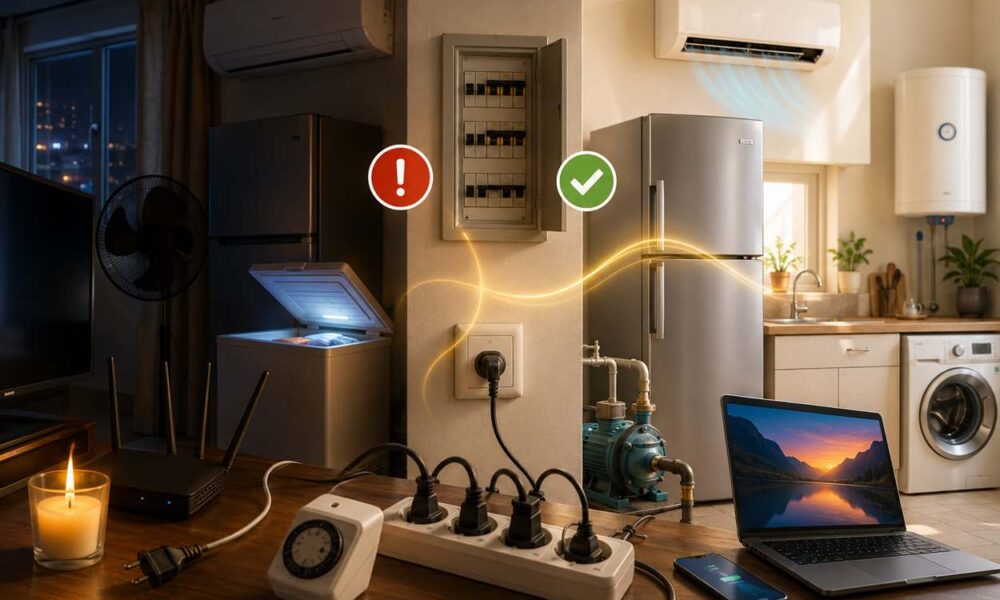
When electricity returns after a power outage, the first instinct is often to switch back on the air conditioner, the water pump, the water heater, the television, and the washing machine. This is precisely what it is best to avoid.
The danger does not come only from the interruption itself. At the moment of restoration, voltage can still fluctuate and many appliances may try to restart at the same time in the home, the building, or even the entire neighborhood. This simultaneous restart can trip a circuit breaker, cause another outage, or damage the most sensitive equipment.
The essentials in two minutes
Do not switch on the entire house at the same instant. Let a simple lamp indicate that power has returned, and observe it for a few minutes. If it flickers badly or if the electricity comes back, keep the large appliances off.
- Refrigerator and freezer: they are priorities. If they stayed plugged in and restart normally, let their control manage the compressor. Do not turn them off and do not keep turning them off and on.
- Water pump: turn it back on only after ensuring that water is available and that it will not run dry.
- Air conditioner: wait about three minutes after power returns stably, then start one device at a time.
- Water heater and washing machine: first check that water is available, then switch them back on separately.
- Television, computer, box, game console, and chargers: reconnect them last, when the power seems stabilized.
Why is power restoration a delicate moment?
During the outage, the refrigerator heats up, pressure drops in the pipes, the air conditioner waits to restart, and the water heater must catch up on the heat lost. When the network is realigned, all these devices may demand a high power load almost simultaneously.
Hydro-Québec explains that a large restart of devices left running can create an overload at restoration and trigger another outage. In Tunisia, this phenomenon becomes particularly concrete after rotating load shedding: thousands of air conditioners, refrigerators, pumps, and water heaters may try to restart within the same time window.
The CEO of STEG indicated in July 2026 that a programmed load shedding normally does not exceed one hour and that a longer interruption typically results from a technical incident. For a refrigerator that remained closed, this duration does not immediately threaten the food: food safety guidelines state that an unopened appliance generally keeps its contents cold for about four hours. This rule, however, assumes that the door stays closed and that the appliance was functioning properly before the outage.
Overload and overvoltage are not the same thing
Overload arises from too much demand when several devices start at once. Overvoltage is a brief and abnormal rise in voltage that can damage electronic boards. A gradual restart reduces the first; an appropriate protection device helps to limit the second.
Refrigerator, freezer and air conditioner: the same compressor, but not the same priority
These appliances use a compressor, whose start-up draws more power than normal operation. Yet, their order of priority is not the same: keeping food cold takes precedence over comfort.
The refrigerator and freezer restart first. If they remained plugged in, that the lights do not flicker, and they restart normally, let their electronics handle the compressor. Avoid unplugging them, then plugging them back in and stopping them several times. If they had been disconnected, wait until the power supply appears stable before reconnecting them.
The air conditioner can wait. After a sudden stop, some systems deliberately prevent the compressor from restarting immediately. Daikin indicates that an air conditioner can wait about three minutes before restarting to protect the unit. This delay serves as a useful reference point, but the model’s manual remains the primary source of guidance.
If the dwelling has several air conditioners, start them one by one, with a few minutes between each. The same caution applies to other compressor-equipped devices: dehumidifier, heat pump, cooled-water dispenser, or thermodynamic water heater.
The number to remember
About three minutes for the air conditioner once power is stable. A device that waits before starting its compressor is not necessarily broken: it may simply be engaging its protection.
Water pump: check the water before restoring electricity
A pump can restart automatically as soon as power returns. If the tank is empty, if the network water has not returned, or if the pump has lost its priming, it may run dry and become damaged.
Before turning it back on, check for water, valves, any leaks, and priming when required by the model. Do not start it at the same moment as an air conditioner or a water heater. Immediately cut its power if it hums without turning, provides no flow, stops repeatedly, or triggers the circuit breaker.
Water heater: never power a tank that is empty
An electric storage water heater can be put back in service when power is stable, provided that its tank is full. If the power outage was accompanied by a water outage, draining, or a strong drop in pressure, the heating elements could overheat without being properly submerged.
If in doubt, open the cold water inlet and then a hot water faucet. Wait for the air to escape and for water to flow steadily before re-energizing the water heater. Avoid turning it back on at the same time as the pump and the air conditioner.
Washing machine: wait for the water and the network to be stable
A washing machine interrupted mid-cycle may retain water in the drum, lock the door, or display an error code. Check the water supply, the drain hose, and the drum contents before resuming the program.
Use the restart, drain, or reset function provided by the manufacturer. Do not force the door and do not start the machine while the major appliances are still restarting.
Television, computer, box and chargers: sensitive electronics last
These devices consume less power than an air conditioner or a water heater, but their power supplies and electronic boards are more sensitive to fluctuations. A computer can also lose data during a sudden outage.
Wait for the lights to stop flickering and for the refrigerator, pump, or air conditioner to operate normally. Then reconnect the box or modem, followed by the router, the computer, the television, the game console, and the chargers. Avoid plugging everything at once into a power strip that is already loaded.
A regular power strip does not automatically provide surge protection. It mainly serves to increase the number of outlets.
Oven, hob, kettle and iron: less fragile, but high-power users
Resistive devices are generally less sensitive than a compressor or an electronic board, but they require a lot of power. A kettle, a cooking hob, a water heater, and a washing machine used together can overload the installation and trip the circuit breaker. Therefore, their restart should also be delayed.
How to tell that power is not yet stable?
Keep the large appliances and sensitive electronics off when you observe:
- lights that alternately become very dim and very bright;
- several outages and restorations within minutes;
- a motor that hums without starting;
- a device that restarts continuously;
- indicator lights flashing abnormally;
- a circuit breaker tripping again;
- a burnt smell, sparks, or a plug that is unusually hot.
In these situations, unplug sensitive devices when it can be done safely. Do not open equipment or intervene in the electrical panel without proper qualification. A device that repeatedly trips protection should remain powered off until inspected.
Surge protectors, stabilizers or uninterruptible power supplies: which protects against what?
| Equipment | Main role | Limit to know |
|---|---|---|
| Power strip | Allows plugging in multiple devices. | Does not necessarily protect against surges. |
| Surge protector | Limits certain brief voltage spikes. | Wears out and may need replacement after a major event. |
| Stabilizer | Corrects certain under- or over-voltages within its operating range. | Does not provide electricity during an outage and does not always replace a surge protector. |
| Uninterruptible power supply (UPS) | Provides temporary power and enables a clean shutdown of a computer or a modem box. | Regulation and protection features vary widely by model. |
A general surge protection can also be installed at the electrical panel by a qualified electrician. No device, however, offers absolute protection against all anomalies or against a direct lightning strike.
Before the next outage: act when the window is announced
When STEG publicly announces in advance a time window and zones likely to be shed, the consumer can reduce the risk even before the outage:
- turn off the air conditioner and other large consumers a few minutes before the window;
- stop the water pump and the water heater if the water return is uncertain;
- put the washing machine on pause or avoid starting a new cycle;
- unplug the television, the computer, the game console, and sensitive chargers;
- keep the refrigerator and freezer plugged in, keep their doors closed, and keep a simple lamp on as a sign of power return.
After an outage, the right reflex is therefore not to wake the whole house. We must let the power stabilize, first preserve the food’s cold, check the water, then progressively restore large appliances and finish with sensitive electronics.