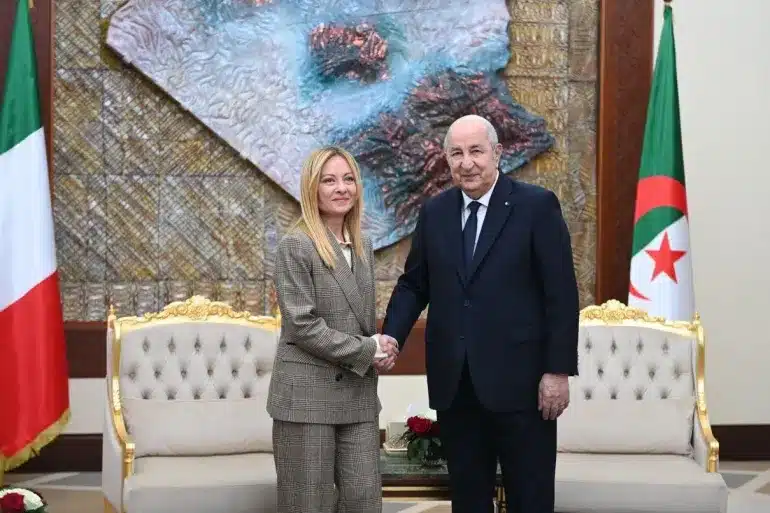
According to information reported by Reuters, the Italian prime minister Giorgia Meloni hopes to secure an increase in Algerian gas imports to compensate for disruptions affecting deliveries from Qatar.
The issue is far from marginal. Qatari gas accounted for about 10 % of Italy’s annual consumption, which means that its interruption creates a significant gap in the country’s energy equation. In a context of war, market tensions and increased volatility, Rome cannot afford to let this shortfall take hold.
The objective is therefore clear: quickly find additional volumes, secure supplies and prevent a temporary fragility from turning into a lasting vulnerability.
Algeria, an increasingly central partner
During a visit to Algeria, Giorgia Meloni met with President Abdelmadjid Tebboune to deepen cooperation between the two countries in the field of energy.
This relationship is not new, but today it takes on an even more strategic dimension. Algeria has already supplied Italy with about 20 billion cubic meters of gas last year, representing nearly 30 % of its consumption. At this level, Algiers is no longer merely an important supplier: it becomes a pillar of Italy’s energy security.
In this sequence, Italy is not simply seeking a replacement supplier. It is seeking a reliable partner, close, politically legible and capable of increasing deliveries at a moment of global tension.
Eni and Sonatrach at the heart of the rapprochement
At the center of this dynamic is the partnership between Eni, the Italian energy giant, and Sonatrach, its Algerian counterpart.
The two countries have agreed to broaden their cooperation, not only around conventional gas, but also in new areas such as shale gas and offshore exploration. This choice shows that the Italy-Algeria relationship is no longer limited to emergency management: it is part of a medium- to long-term strategy.
In other words, Rome does not merely want to weather the crisis. It aims to redraw its energy balances more solidly for the coming years.
Algiers consolidates its role as a strategic partner for Europe
For its part, Abdelmadjid Tebboune reaffirmed Algeria’s commitment to fully playing its role as a strategic and reliable partner for Italy, but also for Europe.
In the current energy tumult, this position gives Algiers growing weight. Algeria is increasingly seen as one of the players capable of providing Europe with a certain degree of stability, at a time when traditional routes are becoming more uncertain and gas balances are rapidly reconfiguring.
This status is all the more important as Europe, and particularly Italy, continues to seek credible alternatives following the drastic reduction of its dependence on Russian gas.
A war that redraws energy alliances
What is at stake here goes far beyond the mere head-to-head between Rome and Algiers. The war acts as an accelerator. It forces states to reassess their dependencies, secure their supply chains, and rebuild stronger alliances.
Italy, highly exposed to energy shocks, is therefore seeking to consolidate a Mediterranean axis capable of cushioning the shocks coming from the Gulf. Algeria, for its part, seizes the opportunity to strengthen its status as an indispensable supplier in a European market hungry for stability.
In reality, this sequence says something broader: in the new geopolitical age that is taking shape, energy is becoming again a tool of power, influence, and national security.
Thus, the rapprochement between Italy and Algeria is not merely a commercial adjustment. It is a strategic response to a world that has become more unstable.
For Rome, it is about quickly compensating for a shortfall, protecting its economy and limiting risks to prices and volumes. For Algiers, it is an opportunity to confirm its central role in Europe’s energy supply.
And for the entire Mediterranean, this move confirms one obvious fact: as war disrupts global flows, countries capable of providing relatively stable energy see their political and economic importance grow.