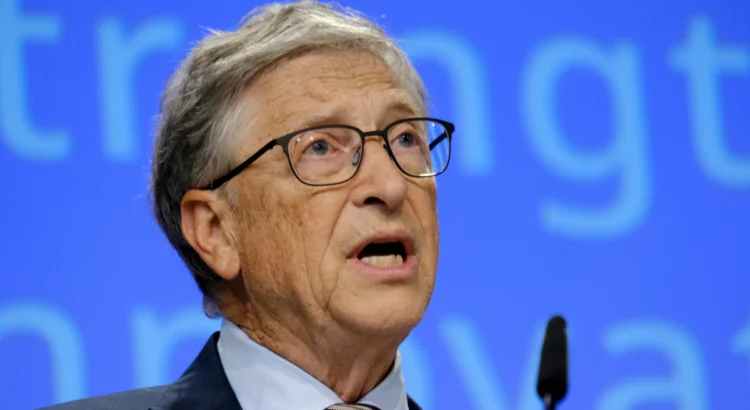
No government would truly be prepared for the upheavals that artificial intelligence could cause in society, Bill Gates believes. The Microsoft co-founder is now warning about risks to employment, cyberattacks, and dependence on AI assistants, while highlighting the substantial potential of this technology in health, education, and agriculture. His foundation plans to invest at least one billion dollars to promote more equitable access to AI.
Bill Gates’s stance on artificial intelligence has grown more cautious.
In an interview with Reuters, the billionaire and philanthropist says governments around the world are significantly lagging behind the pace of AI-driven transformations.
“I don’t think any government is sufficiently advanced on this topic,” he said, before summarizing his finding: “governments are very far behind.”.
The Microsoft co-founder now highlights several risks: the impact on jobs, the use of AI to carry out attacks, and the growing dependence on artificial companions or assistants.
Employment among the main concerns
The future of work sits at the heart of these concerns.
AI tools are now capable of automating or accelerating tasks in a range of fields as diverse as programming, translation, document research, customer service, content creation, or data analysis.
The question therefore affects not only technology companies. It is gradually shaping training policies, education, work organization, and social protection systems.
Gates argues that public authorities must better anticipate these transformations rather than wait for their economic and social consequences to become visible.
Cyberattacks and dependence on AI assistants
Another worry: the malicious use of AI’s growing capabilities.
The same technologies that can boost productivity can also be used to automate certain forms of fraud, facilitate cyberattacks, or mass-produce misleading content.
Bill Gates also warns of the risk of dependence on AI companions, these systems capable of sustaining long-term dialogue with their users and maintaining increasingly personalized interactions.
These developments significantly broaden the scope of the debate: AI is no longer just a technological or industrial issue, but also concerns security, health, education, and social relationships.
“An extraterrestrial intelligence has arrived”
To illustrate the scale of the phenomenon, Gates uses a comparison with science-fiction films in which the appearance of an external threat forces rival powers to cooperate.
He describes AI as a form of “extraterrestrial intelligence” now present and argues that states should be able to work together to manage its consequences.
Gates says he has discussed his concerns with several leaders, notably U.S. President Donald Trump and his team. He also plans to meet Chinese President Xi Jinping.
This international dimension is important as the United States and China are engaged in a technological competition around AI, semiconductors, digital infrastructures, and data.
Significant potential in health
Despite his warnings, Bill Gates does not view artificial intelligence solely as a threat.
He instead continues to see in this technology a considerable potential to reduce certain inequalities, especially in countries that have fewer doctors, teachers, or specialists.
In health, he believes the potential is particularly important.
AI could notably assist frontline health professionals, facilitate some diagnoses, and accelerate the discovery of new medicines or vaccines.
Education and agriculture are also among the sectors the foundation targets.
One billion dollars to broaden access to AI
The Gates Foundation plans to devote at least one billion dollars over the next two years to projects using artificial intelligence, particularly in health, education, and agriculture.
This envelope is part of the foundation’s broader annual spending, planned to be around 9 billion dollars.
One of the goals is to prevent AI benefits from remaining concentrated in the richest economies.
Part of the investments should also aim to improve the data used to train AI systems and allow large language models to operate in more languages.
The challenge of languages and data
This issue is one of the main obstacles to the global deployment of artificial intelligence.
Large models typically have access to far more content in English and a few major international languages.
To function effectively in health, education, or agriculture, they must be able to understand local languages as well as the economic, social, and cultural realities of the populations they serve.
Improving databases and linguistic representation is therefore one of the pillars chosen by the Gates Foundation.
In Tunisia, a national strategy for 2026-2030
In Tunisia, the outlines of the National AI Strategy 2026-2030 were presented by the Minister of Communications Technologies, Sofiane Hemissi.
According to the Presidency of the Government, this strategy aims to frame the development and use of AI in respect of privacy, constitutional rights, national sovereignty, and cybersecurity. The government also highlights Tunisian scientific and academic competencies, the Startup Act, and the country’s position between Europe, Africa, and the Arab world. Tunisia ranks, according to data presented by the government, 29th worldwide for scientific publications devoted to artificial intelligence.
The stated objective is notably to foster innovation and strengthen Tunisia’s positioning in exporting digital solutions.
Avoiding AI worsening inequalities
The main concern expressed by Bill Gates remains ultimately that of access.
If the most capable tools remain concentrated in the hands of a small number of countries and companies with the necessary financial and technological capacities, artificial intelligence could reinforce existing disparities.
Conversely, diffusion in health, education, or agriculture could enable underserved populations today to access new services.
For Gates, the issue is no longer about whether AI will profoundly transform societies, but how governments will organize this transformation and how its benefits can be distributed more widely.