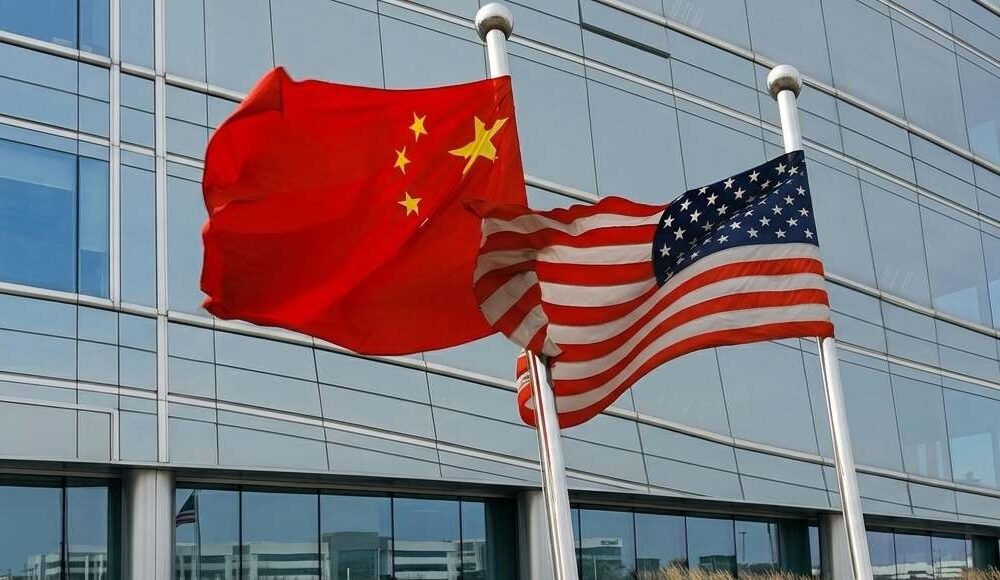
The commercial and strategic tension between Beijing and Washington is reaching a new milestone. China announced on Monday export restrictions targeting ten American companies active in defense, drones, aerospace, maritime industries and rare earths.
This decision comes in response to the United States placing additional Chinese companies on a blacklist linked to firms deemed to be close to the Chinese military.
Ten American Companies Targeted
The Chinese Ministry of Commerce said that Chinese exporters will no longer be able to supply dual-use goods to the affected American companies. These goods may have civilian as well as military applications. Beijing also specified that any ongoing export operations must cease immediately.
Among the targeted companies are several sensitive players in the American industry. The list notably includes rare-earth producers MP Materials and USA Rare Earth, drone manufacturers Teal Drones, Red Cat Holdings and Jaia Robotics, as well as firms linked to aerospace, maritime or defense such as AVEOX, IMSAR, Ball Aerospace & Technologies, Oshkosh Defense and L3Harris Maritime Services.
The choice of these companies is not incidental. Rare earths, drones, advanced electronics and military equipment are now at the heart of the technological rivalry between the two leading powers.
A Second Front: China’s Public Procurement Markets
Beijing has also activated a second lever. In a separate statement, the Chinese Ministry of Finance announced the exclusion of 46 American companies, mainly defense subcontractors, from participating in Chinese public procurement markets.
This list includes major names in the American military industry, notably Lockheed Martin, Raytheon and General Dynamics, as well as entities linked to Boeing Defense. The local subsidiaries registered and operating in China are however exempt from this measure.
In practical terms, the immediate economic impact could remain limited, as many of these groups have little direct activity in the Chinese market. But the political message is clear: Beijing intends to respond in kind to the American restrictions.
Beijing Denounces the American Blacklist
Chinese authorities justify these measures by defending their national interests. The Ministry of Commerce denounced what it called a hostile act by Washington, accused of widening its list of Chinese companies linked to the military sector.
Beijing says it wants to protect its national security and regulate the export of sensitive products. China, however, leaves room for maneuver: Chinese companies will be able to request specific authorizations when certain goods are deemed “truly necessary” for the targeted American companies.
This flexibility shows that Beijing is seeking to send a strong signal without necessarily provoking a total rupture in trade.
The U.S. 1260H List at the Heart of the Escalation
At the origin of this new phase of tensions is the U.S. so‑called “1260H” list. Washington has recently added about 80 Chinese companies and subsidiaries to this list, accusing them of contributing, directly or indirectly, to Beijing’s military capabilities.
This mechanism does not amount to a classic immediate financial sanction. It mainly limits future relations with the U.S. Department of Defense. Starting June 30, 2026, the DoD will no longer be able to award direct contracts to the affected companies. Restrictions on indirect contracts are also to follow in 2027.
Among the Chinese groups recently targeted are major names in technology and industry, such as Alibaba, Baidu, BYD, NIO, YMTC, CXMT, WuXi AppTec, RoboSense and Unitree. For Washington, this list aims to contain Beijing’s strategy of merging civilian and military sectors.
Rare Earths, the Nerve of the Industrial War
The presence of MP Materials and USA Rare Earth in China’s retaliation underscores the strategic importance of rare earths. These materials are essential to numerous industries: defense, electric vehicles, wind turbines, advanced electronics, radars, drones, missiles and communications technologies.
The United States has been seeking for several years to reduce its dependence on China in this field. Beijing, for its part, holds a major lever, as it still dominates a significant portion of global refining and processing of rare earths.
By targeting American companies involved in building an alternative supply chain, China reminds that it retains leverage over the critical links of the global industry.
A Primarily Political, but Strategic Response
Several analysts reckon that the direct economic impact of these new restrictions could be limited, especially because the targeted American companies conduct little direct business in China.
But the scope of the decision goes beyond immediate trade. China shows that it can use its export controls as a tool of strategic response, on par with how the United States uses its blacklist, its technology restrictions, and its rules governing defense contracts.
This sequence comes as Washington and Beijing had recently been trying to stabilize their relations after months of tensions over tariffs, technologies, semiconductors, electric vehicles and critical supply chains.
The new Chinese retaliation shows, however, that dialogue remains fragile. Behind the trade discussions, the structural rivalry between the two powers continues to deepen, particularly in sectors where the military and industrial power of tomorrow is at stake.
For global markets, the signal is important: the Sino-American economic war is no longer limited to tariffs. It now touches strategic raw materials, drones, military equipment, aerospace and dual-use technologies.