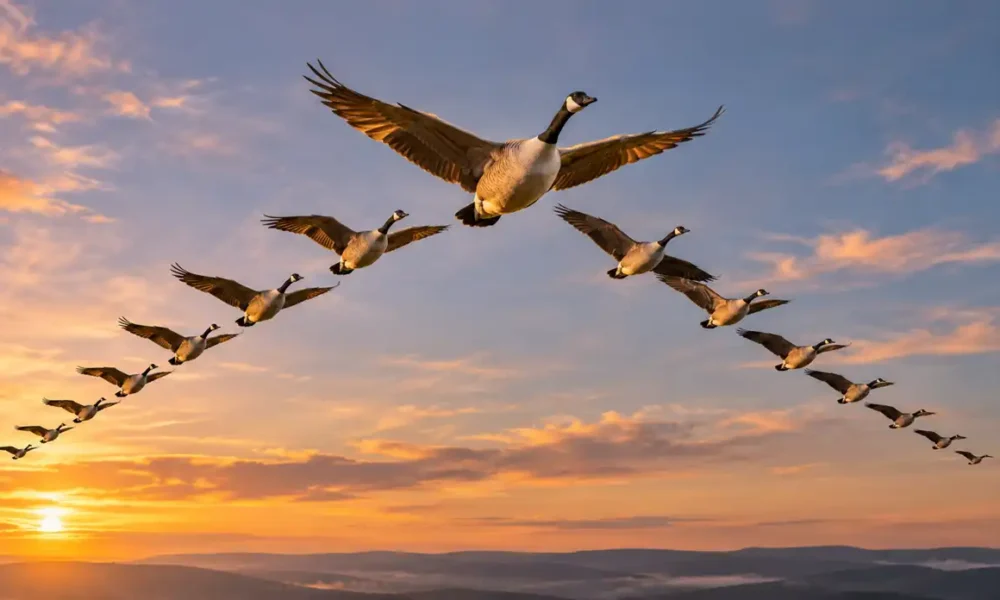
Have you ever watched a group of birds cross the sky by drawing a large V? We often imagine that the one flying in front cuts the wind for the others, a bit like a cyclist at the head of a peloton.
But the secret lies elsewhere: the birds exploit invisible air currents created by the wings of their companions.
A phenomenon so effective that it even inspired Airbus to reduce the fuel consumption of its airplanes.
To understand this astonishing formation, you have to look not at what happens in front of the bird, but behind its wings.
The essentials
Why a V? To position themselves in zones where the air rises and helps support the wings.
Why not in single file? Directly behind a bird, the downward-moving air can, by contrast, require more effort.
How do the birds achieve this? They adjust their position and, in the studied ibises, even the rhythm of their wingbeats.
And the leader of the formation? He does not benefit from the wake of another bird; in some species, individuals take turns.
Why don’t birds do like cyclists?
In a race, a cyclist positions themselves in the wake of the previous rider to reduce wind resistance. If the goal is solely to enjoy this protection, a single file line is very advantageous.
But a bird’s wing does not just slice through the air. It also generates the lift necessary to stay aloft. As it moves, it leaves behind air that moves in several directions. Some areas are useful to the following bird; others hinder it.
This is why geese, ibises, or pelicans often adopt a staggered formation rather than a simple line.
A wing creates invisible vortices
To fly, a bird must support its weight. Thanks to its shape and movement, the wing deflects air downward. In response, the air exerts an upward force on it.
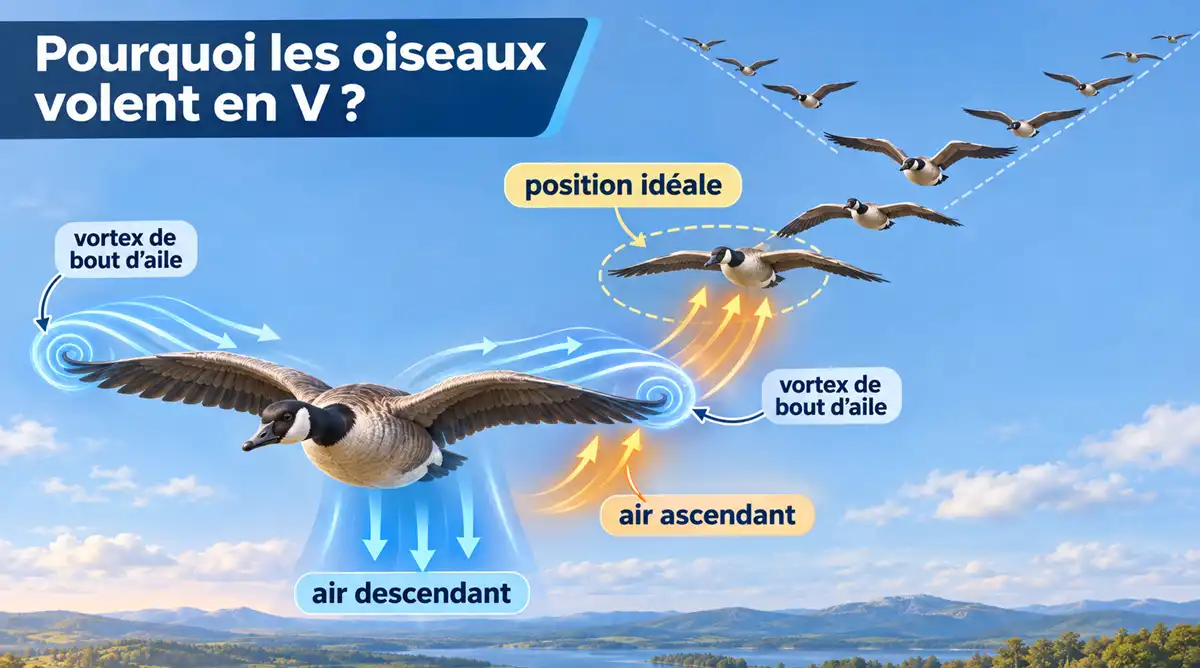
The air pressure is not the same on either side of the wing. Near the tip, part of the air flows around the wingtip and curls around it. It forms a wingtip vortex, also called a vortex.
Imagine a boat crossing a lake: behind it, the water forms eddies you can still see after it passes. In the sky, the wings also leave behind eddies, but these are invisible.
Visualize the two zones behind a bird
In the center of its wake: the air tends to descend. A bird placed there may have to put in more effort to maintain its altitude.
On the sides, near the wingtips: a portion of the air rises. A bird that positions itself in the right spot can take advantage of this upward current, like a little aerodynamic boost.
How does this invisible help shape a V?
The second bird does not necessarily position itself directly behind the first. It shifts slightly, so that part of its wings can benefit from the rising air.
The third bird then looks for a favorable spot behind the second. From shift to shift, an inclined line appears. When birds do the same on the other side, the formation takes the shape of a V.
This isn’t magic: the bird must always fly, beat its wings, and adjust its trajectory. But the extra lift provided by this upward current can reduce its effort.
In 2014, ibises revealed an even more surprising secret
In 2014, an international team published in the scientific journal Nature a study conducted on 14 naked ibises, large migratory birds equipped with small devices measuring their position and movements.
The researchers collected data during a migration from Austria to Italy, guided by an ultralight device. They were able to observe with unusual precision the birds’ positions and the motion of their wings.
Result: the ibises placed diagonally adjusted not only their distance but also the synchronization of their wingbeats. The tips of their wings followed trajectories that allowed them to better take advantage of the updrafts.
When an ibis ended up almost directly behind another, it shifted its wingbeats, which could help to limit the adverse effect of the down-currrents.
In other words, these birds did not simply find the right spot: they also adapted the motion of their wings to match those of their neighbors.
How many energy do they save?
As early as 2001, French scientists studied white pelicans accustomed to flying alone or in formation. They notably compared their heart rate, used as an indirect indicator of physical effort.
When they flew in formation, their heart rate was about 11 to 15% lower than during the solitary flights studied. They could also spend more time gliding.
Caution: this does not mean they exactly consumed 11 to 15% less energy. Heart rate is not a direct measure of calories burned, and the gain can vary by species and conditions.
What the researchers actually measured
2001 — Pelicans: lower heart rate in formation; a result compatible with reduced effort.
2014 — 14 ibises: positioning and coordinated wingbeats to exploit the updrafts.
2015 — Ibis: frequent exchanges of position between those at the front and those following.
2021 — Airbus: two A350s flying three kilometers apart demonstrated that a plane can also benefit from another’s wake.
But who helps the bird placed at the very front?
The bird at the tip of the V does not receive any upward current generated by a companion ahead. It must generate its lift without that particular help.
Researchers therefore studied another question: why would the same birds still agree to provide this extra effort?
A study published in 2015 in the journal PNAS showed that, among the ibises observed, positions changed frequently. The birds that flew at the front could then profit from the wake of others.
Researchers even found, between some individuals, a correspondence between the time spent leading and the time spent following. This suggests a form of cooperative alternation.
It isn’t that every bird precisely calculates its working time or that all species behave identically. But in these ibises, the benefit of group flight was not constantly reserved for the same individuals.
Airbus picked up the idea to make two planes fly together
On November 9, 2021, Airbus conducted a live test: two A350 aircraft crossed the Atlantic between Toulouse and Montréal, flying about three kilometers apart.
Thanks to adapted piloting and coordination systems, the follower aircraft was able to position itself in a favorable zone of the lead aircraft’s wake, thereby reducing the thrust required from its engines.
According to Airbus, the test avoided more than six tonnes of CO₂ emissions on that route. The group mentioned a potential fuel saving exceeding 5% on some long-haul flights.
This does not mean that commercial airplanes will all fly in formation now: safety, trajectories, and air traffic control rules require tailored procedures. But this experiment illustrates how observing birds can inspire technology.
True or false?
“The lead bird merely cuts through the wind.” — False. The formation mainly lets the followers exploit upward currents created by the wings.
“The V is always perfectly symmetric.” — False. Formations can change shape, and the birds move within the group.
“All migratory birds fly in V formation.” — False. This behavior is mainly found in certain large migratory species. Many other species travel alone or in irregular groups.
Next time you see a V in the sky…
Remember that above our heads, the birds do not just follow a leader. They also seek to benefit from a movement of air created by the wings of their companions.
Some shift to meet an updraft. Others adjust their wingbeats. And, in some species, the most demanding position is shared.
The secret of the V is therefore not to hide from the wind, but to use intelligently the air that others set in motion.
A small lesson in aerodynamics, and a discovery that even aviation engineers continue to explore.