
Did you know? The dolphin can sleep underwater while keeping part of its brain awake. It can even close one eye and leave the other open.
This strange way of sleeping allows it to rest without forgetting one essential thing: regularly surfacing to breathe.
The Essentials
• The dolphin can sleep underwater, often while swimming slowly.
• One half of its brain rests while the other stays awake.
• It can thus keep one eye open and stay attentive to its surroundings.
• This adaptation mainly allows it to continue to surface to breathe.
How can a dolphin sleep halfway?
In humans, both halves of the brain rest at the same time when we sleep deeply. In the dolphin, it’s different: one half can sleep while the other remains awake.
Scientists call this unihemispheric sleep. The word may sound complicated, but the principle is very simple: the dolphin basically puts one half of its brain “on pause,” then alternates with the other.
It can thus continue to swim slowly underwater during its sleep, instead of becoming completely unconscious as we do.
Why must it stay partially awake?
Because a dolphin is a mammal. It lives in water, but it does not have gills: it must breathe air with its lungs.
Even when it sleeps underwater, it must therefore continue to periodically surface to take in air. Keeping part of the brain active lets it coordinate these rises without completely interrupting its rest.
This vigilance also has other advantages. It helps it stay aware of what surrounds it, to follow other members of its group, and to react if danger appears.
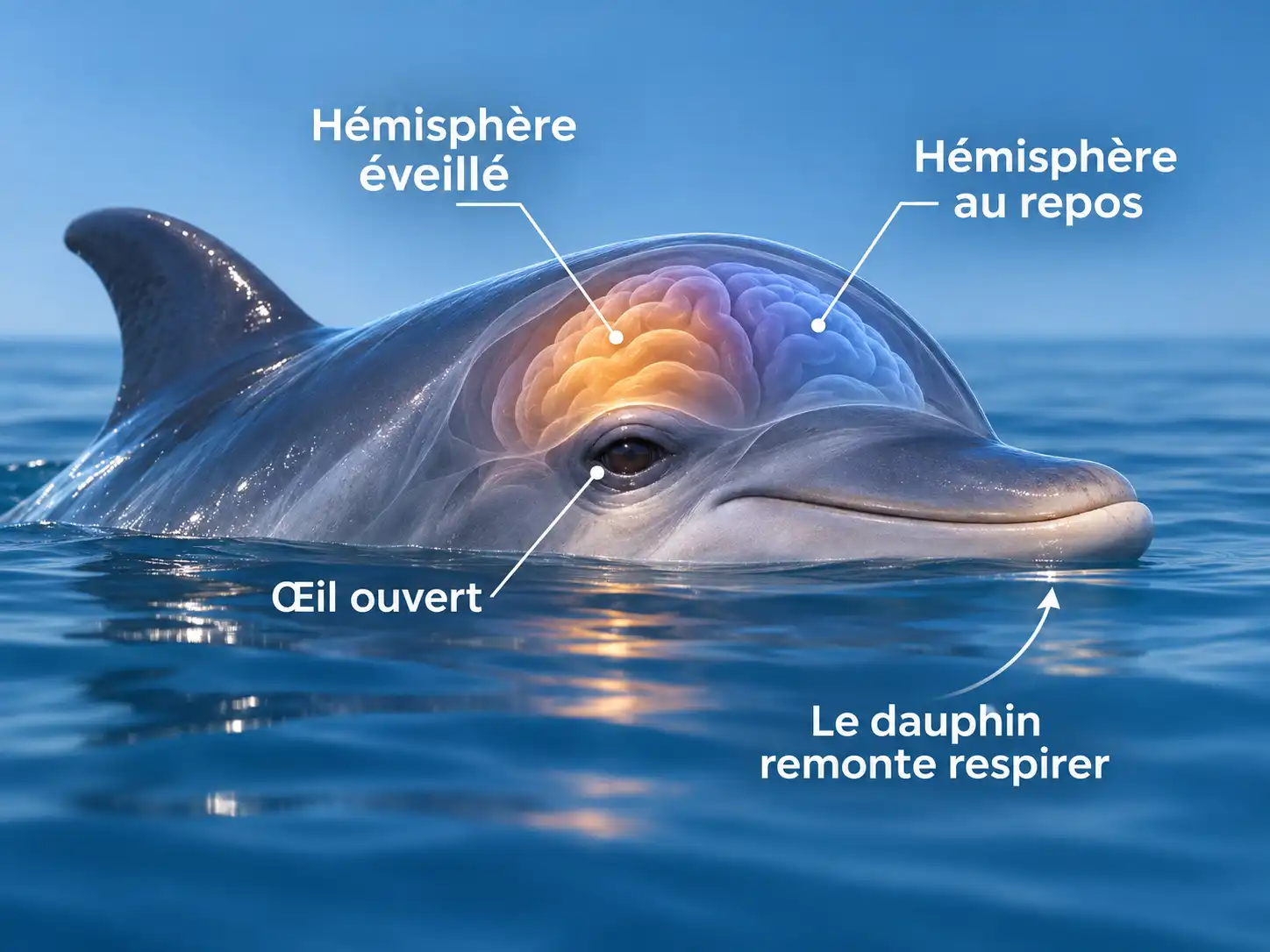
One eye open while the other rests
This particular organization of the brain explains why a dolphin can sleep with one eye closed. The other can stay open and continue to observe the environment.
Researchers have observed this type of sleep in several species of dolphins and more broadly in cetaceans. It allows them to combine two needs that seem incompatible: sleeping and staying sufficiently vigilant to live in the ocean.
So, the next time you see a dolphin slowly moving underwater, remember that it might be sleeping… but only with one half of its brain.