For a long time, military power was measured by the number of soldiers, tanks, planes and artillery pieces. The war in Ukraine has not made these means obsolete, but it has added a new dimension that has become decisive: the ability to collect data, analyze it quickly, and transmit actionable information to the unit capable of acting.
Artificial intelligence has not replaced the fighters. It has transformed the way of viewing the battlefield, coordinating units, guiding certain drones and adapting technologies to the evolutions of the front.
The advantage no longer depends solely on the quantity of weapons available. It also depends on the speed with which an army can observe, understand, decide and strike.
A transformation begun as early as 2014
The digitization of the Ukrainian army began after the annexation of Crimea and the outbreak of the war in Donbass in 2014.
Faced with outdated maps and slow information circulation, soldiers, volunteers and engineers developed their own tools.
GIS Arta notably facilitates the coordination of artillery fire. Kropyva allows units to consult tactical maps, share positions and perform certain calculations.
These software programs are not, by themselves, artificial intelligences. They nonetheless prepared the Ukrainian army for a war in which data circulates digitally and can be exploited almost immediately.
Delta, a living map of the front
Delta has become one of the main digital command-and-control systems used by Ukraine.
The platform brings together on a single map information from drones, satellites, radars, sensors, ground units and intelligence services.
Commanders can consult known enemy positions, review recent imagery, and share information with the concerned units.
Delta is not an artificial brain directing operations alone. It constitutes a shared infrastructure enabling a shorter time between observing a target and transmitting its position to a unit capable of intervening.
This acceleration profoundly changes the tempo of war. A vehicle or an artillery piece that can depart its position within minutes—the value of information depends as much on its accuracy as on the speed with which it is transmitted.
AI to analyze thousands of drone images
The multiplication of drones has created a new problem: information overload.
Thousands of devices record daily the trenches, roads, vehicles and troop movements. No group of analysts can examine all of these images alone.
The Ukrainian Avengers platform uses computer vision to perform an initial triage. Its algorithms can flag the probable presence of tanks, armored vehicles, artillery pieces or other equipment.
The Ukrainian Ministry of Defense states that Avengers can recognize about 70% of equipment appearing in certain video streams and detect an object in a little over two seconds. These figures remain official Ukrainian data and may vary depending on image quality, camouflage or weather.
The software does not necessarily replace the analyst. It highlights sequences considered as priority.
Artificial intelligence thus acts as a filter between the mass of images and human decision-making.
A much shorter strike chain
This is probably the most important transformation.
In a traditional military organization, several steps separate target detection from the strike: observation, identification, confirmation, transmission to command, weapon choice and authorization.
Digital platforms and algorithms shorten this chain.
A target spotted by a drone can be geolocated, placed on a digital map, and then quickly transmitted to an artillery unit or an attack drone.
AI does not necessarily make the decision to strike. It does, however, reduce the time available to analyze the situation and act.
This speed improves the effectiveness of weapons, but it also raises a question: does the soldier retain real decision-making power when he must validate in a few seconds a target already detected and prioritized by several software systems?
Drones more autonomous in the face of jamming
Russia and Ukraine are widely using electronic warfare to disrupt communications, video links and navigation signals.
A remotely piloted drone can become unusable when the link to its operator is cut.
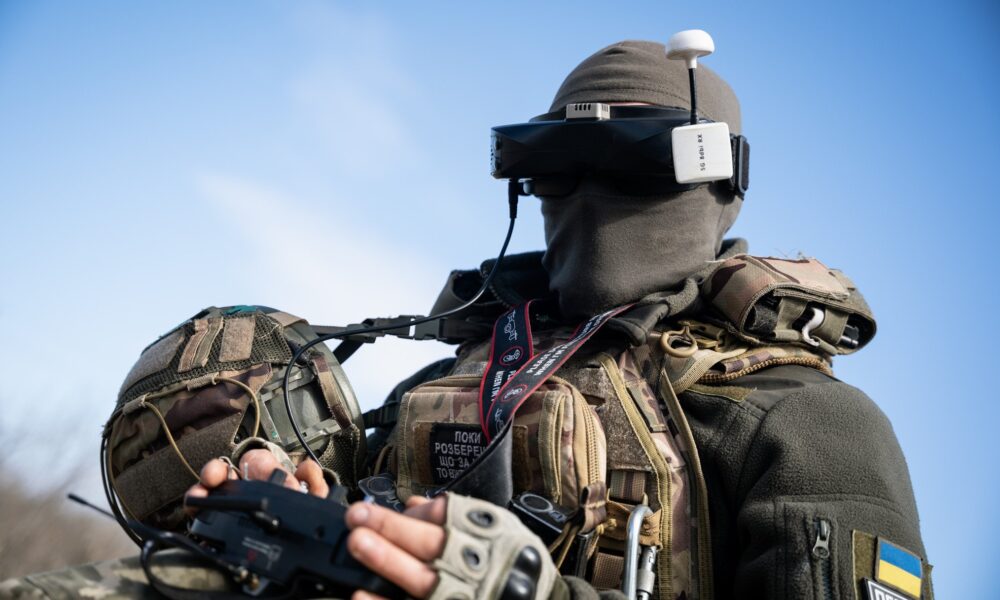
To circumvent this difficulty, some Ukrainian drones now use AI-assisted guidance systems.
The pilot identifies and selects a target. The onboard software then uses the drone’s camera to automatically follow that object during the final phase of flight.
If the radio link is interrupted, the device can continue steering toward the previously locked target.
Reuters documented as early as 2024 the development of several such systems. In 2025, the American company Auterion announced supplying Ukraine with 33,000 AI-enabled guidance kits.
However, it is important to distinguish autonomous target tracking from autonomous decision to attack. In publicly described systems, the initial choice remains made by a human operator.
How far does AI intervene in strikes in Russia?
Ukraine regularly conducts drone strikes against refineries, oil depots and military installations located on Russian territory.
These operations aim to disrupt logistics and raise the economic cost of the war for Moscow.
Some long-range drones use advanced navigation systems. Artificial intelligence can contribute to terrain recognition, image analysis and trajectory correction.
The exact role of AI in each strike remains largely secret.
Brave1, the ecosystem that accelerates innovation
The Ukrainian transformation relies not only on technologies. It also depends on a specific organization bringing together the military, startups, volunteers, engineers and public institutions.
Launched in 2023, the Brave1 platform connects the needs of the armed forces with companies capable of offering solutions.
It facilitates financing, testing, administrative procedures and the acquisition of technologies deemed useful.
The Ukrainian state does not therefore develop all the systems itself. It acts as coordinator, buyer and facilitator.
This organization helps to significantly shorten innovation cycles.
A unit can report a problem it encounters with a new Russian jammer. Developers propose a solution, build a prototype and test it in the field. The equipment is then corrected, reproduced or abandoned based on results.
The loop becomes :
front-line need, prototype, test, correction, new deployment.
In traditional military programs, this process can take several years. In Ukraine, some adaptations are carried out in a few weeks.
Front data becomes a strategic resource
Each drone mission yields videos, coordinates, data on jamming and information on the operation’s result.
These elements can then be used to improve the algorithms.
A model designed in a lab may fail in the face of smoke, camouflage, mud, snow or electronic interference. Real-world images therefore allow correcting its errors more quickly.
Ukraine thus has a rare resource: several years of data from a high-intensity war.
It has begun to selectively open a portion of this data to companies and partners to develop new systems, notably for drone detection and interception.
The military value thus lies not only in weapons. It also lies in the ability to collect, organize and exploit the data produced by their use.
A revolution that has its limits
The performance of artificial intelligence should not be exaggerated.
Algorithms can misidentify a vehicle, be fooled by camouflage, or lose effectiveness when the images are poor.
Russia is also developing its own drones, software and jamming capabilities. Each Ukrainian innovation triggers a Russian countermeasure, which in turn provokes a new adaptation.
The technological advantage therefore remains temporary.
Moving from prototype to mass production also presents a challenge. A solution effective in one unit is not necessarily ready for use by the entire army.
Standardizing software, ensuring compatibility, training operators and guaranteeing maintenance are required.
Finally, the presence of a human in the chain is not enough to guarantee real control. That person must have the time, information and authority necessary to challenge the system’s recommendation.
A new way of waging war
The main lesson from Ukraine is not the emergence of an army of robots fighting on their own.
It is the transformation of war into a digital system linking:
- drones and sensors that observe;
- algorithms that sort and analyze;
- digital maps that organize information;
- networks that transmit;
- weapons that intervene;
- humans who authorize, supervise or correct.
AI has reduced the time separating detection from action. It has made certain drones more resistant to jamming and allowed Ukraine to use more effectively means that are inferior to Russia’s.
But the main lesson may be organizational.
Ukraine has become a reference not because it invented perfect technology, but because it built a system capable of experimenting, failing, correcting and redeploying quickly.
The war of the future will probably not be won by the army that possesses only the best drone or the best algorithm.
It could be won by the one that best connects its fighters, its data, its software and its weapons — and learns faster than its opponent.

Adel Khelifi