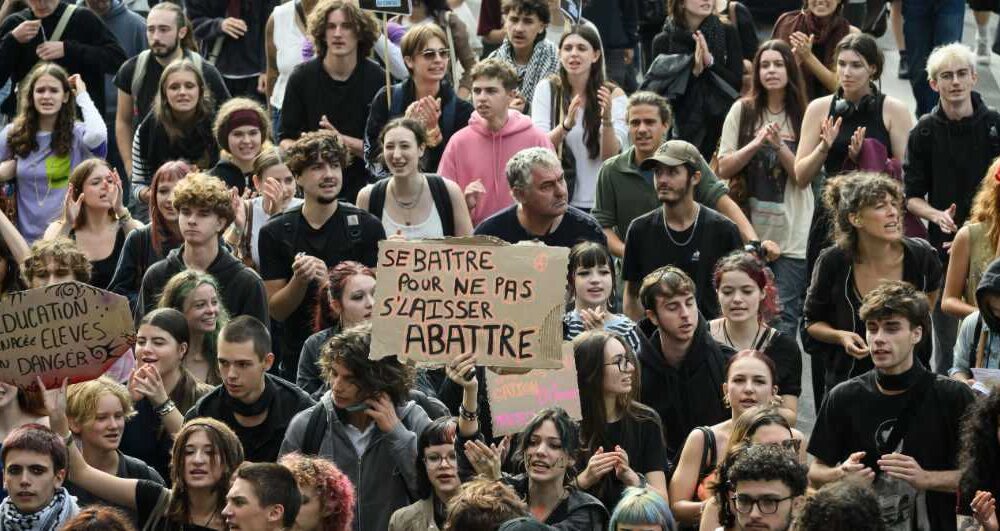
France is preparing for a day of demonstrations on Saturday, October 17, 2026, presented by different collectives as a “convergence of struggles.”
High school students, the Yellow Vests, workers, farmers and transporters express demands sometimes different, around purchasing power, public services and living conditions. This mobilization coincides with the start of the Toussaint holidays, a departure period also important for Tunisian families living in France.
What are the protesters’ objectives, the government’s responses and the risks for travel?
The essentials
October 17: calls to protest circulate in several French cities, without a single national coordination.
161,500 to 480,000: the two estimates of the number of participants in the October 13 demonstrations, according to the Interior Ministry and youth organizations.
12 to 18 cents: the diesel price drop promised by the government starting in November.
Toussaint holidays: departures begin this weekend, with traffic already announced as heavy by Bison Futé.
How did the October 17 call to protest originate?
Contrary to what some posters circulating on the Internet suggest, the initial call to protest on October 17 did not arise from a joint decision of the major union centers.
Its origin dates back to September 7, 2026, when a young TikTok user denounced fuel prices and proposed organizing a demonstration. A second video set the date for October 17, chosen in particular because it is a Saturday at the start of the school holidays.
The video went viral, surpassing 1.5 million views according to an investigation by Le Monde. Posters, sometimes AI-generated, circulated on several social networks using the visual codes of the Yellow Vests.
This movement, initially informal, gradually joined the high school student protests and drew the support of several organizations.
The CGT, Solidaires and the Confédération paysanne support or relay calls to participate, depending on their capacities and local structures. These organizations, however, do not lead a unified national movement.
Therefore, this is an attempt at convergence: its success will depend on the actual participation of the different groups on Saturday.
High school students: busy schedules and degraded facilities
The high school students have been mobilized for several weeks to denounce difficulties in schools: unfilled substitute teaching positions, long days, crowded classes, degraded buildings and uncertainties related to orientation.
A consultation launched by the Ministry of National Education collected more than 60,000 initial contributions. Their analysis helps to better understand the concerns expressed:
- 70 % mention the organization of timetables;
- 48.3 % mention the state of school buildings;
- 27.2 % report the lack of teachers or unfilled absences;
- 16.4 % mention Parcoursup.
These percentages correspond to the themes mentioned in the analyzed contributions, and not to a representative survey of all French high school students.
Students are notably asking for faster replacements, better organization of classes, renovation of buildings and greater transparency in admissions to higher education.
The government’s response: Minister Édouard Geffray announced the mobilization of 3,000 substitute teachers already employed by the Ministry of National Education, but who were not yet assigned to classes.
So this is not 3,000 new hires.
On October 14, the government indicated that 2,000 of these teachers had been assigned. At the same time, the ministry authorized the recruitment of 920 additional contractual staff, of whom 170 were already recruited at that date.
On Parcoursup, the minister defends the current system by recalling that the programs, not the platform itself, examine and select applications. The government refuses its abolition, while considering adjustments regarding orientation and the clarity of admission criteria.
The high school organizations judge the initial responses still insufficient, particularly regarding the permanent resources of the public school system.
Yellow Vests: fuel and purchasing power at the center of demands
The return to the reference to the Yellow Vests recalls the mobilization that appeared in France in 2018, when rising fuel prices helped trigger a much broader protest movement.
In September 2026, diesel reached around €2.41 per liter on average nationwide, according to price readings relayed by AFP.
At that level, a 50-liter fill would cost €120.50, a particularly sensitive amount for motorists who travel long daily distances.
The demands voiced by various collectives center on lowering fuel prices, the cost of food, wages, pensions and tax levies.
Some also echo the historic Yellow Vests demands, notably the citizen-initiated referendum.
The government’s response: Prime Minister Sébastien Lecornu announced the mobilization of 10 million barrels of diesel from strategic stocks to promote a drop of 12 to 18 cents per liter starting on November 1.
For a 50-liter fill, this drop would theoretically amount to a savings of €6 to €9, subject to full pass-through at the pump.
The Prime Minister himself speaks of an economy “around ten euros” per fill, an approximate estimate depending on the volume purchased and the actual drop.
A €100 aid over three months should also benefit, under conditions, some workers who use their car.
But these measures will not immediately address the October 17 protests, since the diesel price reduction is expected to begin in November.
Unions: wages, public services and debate on aid to businesses
The union organizations supporting the mobilization highlight demands regarding wages, pensions, working conditions and the resources devoted to public services.
The Solidaires union specifically calls for a general pay raise, indexing them to prices, a cap on energy prices, and higher taxation of windfall profits.
Wage indexing would automatically adjust wage growth to inflation to preserve purchasing power.
The CGT also calls for a better evaluation of public aid granted to businesses.
The figure of €211 billion, regularly cited in this debate, comes from an estimate made in 2025 by a Senate inquiry commission, focusing on public aid to businesses in 2023.
This assessment includes a broad set of mechanisms, including subsidies, tax arrangements and relief from social security contributions. It is not solely sums directly paid to businesses.
The government’s response: the executive defends a program to restore public finances. It aims to reduce the French deficit from 5.4% of GDP expected by the end of 2026 to 5% in 2027, at the cost of a 54-billion-euro announced budgetary effort.
This amount includes various consolidation measures and does not correspond exclusively to a direct cut in spending.
The unions fear that this strategy will reduce the resources of public services and limit possibilities for pay raises.
Not all union federations partake in the October 17 movement. Other organizations prioritize their own deadlines, notably early November.
Farmers: drought, incomes and rising production costs
The Confédération paysanne has called on its members to participate in the October 17 day to defend agricultural income, access to quality food and public policies adapted to the sector’s difficulties.
The demands come after a summer marked by exceptional drought.
According to French government data, 65% of the territory was affected by exceptionally severe drought. Water restrictions affected 95 departments, including 79 placed in crisis at the height of summer.
Farm losses were significant in several regions, while the rise in diesel prices exacerbated cash-flow difficulties for farms.
Farmers are seeking more stable incomes, risk-protection mechanisms against climatic uncertainties, and better consideration of production costs.
The government’s response: an exceptional plan of more than one billion euros was announced in September.
It includes notably €520 million mobilized for national solidarity compensation, €30 million for agricultural calamities and over €300 million in tax relief on non-built agricultural land.
These aids aim to compensate part of the losses and support the revival of production. Agricultural organizations, however, believe that income difficulties and climate adaptation require longer-term solutions.
Road transporters: a distinct mobilization announced for October 21
Road transport professionals are also facing rising fuel prices.
Companies point out that diesel accounts for a large portion of their costs and that they cannot always immediately pass the increases on to their clients.
The European Road Transport Operators Organization (OTRE) and the Federation of Independent Bus Operators (FAI) call for a fuel cut, a strengthened tariff-cost indexation mechanism linked to energy costs, and the reintegration of certain transporters into aid schemes.
They have announced a mobilization in Paris starting on Wednesday, October 21, 2026.
This deadline is separate from October 17. Actions by transporter and driver collectives may occur on other dates, but there is currently no confirmed joint call from all federations for Saturday.
What risks on Saturday: traffic, tensions and continued protests?
The first risk concerns local traffic disruptions.
Activist maps and posts on social networks announce gatherings at roundabouts, near service stations and, in some cases, near depots or refineries.
These announcements do not, however, constitute proof that facilities will be blocked or that their supplies will be interrupted.
The second risk concerns potential incidents between some protesters and law enforcement. Clashes and property damage have already been reported on previous mobilization days, even though the majority of participants demonstrated peacefully.
Finally, the third issue is political: a large mobilization could increase pressure on the government, which must defend its 2027 budget plan.
Conversely, the diversity of demands, the lack of general coordination and the start of the holidays could limit the scale of the day.
Are you traveling to Tunisia for Toussaint?
The Toussaint holidays officially begin Saturday, October 17, 2026 in school zones A, B and C of mainland France. For Tunisian families planning a stay in Tunisia, demonstrations could add to the usual difficulties of departures on vacation.
1. Traffic: Bison Futé reports heavy traffic on Friday, October 16, classified orange for departures nationwide, then Saturday in Île-de-France. The agency recommends leaving or crossing the Paris region before 8 a.m. or after 3 p.m. on Saturday, when possible.
2. Airports: if you are taking a flight to Tunis, Djerba, Monastir or another Tunisian airport, check your flight status directly with your airline. Potential difficulties mainly concern road access: no general cancellation of flights to Tunisia is confirmed at this stage.
3. Sea crossings: travelers heading to the ports of Marseille or other embarkation ports should consult their shipping company and local road information before departing. No general stoppage of sea connections to Tunisia has been established.
4. Roundabouts and fuel depots: calls for gatherings exist, but places and times circulated on social networks are not all officially confirmed. Do not rely on a militant map as if it were real-time traffic data.
5. In case of delay: allow a reasonable margin to reach the airport or port, keep your carrier’s contact details and monitor local alerts. A missed flight due to traffic jams does not automatically entitle you to a refund.
Useful information:
Bison Futé
for circulation,
Service-Public
for school holidays and the site or app of your airline or ferry company for flights and crossings.
A test for the government, but mobilization still uncertain
Saturday, October 17 will be a test for the collectives seeking to bring together several movements around common demands.
The protest gathers real concerns, but the anticipated responses differ: teachers for high school students, a reduction in fuel costs for motorists, wage increases for workers, more stable agricultural incomes and transport tariffs better aligned with costs.
The government has announced several financial and administrative measures while maintaining its target to reduce the public deficit in 2027.
The extent of the mobilization, potential blockages and the impact on transport can only be assessed on the basis of what actually happens on Saturday.
For Tunisians living in France, the main immediate watchpoint remains the coincidence between the calls to protest and the first departures of the Toussaint holidays.