Donald Trump again asserts that the war against Iran will end “very soon.” But on the heels of a renewed flare-up in the Strait of Hormuz, London accuses the Islamic Revolutionary Guards Corps of being behind a threat targeting a base hosting American bombers.
In the United States, energy prices and the unpopularity of the conflict weigh on households and on the campaign for the midterm elections on November 3.
The Essentials
- Trump envisions an imminent end to the war, but no ceasefire agreement has been announced.
- The United Kingdom attributes to Iran a threat against the RAF Fairford base; Tehran denies it and London announces sanctions against two Iranians.
- The Islamic Revolutionary Guards Corps say they struck a tanker in the Strait of Hormuz; 60 countries defend freedom of navigation and reject illegal tolls.
- In the United States, regular gasoline costs an average of $4.36 per gallon, compared with about $3.08 a year earlier.
- According to AP-NORC, 69% of Americans surveyed believe the war was not worth it.
Trump promises a war exit and acknowledges the difficulties of negotiations
At a Republican rally held on Monday, October 12, in Ohio, Donald Trump asserted that the war, launched on February 28 by American and Israeli strikes on Iran, would end “very soon.” The American president expects a sharp decrease in oil prices when hostilities end.
He framed the military intervention as a necessary operation to prevent Tehran from acquiring nuclear weapons. He claimed that Iran had been, before the strikes, “two weeks” away from possessing such a weapon and that Iran’s nuclear capabilities had been destroyed. These are Donald Trump’s assertions and do not constitute an independent assessment of the Iranian nuclear program.
In an unusual remark, Trump also said that Washington may have gone too far in eliminating Iranian officials, to the point of complicating the identification of interlocutors for negotiation. He argued that Iran wished to strike a deal but did not know how to proceed. He also claimed that 159 Iranian ships had been sunk; this tally advanced by the president has not been independently established in the sources consulted.
The head of Iranian diplomacy, Abbas Araghchi, for his part says Tehran continues its diplomatic efforts to defend its interests. Iranian authorities are calling for the easing of sanctions and the lifting of the American blockade on their oil exports before a new agreement. The breakdown of trust between the two sides, despite the memorandum reached in June, continues to block negotiations.
Fairford: London accuses the Revolutionary Guards; Tehran rejects the accusations
The British Prime Minister Andy Burnham told Parliament that it was highly likely the threat targeting the RAF Fairford airbase on September 27 had been coordinated from Iran and almost certainly directed by the Islamic Revolutionary Guards Corps.
Located about 160 kilometers west of London, this Royal Air Force base regularly hosts American bombers used in operations in the Middle East. After the incident, several B-1 and B-52 aircraft left the facility.
The investigation remains shrouded in uncertainties. Five men were initially apprehended near the base after the discovery of three vans containing fuel, but no explosives were found. They were released on conditional terms, with no charges at this stage. Further arrests followed.
The United Kingdom sanctioned two Iranian nationals: Ruhollah Bazghandi, described as responsible for counter-espionage within the IRGC, and Shahram Ali Reza Tamarzadeh Jakki, described by London as linked to the Zindashti criminal network. The sanctions include asset freezes and travel restrictions. The Iranian ambassador was also summoned by the British Foreign Office.
A joint statement issued on October 12 supported the British attribution and condemned the hostile operations attributed to Iran. Initially reported as signed by 29 countries, it now lists 32 names in the list published by London. Tehran, for its part, denounces the accusations as unfounded and a hostile information operation; its ambassador said his country was willing to cooperate with the investigation.
Hormuz: a tanker hit and 60 countries oppose tolls
The Navy of the Revolutionary Guards said on Monday that it had struck a supertanker in the Strait of Hormuz, accusing it of having disabled its tracking system and ignored its warnings. According to the Iranian account, the vessel caught fire. The British maritime surveillance agency UKMTO, for its part, reported several incidents affecting ships in the area; the exact circumstances are under verification.
Off the coast of Oman, a crew member of the merchant vessel JOHN K was evacuated by helicopter after a fire in the engine room, about 44 nautical miles off the coast of the Al-Batinah South province. Omani authorities have not established a link between this fire and the attacks reported in the strait.
In this context, 60 countries, including EU member states and several partners, backed on October 12 a statement reaffirming the freedom of navigation in international straits. The text rejects illegal tolls, discriminatory restrictions, and pre-authorization requirements hindering the legal passage of ships.
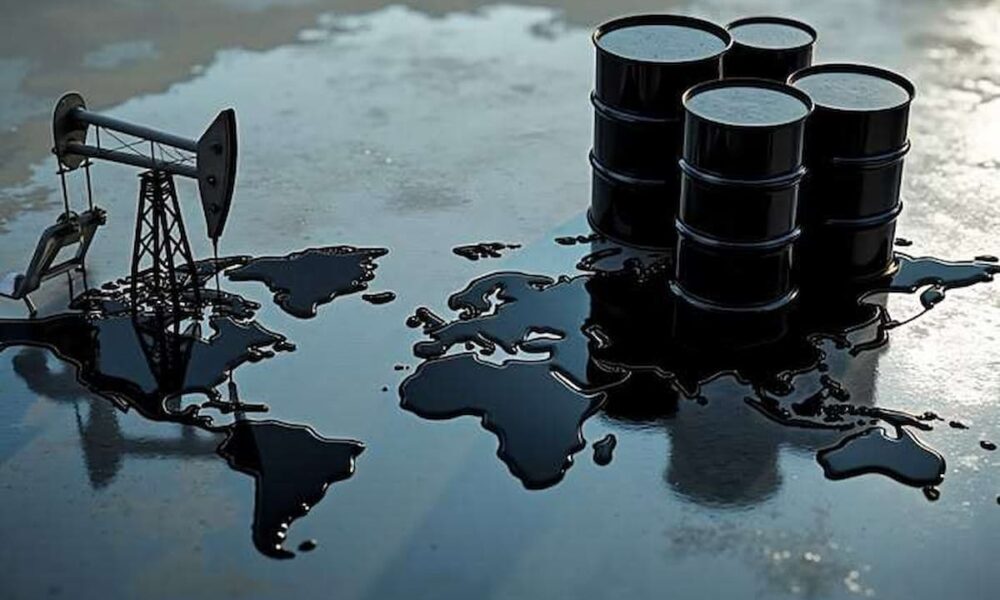
For energy markets, the risk remains high: before the war, around 20 million barrels of oil and refined products transited daily through Hormuz, representing about a fifth of global consumption, according to the International Monetary Fund.
In the United States, a war that weighs on gas stations and the cost of living
While Trump announces an imminent drop in oil prices, American motorists continue to pay far more for fuel than before the conflict. The automobile association AAA estimated on October 12 the national average price of regular gasoline at $4.3556 per gallon, versus about $3.08 on the same date in 2025, a rise of around 41%.
The cost of the war for American consumers
$4.36: average price of a gallon of regular gasoline on October 12, 2026 (AAA).
+27.4%: year-on-year rise in the U.S. gasoline price index in August (BLS).
+16.3%: year-on-year rise in the energy index in August (BLS).
+3.4%: overall inflation over twelve months in August; September figures will be released only on October 14 (BLS).
The rise in fuel costs weighs directly on commuting and indirectly on transportation costs for goods. For households, it adds to the pressure from food, housing, and everyday expenses. Price growth cannot be attributed solely to the war: refining capacity, demand, and distribution conditions also play a role.
The price of oil remained around $103 per barrel on October 12, according to Reuters. Diesel, essential for road transport, recently cost about $6.28 per gallon in the United States, according to market data cited by business press.
A war disapproved by 69% of Americans polled
The political impact becomes clearer ahead of the midterm elections on November 3, 2026. According to an Associated Press–NORC poll released in early October, 69% of those polled say the war against Iran was not worth it, up from 64% in July. Only 28% approve of how Trump is handling this issue.
Several Republican candidates have publicly called for a quick end to the conflict. The president, for his part, says that the electoral calendar does not influence Washington’s military or diplomatic decisions.
Meanwhile, billionaire Elon Musk has contributed around $366 million to the 2026 American electoral cycle, including $276 million since July, mainly to support Republicans. Among these contributions are $158 million to the Senate Leadership Fund and $76 million to his America PAC committee, according to the Associated Press and Reuters.
The IMF warns: the economic bill exceeds the United States
In its new outlook released on October 13, the International Monetary Fund projects global growth of 3.1% in 2026, up from 3.0% in its July forecast. This resilience rests notably on investments related to artificial intelligence, but the IMF cautions about the risks of a prolonged war and energy prices staying high.
The institution expects American growth of 2.3% in 2026. Its central scenario assumes an average oil price of $96 per barrel in 2026. In an adverse scenario, with a barrel reaching $130 through the first quarter of 2027, global growth in 2027 would be reduced by 0.5 percentage points and global inflation would rise by an additional 1.1 percentage points.
The IMF has also sharply revised its projections for Gulf states directly exposed to the disruptions: it particularly expects a contraction of GDP by 3.3% in Saudi Arabia in 2026. These forecasts remain conditional on the military evolution and oil flows.
Tehran strengthens its defenses while Trump minimizes Moscow and Beijing’s role
According to the Wall Street Journal, satellite images reveal new protective devices around sensitive Iranian sites, notably at Natanz and in the Pickaxe Mountain area. The newspaper also reports that Iranian officials have warned about regional consequences of a possible resumption of American strikes. These details come from the journal’s report and the sources it cites.
On his Truth Social network, Trump also claimed that he does not believe Russia and China are providing significant military aid to Iran. He argued that the two powers have too much to lose and that Washington would be quickly informed of such assistance. His assessment does not settle the accusations of potential technology transfers or indirect support.
An announced end to the war, but no crisis exit yet secured
Nearly eight months after the first strikes, the optimistic statements of the American president contrast with the strengthening of Iranian defenses, the attacks in the Strait of Hormuz, and the diplomatic tensions between London and Tehran.
The negotiated path remains open, but disagreements over the oil embargo, sanctions, and security guarantees remain significant. Meanwhile, the consequences of the war are visible in fuel prices, in economic forecasts, and in the American electoral campaign.
For American households, the promise of a rapid price drop now depends as much on the security of oil routes as on an as-yet uncertain political agreement.