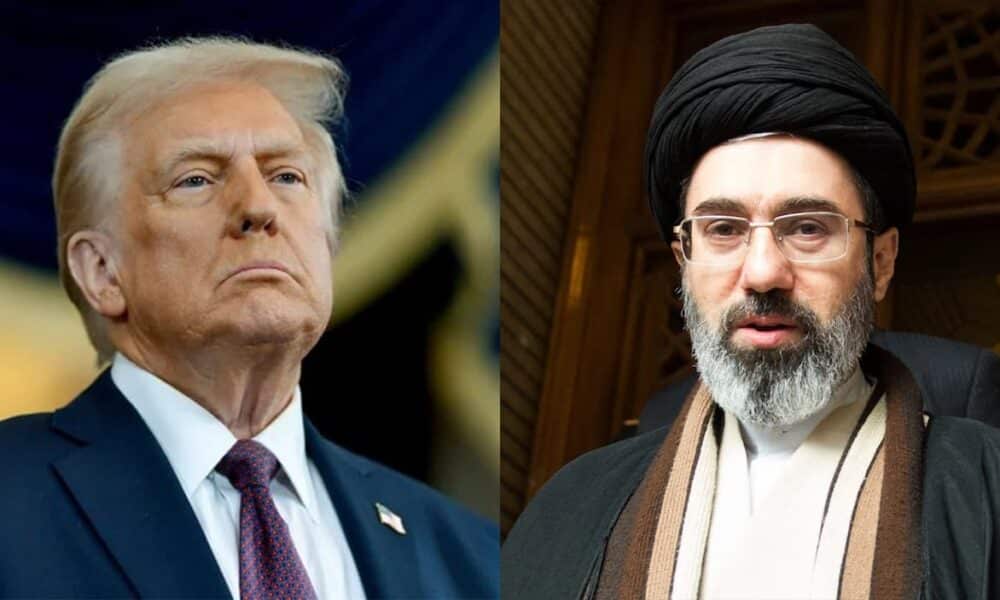
Donald Trump says that the war with Iran could end soon, “one way or another.” But Tehran makes any diplomatic progress conditional on the abandonment of American threats, while the Revolutionary Guards claim a new attack on a gas-carrying ship in the Strait of Hormuz. This military and economic confrontation continues to weigh on global oil and on the finances of importing countries, including Tunisia.
This Saturday, October 10, 2026 marks, according to Al Jazeera’s coverage chronology, the 115th day since the memorandum of understanding reached in June between Washington and Tehran and the 224th day since the outbreak of the war, on February 28. The antagonistic statements from the two capitals show that no definitive settlement has been achieved.
Key figures
28 million barrels: volume that would have traversed the Strait of Hormuz on Thursday, according to Donald Trump, with no independent confirmation of this record.
10.1 million barrels per day: crude oil flow previously estimated by Kpler through the strait, i.e., 74% of the pre-war level.
More than 1,500 individuals and entities: sanctions claimed by a senior U.S. Treasury official over six weeks; 17 ships targeted in a new round of measures on October 8.
104.72 dollars: closing price of Brent crude on Friday, October 9, according to Reuters.
Pezeshkian: No effective negotiations under threat
Iranian President Massoud Pezeshkian again stated on Friday, at a summit in Turkmenistan, that dialogue with the United States could only succeed in the absence of pressure and threats. According to him, discussions must be based on respect and reciprocal commitments, and not on a display of military might.
Indirect negotiations have stalled since the summer. A memorandum reached in June had outlined a path out of the conflict, but did not lead to a durable peace. More recent exchanges, notably on the margins of the United Nations General Assembly, did not yield a decisive breakthrough.
By contrast, Donald Trump says the Iranian dossier will be resolved quickly. He maintains that Tehran must never possess a nuclear weapon and has threatened the country with existential consequences if it does not bow to Washington’s demands. The American president also stated that Iran was economically at the end of its rope and that its inflation had reached 300%. This last figure is a claim by Trump, not an independently verified measure in the sources consulted.
In Hormuz, two opposing versions of reality
Trump says that the American military now fully controls the Strait of Hormuz. According to him, 28 million barrels of oil would have transited there on Thursday, October 8, a volume he presents as higher than pre-war records.
The Iranian Revolutionary Guards, however, claim to exercise control over the passages and reject the figures put forward by Washington. On Friday, their navy said it had struck the NV Sunshine, a liquefied petroleum gas (LPG) carrier, as it was, they say, taking an “illegal” route south of the strait. Iran says a fire affected the engine room. The ship’s identification and all the circumstances of the incident were not fully corroborated independently.
Independent tracking data provide a different light. According to Kpler, cited by Reuters on October 8, crude oil flows through the strait had fallen to at least 10.1 million barrels per day, i.e., 74% of their pre-war level and 27% below the peak recorded the previous week. Only seven merchant vessels had transited on Tuesday, then ten on Wednesday. Before the conflict, about 125 large commercial ships used this passage daily.
These independent data pertain to different days and cargo categories than the figure announced by Trump. They do not allow validating his 28 million barrels for Thursday. Kpler also notes 6.7 million barrels per day exported via alternative routes through the Gulf of Oman and the Red Sea, helping to offset part of the disruptions.
The American Treasury intensifies the financial war
On Al Jazeera, Erin Brown, U.S. Undersecretary of the Treasury for International Affairs, said that Washington had sanctioned more than 1,500 individuals and entities over the six previous weeks, as part of the operation dubbed “Economic Outcast.” She asserts that Iranian financial circuits, including cryptocurrency transactions, are targeted.
On Thursday, October 8, the U.S. Treasury Department officially announced new measures against networks involved in Iranian oil exports, notably 17 ships. The American administration says it wants to dry up the oil revenues used, it says, to finance Tehran’s military apparatus and regional activities.
Brown maintains that no Iranian barrel would leave the country any longer. This claim of a total halt, however, is not independently established: information gathered by the Washington Post indicates that Iran continues to move certain shipments via existing stockpiles or alternative routes, despite a substantial drop in its exports.
Oil tops $104, fuels remain under strain
The uncertainty around Hormuz reverberates through global markets. On Friday, October 9, Brent closed at $104.72 per barrel, up 0.42%, while U.S. WTI finished at $91.85, up 0.39%, according to Reuters.
Before the war, the strait was a key passage for roughly one-fifth of global supplies of oil and petroleum products. Attacks on ships, higher insurance and transport costs, and refinery disruptions are now complicating fuel flows. In the United States, diesel was about $6.28 per gallon, up about 70% since the start of the war, according to Reuters.
The conflict is also fueling higher shipping costs: the Financial Times reports daily rates reaching up to $1.6 million for some large tankers, in a context of greater risks on Gulf routes. Other disruptions, including preemptive production shutdowns tied to a hurricane in the Gulf of Mexico, amplify price volatility.
Lebanon: six injured in strike near Syria
Regional confrontation remains active on the Syria-Lebanon border. On Friday, an Israeli drone strike in the Hermel district, Lebanon, left six injured according to the Lebanese Health Ministry: five Syrians, including two women, and one Lebanese.
The Israeli army said it had targeted a Syrian national whom it accuses of planning operations against its forces in coordination with Iran. The death of this man was not confirmed in the military statement consulted.
The regional humanitarian toll remains heavy. In its September status, the International Organization for Migration (IOM) counted in Lebanon, as of September 9, 333,144 people still displaced and more than 818,000 returns initiated. It also relied on a Lebanese Ministry of Health tally of 4,335 dead and 12,277 injured since March 2, 2026. These dated data do not constitute an up-to-date count as of October 10.
Tunisia: why the Hormuz crisis already weighs on the budget
For Tunisia, a net energy importer, the issue goes beyond diplomacy. The 2026 finance law was built on an assumption of Brent at $63.3 per barrel, well below current levels on international markets.
According to budget execution data as of June 30, 2026, cited by the National Radio and La Presse, the average price of oil had already reached $92.6 in the first half of the year. Fuel subsidy expenditures stood at 2.427 billion dinars, i.e., 48.6% of the corresponding annual forecasts.
If prices remain high, energy import costs and subsidy needs could continue to weigh on the budget, businesses and purchasing power. The exact impact, however, depends on import volumes, exchange rate, purchase contracts, and possible adjustments to energy policy: it cannot be inferred from the single gap between Brent’s price and the budget assumption.
A still-unclear end to the war
Despite the optimistic statements from Donald Trump, no credible timetable for a definitive settlement has been announced. Washington is betting on sanctions and its military presence; Tehran is demanding an end to the threats and continues to claim control over Hormuz.
Future developments will depend as much on the state of negotiations as on the actual security of ships, the resumption of energy flows, and the ability of both sides to agree on verifiable commitments. For markets and importing countries, a sustained price drop remains tied to real de-escalation, not just political announcements.
Sources : Al Jazeera, coverage through October 10, 2026; Reuters/Kpler, October 8; U.S. Treasury, October 8; Reuters, oil markets of October 9; IOM, Lebanese situation in September; Tunisian National Radio, budget execution as of end-June 2026. Data as of the availability of sources on October 10, 2026.