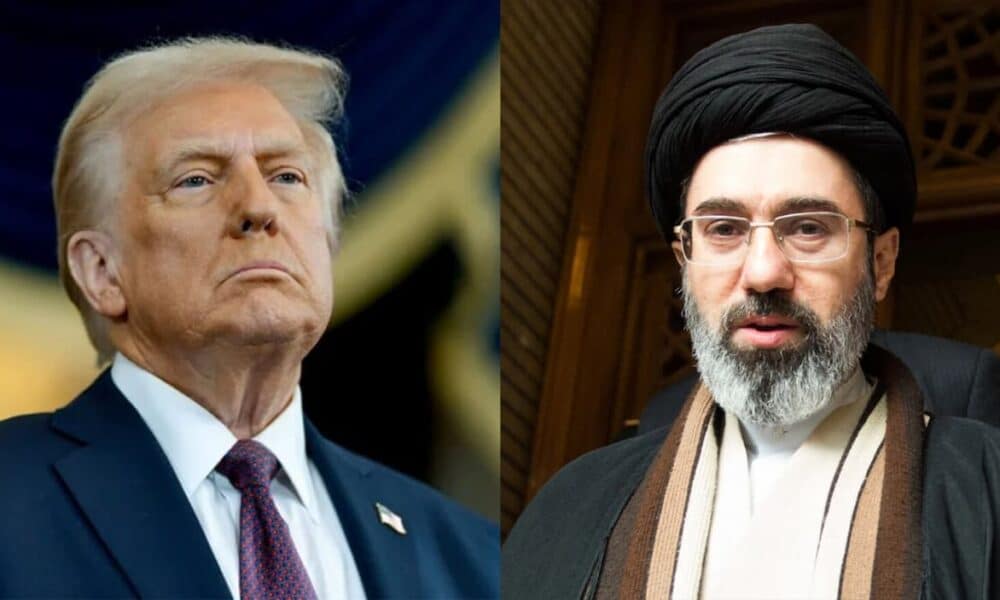
The confrontation between Washington and Tehran enters a new phase, less focused on the immediate pursuit of an agreement and more on the economic strangulation of Iran. On the 64th day since the signing of the memorandum between the two countries and 173 days after the start of the war, Donald Trump promised an unprecedented campaign of “isolation” and threatened heavy consequences to any state or economic actor that continued to support Tehran.
This economic offensive comes as negotiations remain stalled, traffic through the Strait of Hormuz remains well below normal, and the American military has, according to Axios, quietly set up a maritime corridor intended to maintain part of the Gulf’s oil exports.
Trump Now Threatens Iran’s Economic Partners
In a message posted on social media on Wednesday evening, Donald Trump promised a “economic war and isolation on an unprecedented scale” against Iran.
The American president is no longer targeting Tehran alone. He warns that any country allowing its financial institutions, its businesses, its airports, or its public agencies to provide “any form of support” to Iran would expose itself to heavy economic consequences.
The Wall Street Journal reports that Trump presented this new phase as a kind of “economic D-Day”, promising what he described as the toughest economic operation ever conducted against a country.
One caveat remains significant: Washington has not yet detailed the concrete new measures that would accompany this announcement. No country has been named, and Trump has not specified what additional mechanisms would be added to the sanctions arsenal already imposed on Iran for decades.
This lack of detail will be decisive. New secondary sanctions targeting banks, companies, insurers, ports, or trading partners could have consequences well beyond Iran’s economy.
China on the Front Line If Washington Truly Tightens Sanctions
The reach of the American threat will depend in particular on how Washington treats Tehran’s major partners.
According to 2025 data from Kpler cited by Reuters, China bought more than 80% of Iran’s oil shipped by sea.
Beijing thus appears as the actor most directly affected if the United States decides to apply sanctions to countries continuing to provide an economic lifeline to Iran.
But the choice would be delicate for Washington: China is also one of the United States’ main trading partners and has means of retaliation, notably in the realm of strategic commodities.
The United Arab Emirates have, for their part, already announced the suspension until further notice of their commercial activities, economic exchanges and financial transactions with Iran.
Tehran Denounces “Economic Terrorism”
Iranian Foreign Minister Abbas Araghchi immediately rejected the American announcement.
He portrays the “economic D-Day” mentioned by Donald Trump as an attempt to divert attention from the United States’ internal difficulties, notably their debt and the rising cost of financing.
The Iranian foreign minister also accuses Washington of practicing “economic terrorism”, arguing that this policy threatens not only Iran but also the sovereignty of other states and the functioning of the global economy.
Tehran thus maintains its line: sanctions and military pressure should not, according to its leaders, be equated with negotiation.
Araghchi also had a telephone call with the head of the Pakistani army, Marshal Asim Munir, as Islamabad continues to play a role in regional contacts around the conflict.
Iran Claims Its Next Weapons Will Be “Different”
On the military front, the Revolutionary Guards also adopt a hardening stance.
Their spokesman says that Iran continues uninterrupted production and development of its armaments and that, in case of a new phase of war, the abilities used could be different from those observed so far.
According to his statements, the changes could concern notably the generation of warheads, the accuracy of strikes, or the range of missiles.
The Revolutionary Guards claim to be advancing simultaneously in several categories of weapons, with the aim of increasing their precision and destructive power.
These are Iranian statements about their own military capabilities, which do not by themselves allow assessing the real state of their stocks or the performance of the new systems mentioned.
18 American Soldiers Killed and 757 Wounded Since the Start of the Conflict, According to CNN
The length of the war is also starting to appear in American figures.
CNN reports, based on an update of the U.S. Department of Defense’s database, that 18 American service members have been killed and 757 wounded since the start of the war against Iran on February 28.
The number of wounded has surpassed 750 after more than 50 cases were added in the latest update.
This total nonetheless requires methodological precision. CNN obtains it by adding the victims recorded in Operation Epic Fury and those recorded since July in a new Pentagon category called “Overseas Operations”.
The U.S. Department of Defense has not publicly provided all details allowing individual attribution of the victims in this second category to the Iranian conflict. The total of 18 dead and 757 wounded should therefore be presented as CNN’s calculation based on Pentagon data, and not as a detailed tally published under a single official heading dedicated to the Iran war.
A Discreet American Corridor in the Strait of Hormuz
One of the most important developments concerns, however, oil.
According to Axios, citing two American officials, the U.S. military has for several weeks set up a discreet operation allowing tanker ships to cross the Strait of Hormuz via a corridor located to the south, along the coast of Oman.
The setup is not solely about escorting ships leaving the Gulf.
Empty tankers would be assisted in entering from the Arabian Sea, loading crude in Gulf-producing countries, then exiting through the same passage under American military coordination.
According to the officials cited by Axios:
- 15 to 20 tankers would enter and exit each night through this corridor ;
- nearly 10 million barrels of oil per day would now be moved to global markets ;
- this would represent about half of pre-war volumes ;
- on some nights, volumes would reach 15 to 20 million barrels.
The operation would be run from the U.S. Army’s Fort Bragg headquarters, with Gulf partners. The United States would separately organize inbound and outbound convoys, while American aviation would provide protection against Iranian drones and cruise missiles.
Why Does Kpler Yet See Only Nine Passages?
Axios’s figures may seem to contradict those from Kpler.
The latest data from the maritime-tracking company show only nine ships carrying crude having passed through the Strait of Hormuz on Wednesday, exactly the same number as on Tuesday.
However, the two series do not necessarily measure the same thing.
Kpler counts visible movements corresponding to its vessel categories and tracking systems. Reuters notes that some ships may travel with their transponders turned off, in which case they do not appear in these counts.
Axios describes, for its part, a specific military operation mainly involving tankers and based on statements from American officials.
These data thus indicate one reality: significant volumes of oil are starting to exit the Gulf again, but ordinary commercial traffic through the Strait remains far from having returned to normal functioning.
Trump Believes Hormuz Will Lose Its Importance
Donald Trump now states that this crisis could permanently reduce the Strait of Hormuz’s strategic importance.
He says that the development of new infrastructure, pipelines, and alternative energy routes will gradually bypass Hormuz. He also notes the increase in American production in Texas, Alaska, and Louisiana.
The president further states that the U.S. Navy now fully controls the strait and that only ships authorized by Washington may cross it.
Tehran, however, contests this claim, continuing to assert its control over the passage.
And despite the development of alternative routes, Hormuz remains difficult to replace in the short term: before the conflict, about a fifth of the world’s traded oil passed through this strait, according to Reuters .
Even the approximately 10 million barrels per day currently claimed by American officials would, according to Axios, represent only about half of pre-war oil flows.
The Iranian Economy Becomes the New Battlefield
The governor of the Central Bank of Iran also stated that Iran was currently no longer able to export its oil normally, a sign of the impact sought by the blockade and sanctions.
The statement comes in a context where the Iranian economy was already fragile before the latest American announcements due to decades of sanctions, war, trade disruptions, and difficulties accessing foreign currency.
For Washington, the aim now seems to be to turn this vulnerability into a bargaining tool: limit oil revenues, cut financial circuits, and raise the cost borne by countries and companies continuing to do business with Tehran.
For Iran, the opposite challenge is to show that economic pressure will not be enough to force political surrender and that Tehran retains military and maritime means of retaliation.
Thus, the confrontation is gradually shifting terrain.
After air strikes, missiles, and the battle around the Strait of Hormuz, finance, international commerce, banks, and oil exports are now central weapons of the conflict.
The effectiveness of the new American strategy will nevertheless depend on one question that remains unanswered: Donald Trump has announced an unprecedented scale of an “economic war,” but Washington still must specify what new measures it is actually willing to impose—and how far it will go in facing the countries that will continue to trade with Iran.