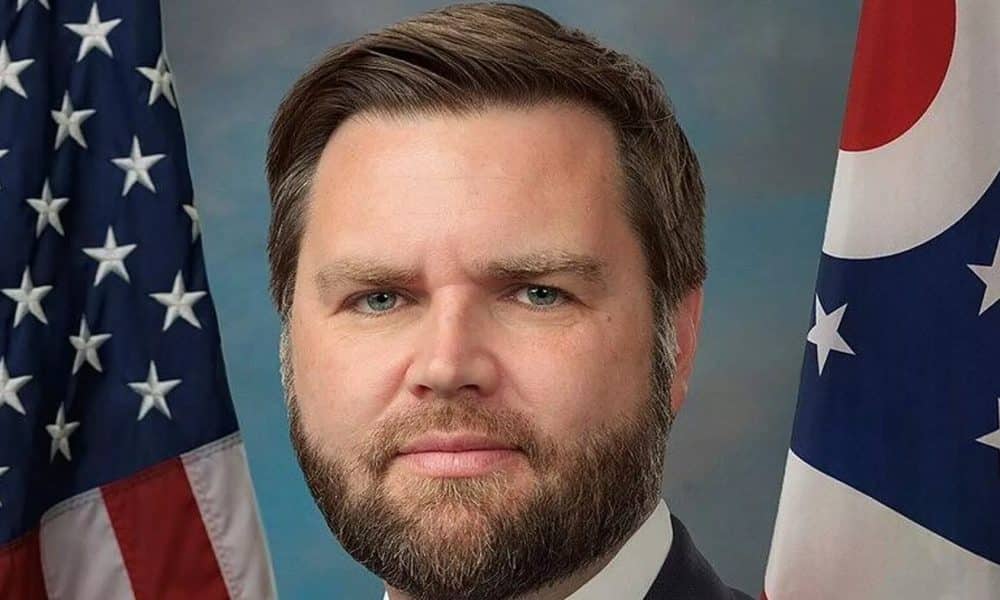
The American vice president J.D. Vance has sparked numerous reactions after mentioning, in a long interview devoted notably to his faith, the possibility that humanity has entered a period signaling the “end of times.” He also stated that he would not be surprised if the Antichrist was already among men, while affirming that he wishes to stay focused on his political responsibilities.
The essentials
- J.D. Vance asserts that he does not rule out that humanity has entered a period corresponding to the “end of times.”
- The American vice president says he would not be surprised if the Antichrist was already among men.
- He says he sometimes feels a form of “spiritual darkness” during certain meetings with international leaders.
- Vance also expresses strong reservations about certain uses of artificial intelligence, notably when it replaces human relations.
- He remains, however, in favor of AI development and opposed to regulation that he regards as excessive.
- He has also defended Donald Trump after the release of an AI-generated image that had drawn criticism in some Christian circles.
Vance ponders the “end of times”
Asked about the possibility that the world has already entered a period corresponding to the “end of times,” J.D. Vance replied that he did not know and that he preferred not to dwell too much on this question.
According to him, such a preoccupation could even become spiritually harmful by diverting him from the responsibilities he believes he still must fulfill.
The American vice president, however, acknowledged that certain contemporary evolutions led him not to exclude the darkest scenarios. He explained that certain events made him think he would not be particularly surprised if the Antichrist was already among men.
Vance also recounted that he sometimes felt a “spiritual darkness” during meetings in which international leaders and officials participate. Some discussions would, according to him, “sound all spiritual alarms.”
Nevertheless, his reasoning remains strongly marked by his religious conception of duty: he says he wants to continue his work in accordance with what he regards as the will of God, whatever the outcome.
He thus explained that if his action were to lead to the end of times, he would accept it as part of this divine will, while a better world would obviously be the outcome he would desire.
Vance also estimated that the “end of times” would inevitably arrive, the real unknown being, in his view, whether it would occur in thousands of years or in a few months.
Asked about his own chances of going to heaven, on a scale from 1 to 10, the vice president replied that he assessed them at around 7 or 8 out of 10.
Artificial intelligence at the heart of his spiritual concerns
J.D. Vance also linked some of his religious concerns to the development of artificial intelligence.
He spoke of what he considers a form of “dark spiritual energy” surrounding certain uses or communities connected to AI.
The vice president notably cited a ceremony held in 2025 in San Francisco by more than 200 AI enthusiasts on the occasion of the retirement of the Claude 3 Sonnet model. Presented as a symbolic funeral ceremony, the initiative had brought together users attached to the model.
Vance says he was deeply uncomfortable with this practice, which he interprets through his religious lens.
He is also critical of the use of AI as a substitute for human relations, especially when users seek AI systems for advice about their couple or their social life.
According to him, gradually distancing humans from social interactions to which he believes God has destined them represents a major risk. He has even gone so far as to call some of these uses “demonic.”
A stance nevertheless favorable to AI development
However, these statements do not mean that J.D. Vance is opposed to the development of artificial intelligence.
His political career is closely tied to Silicon Valley and several figures from the tech sector. The American vice president also advocates a policy favorable to innovation in AI and has regularly shown hostility to what he regards as excessive regulation of the sector.
Thus, his position distinguishes two questions: on one hand, the technological and economic development of artificial intelligence, which he supports; on the other, certain social and cultural uses that he deems problematic in light of his religious beliefs.
Vance defends Trump after a controversial image
The interview also addressed a controversy provoked by Donald Trump.
The American president had shared an AI-generated image depicting him in a look that evoked Jesus Christ. The image drew criticism, including from some Christians who support Trump, before being removed.
J.D. Vance defended the American president, stating that he had no intention of ridiculing Christianity or Jesus.
According to him, the image primarily reflected Donald Trump’s characteristic humor and should not be interpreted as the president’s attempt to present himself as Jesus.
Religion, technology and politics in a single discourse
The interview thus offers an unusually detailed glimpse into how the American vice president articulates his religious convictions with the exercise of power.
Converted to Catholicism in 2019, J.D. Vance does not present his questions about the Antichrist or the end of times as political certainties or forecasts. They relate to his personal and religious reading of the world.
Nevertheless, his statements show that this spiritual dimension occupies a significant place in his view of certain contemporary issues, notably international relations and artificial intelligence, while he holds one of the highest offices in the American executive.