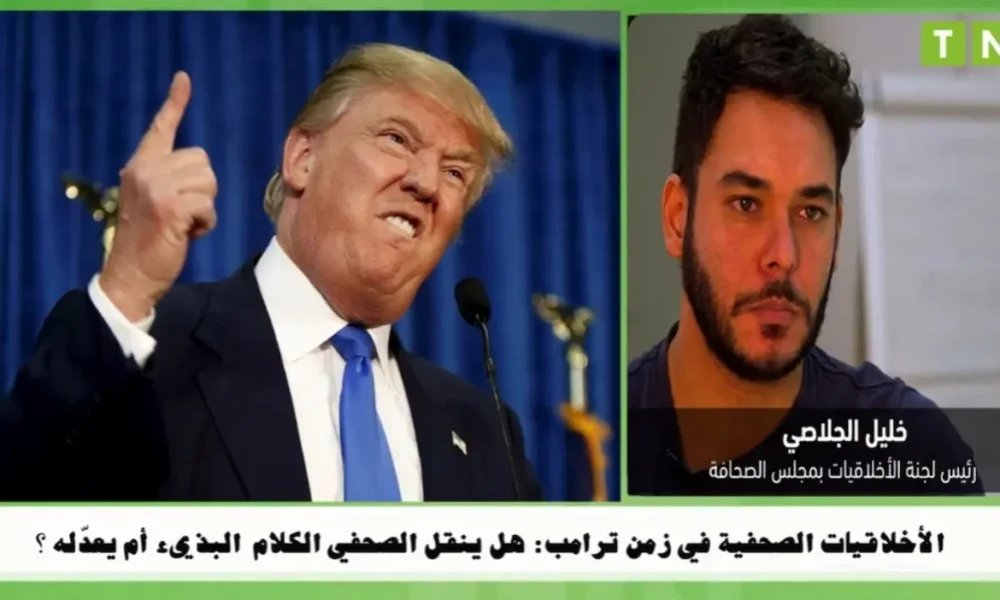
The statements by American President Donald Trump have become a recurring topic of debate in media outlets around the world, notably due to the frequent use of aggressive and sometimes vulgar language. These remarks raise questions about how journalists should handle these statements, especially when they go against the ethical and professional standards of journalism. When Trump uses harsh and inappropriate words, journalists find themselves in a delicate situation: how to reconcile the principle of faithfully reporting reality with the ethical principles of the profession?
In this context, Khalil Jelassi, president of the Ethics Commission of the Press Council, clarified, in an interview with Tunisia Digital, that the journalist’s first duty is to transmit information in a precise and factual manner. The journalist has the responsibility to report events as they unfold, without content distortion. However, this principle becomes more complex when the reported remarks contain offensive terms, as is sometimes the case with Trump’s speeches. According to Jelassi, a Tunisian journalist, for example, cannot afford to reproduce injurious statements, even if the source is a political figure. It is however possible to mention the context of these remarks without directly repeating the offensive terms.
The press is not limited to retransmission: analysis and critique are essential
Jelassi explained that the journalist’s role goes far beyond simply retranscribing political speeches. They must also include a critical analysis of the context and the message conveyed. Whether in Tunisia or elsewhere, political leaders may sometimes utter statements that are either erroneous or misleading. This is where the journalist’s responsibility lies: they must not only report the remarks but also analyze them constructively, offering readers an interpretation that goes beyond the mere transmission of words.
Deceptive political discourses: the need for analysis and verification
One of the essential points raised by Jelassi concerns political discourses that can be deceptive or contain incorrect information. He emphasized that the journalist should not simply retransmit the words of the officials as they are, but should also perform a critical analysis of these statements. This analysis helps guide the public toward a better understanding of what is said, by deconstructing the discourse from objective facts and not from personal opinions or subjective interpretations.
The analysis must be grounded in studies and reliable data
Jelassi insisted that the analysis of a political discourse must rest on solid and verifiable data. As with Trump’s statements, which can have a direct impact on public opinion, the global economy, or even international relations, these discourses must be analyzed based on concrete facts. A journalist should not simply express a personal opinion or deliver a general impression. On the contrary, they must be able to clearly show the effect of these remarks on the real world and offer a precise interpretation of events.
Political discourse as a political act: a shift in political communication
In conclusion, Jelassi stressed that political discourse has become a political act in itself. The statements of political figures such as Trump have the capacity to directly influence financial markets, diplomatic relations, or even global economic balances. The journalist must therefore understand that their role is not limited to reporting these speeches, but they must also analyze their effects and contextualize them for their audience. When discourse becomes a political act, it is essential for the journalist to be aware of the importance of these remarks and their potential impact on society.