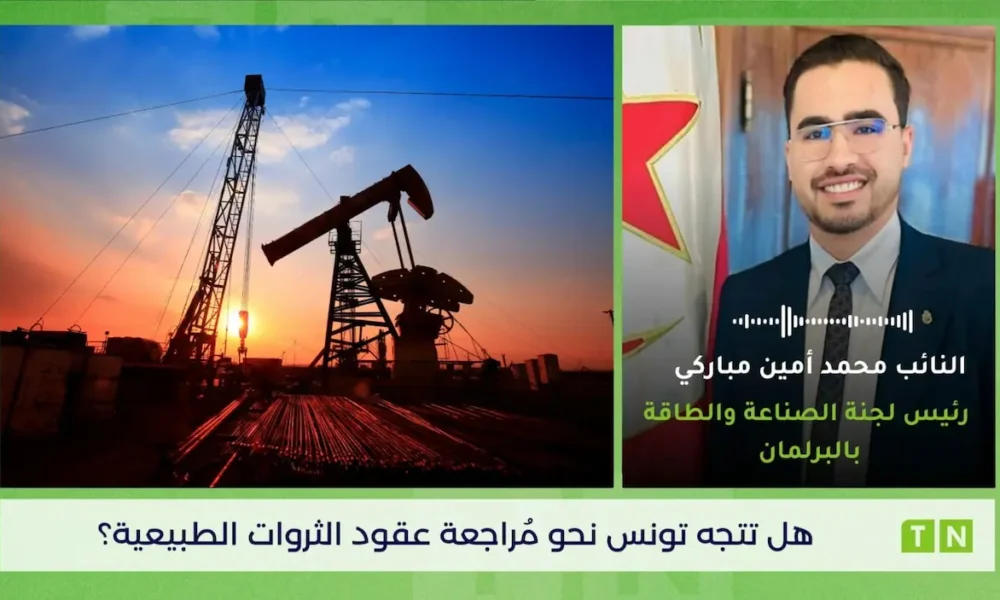
The president of the Commission on Industry, Trade, Natural Resources, Energy and Environment at the Assembly of the Representatives of the People, Mohamed Amine Mbarki, stated that no official data at this stage allows establishing that the State has decided to revisit the old contracts related to the exploitation of oil fields and natural resources.
In an interview granted to Tunisie Numérique, the deputy specified that the information circulating on social networks about this subject cannot be considered an official directive in the absence of decisions or documents issued by the competent authorities.
Salt Contract: a debate about the 1949 date
Mohamed Amine Mbarki also returned to the controversy surrounding the exploitation contract for salt.
According to him, the date circulated on certain social media pages does not correspond to the one found in the documents on which he relies.
The president of the commission indicated that the contract in question dates back to 1949 and not to 1930, noting that it would have been published in the Official Journal on 6 October 1949.
He stressed the necessity, for this type of matter, to go back to the original contracts and texts before drawing conclusions or disseminating information.
Cercina: the extension project has not been withdrawn
The Cercina field is among the main cases currently under review by the commission.
Mohamed Amine Mbarki indicated that the bill relating to the extension of its exploitation was submitted at the initiative of the Presidency of the Republic.
He added that the commission had received, to date, no official notification announcing its withdrawal.
According to him, the final decision will rest with the Assembly of the Representatives of the People, which will have to rule by a favourable or unfavourable vote after the completion of the text’s examination.
The deputy believes that, if an official orientation were indeed to move toward revising the exploitation contracts for natural resources, clarifying the fate of the Cercina project would be among the questions to be considered.
Chaâl: reservations and questions within the commission
The president of the commission also spoke about the Chaâl file and the questions related to its attribution to the Tunisian Company for Petroleum Activities, ETAP.
He reported several reservations and questions within the commission, without issuing a definitive conclusion on the file.
According to him, these points will have to be followed up with the relevant bodies.
Aïn 3: the commission wants to assess the State’s interest
Regarding the Ain 3 field, Mohamed Amine Mbarki announced that the commission intends to refer to the Ministry of Industry, Mines and Energy in order to obtain clarifications and additional data.
One of the main questions should concern the interest that the Tunisian State could derive from exploiting this field.
The commission thus intends to examine the economic and technical dimensions of the project to assess what it could bring to the finances and the interests of the State.
Ashtart and Rahmoura: two files already examined by Parliament
Mohamed Amine Mbarki recalled that the commission had already examined the Ashtart and Rahmoura files.
According to him, the commission had rejected the two agreements after noting several observations and what he describes as “irregularities” during their examination.
He specified that the authority behind the two projects had subsequently withdrawn them.
These assertions remain attributed to the president of the commission. They do not, in themselves, permit concluding the existence of established legal violations in the absence of conclusions or official decisions from the competent authorities.
An investigation covering 14 points and files
The deputy also stated that the commission has, in his view, documents and official data showing that the former Minister of Industry, Mines and Energy had opened an investigation covering 14 points and files.
Among these would notably be the Chaâl and Cercina files.
Mohamed Amine Mbarki announced that the commission intends to follow the course of this investigation with the minister currently in charge of managing the Industry department.
The chair of the commission, however, did not provide any data on the final conclusions of this investigation or on the results of the investigations concerning each of the cited files.
Thus, opening an investigation does not, in itself, constitute proof of a crime or of responsibility.
A call to examine the contracts in light of the State’s interest
As part of the debate on the exploitation of natural resources, Mohamed Amine Mbarki argued in favor of examining the possibility of revising the contracts when the country’s interest requires.
He stated that these files should be evaluated on the basis of their economic profitability, their legal conditions, and their technical aspects.
According to him, the objective should be to determine precisely what these contracts bring to the Tunisian State.
A full-time minister for the sector
The president of the Industry Commission also suggested that the volume and complexity of the files under the Ministry of Industry, Energy and Mines justify, in his view, appointing a minister fully devoted to this department.
He explained that the energy, mining and natural resources sectors require continuous monitoring as well as mastery of the technical, economic and legal dimensions of contracts and concessions.
In the same context, Mohamed Amine Mbarki indicated that a new head had been appointed to lead ETAP, replacing the former president, Dalila Chebbi Bouattour, who retired on 1 August 2026.
He expressed the hope that this new appointment would, in his words, contribute to bringing about positive change within the company.
Auditions planned after Parliament reconvenes in October
The Industry Commission is expected to deepen the examination of several of these files after Parliament resumes its activities at the beginning of October.
Mohamed Amine Mbarki announced the scheduling of hearings with representatives from the Ministry of Industry, Mines and Energy as well as the Tunisian Company for Petroleum Activities.
These sessions should allow deputies to submit their questions and obtain clarifications on the files currently under review.
The chair of the commission assured that it would continue its oversight role and its legislative work on the contracts and projects related to the exploitation of natural resources.
According to him, the main evaluation criterion must remain the interest these agreements represent for the Tunisian State.