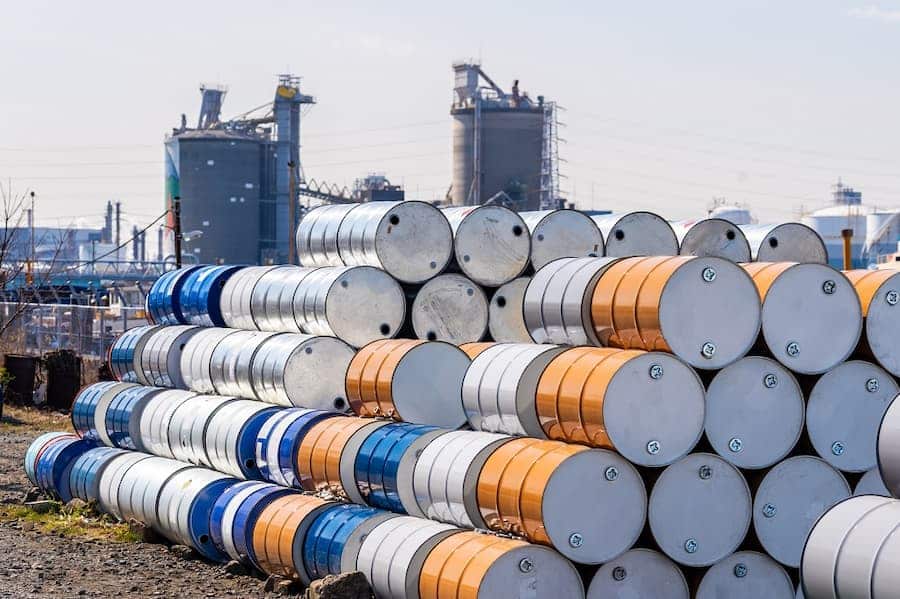
Global oil stockpiles observed have fallen again sharply in August, according to the latest Oil Market Report by the International Energy Agency (IEA). They declined by 95 million barrels over the month, bringing the cumulative drop since February to 507 million barrels.
This trend comes amid persistent supply disruptions in the Middle East, a decline in global production and heightened tensions over crude prices and maritime transport.
Key Takeaways
- Observed global stocks fell by 95 million barrels in August.
- The cumulative decline since February reached 507 million barrels, or 2.8 million barrels per day on average.
- Offshore crude volumes declined by 65 million barrels.
- Non-OECD stocks fell by 52 million barrels, while OECD stocks rose by 23 million barrels.
- The North Sea Dated crude reached $113.48 per barrel on September 9.
A cumulative decline of 507 million barrels since February
According to the IEA, global stocks observed recorded a new draw of 95 million barrels in August.
Since February, the cumulative decline now stands at 507 million barrels, equating to an average pace of 2.8 million barrels per day.
This development signals a marked tightening of available oil supplies observed worldwide over the last few months.
Offshore crude falls by 65 million barrels
Volumes of oil transported or stored offshore fell by 65 million barrels in August.
The IEA links this development to new attacks targeting tanker traffic from the Middle East, in a context of elevated security risks. These tensions on sea routes have also contributed to a sharp rise in transport costs, while demand for tanker ships remains robust.
Divergent trends between OECD and other economies
The decline was not uniform across regions. Non-OECD stocks decreased by 52 million barrels, with a particularly pronounced drop in China.
Conversely, OECD stocks rose by 23 million barrels. The gain in commercial stocks more than offset a 19 million barrel decline in government stocks.
| Indicator | Change |
|---|---|
| Global stocks observed in August | -95 million barrels |
| Cumulative decline since February | -507 million barrels |
| Average rate of decrease | -2.8 million b/d |
| Oil offshore | -65 million barrels |
| Non-OECD stocks | -52 million barrels |
| OECD stocks | +23 million barrels |
Global production falls to 100.1 million barrels per day
Global oil production decreased by 1.6 million barrels per day in August compared with the prior month, standing at 100.1 million b/d.
More than 10 million barrels per day of Gulf production remained shut in an environment of elevated security risks.
For all of 2026, the IEA projects a 5.7 million b/d decline in global supply, to 100.7 million b/d. The anticipated rebound in the Gulf is now pushed back to 2027.
The agency then expects a rebound of global production by 8 million b/d.
Global demand is also expected to fall in 2026
The IEA anticipates a global crude oil demand decline of 2.5 million b/d in 2026.
This estimate marks a downward revision of 0.94 million b/d versus the report published a month earlier.
The agency cites mainly the persistence of the stalemate in talks between the United States and Iran, which delays the prospect of normalization of oil flows.
Losses are expected to be concentrated primarily in middle distillates and feedstock for petrochemicals, especially in Asia. Demand, however, is forecast to rebound by 2.6 million b/d in 2027.
Crude surpasses $113 per barrel
The market tightening has also shown up in prices. The Brent crude benchmark North Sea Dated rose by $7.61 per barrel in August, averaging $91 per barrel.
It then climbed to $113.48 per barrel on September 9.
The IEA also notes a particularly pronounced backwardation, a situation in which near-term prices are higher than those for more distant maturities.
This condition accompanies the tightening of the physical market driven by disruptions in the Middle East and Russia, as well as the shifting portion of demand toward Atlantic-basin shipments.
Refineries under pressure
Volumes processed by refineries reached 81.4 million b/d in August, up 960,000 b/d month over month.
They remain nonetheless 4.2 million b/d below their year-ago level, with declines recorded in the Middle East, Russia, and several Asian crude-importing economies.
For 2026, the IEA projects a global drop in refined volumes of 2.6 million b/d, to 81.5 million b/d.
Refining margins also hit record levels in the Atlantic basin in August, driven mainly by a sharp increase in diesel margins. In Singapore, the surge in freight costs weighed on profitability.
IEA data thus describe a market marked by a rapid drawdown of observed stocks, persistent disruptions to production and trade flows, and strong price and shipping tensions.
The agency nevertheless foresees a clear rebound in both production and demand in 2027, subject to the expected restoration of oil flows and the capacities that are currently disrupted.