The press release runs to just a few lines. On June 26, 2026, the board of directors of Sitex, the Industrial Textile Company, decides to postpone the general meeting originally scheduled for June 30. The 2025 accounts still need to be finalized and the latest developments of the judicial restructuring plan incorporated.
Officially, this is a technical postponement. But behind this administrative decision wavers half a century of Tunisian industrial history.
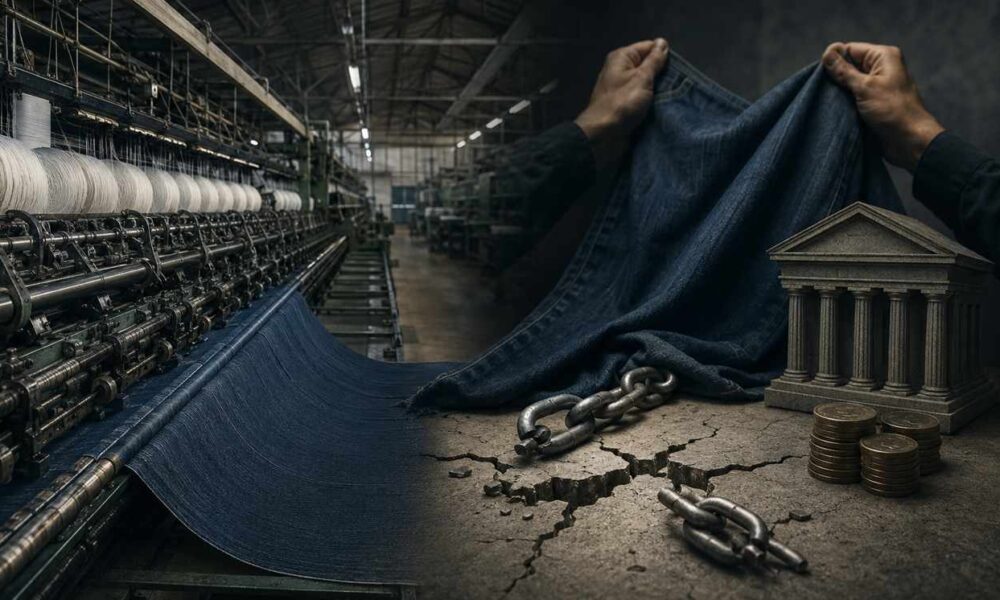
How could a company that produced up to 10 million meters of fabric per year, worked with some of the world’s largest brands and helped shape an entire sector, end up under the supervision of a judicial administrator?
The answer does not lie in a single crisis or a single decision. It tells of a slow accumulation: commercial dependence, collapse of activity, operating losses, fragile cash flow, late responses and an inability to translate industrial and real estate value into liquidity.
The city that learned to manufacture with the war’s leftovers
To understand Sitex, one must first go back to Ksar Hellal.
According to the regional industrial tale, inhabitants began in the 1940s to recover the threads from tents and parachutes abandoned after World War II. The materials were unraveled, retrieved and then reused.
From this economy of necessity gradually arose one of Tunisia’s major textile hubs.
Sitex is part of this history. As early as 1973, the company developed technical and commercial cooperation with the British group Swift. According to the company, this partnership facilitated technology transfer, the training of Tunisian skills, and access to the supply chains of major international brands. Stusid Bank, which has since become Tunisian Saudi Bank, also supported its development.
Sitex was legally established in February 1977. Production began in Ksar Hellal in 1979, before the relationship with Swift was strengthened in the 1980s.
The model rests on a relatively rare industrial integration. The company runs a spinning mill in Sousse and a weaving and finishing site in Ksar Hellal. It thus engages in several steps upstream from clothing assembly: spinning, weaving, dyeing and finishing.
Sitex is therefore not merely a factory that assembles garments. It produces the material that other companies transform.
This distinction is essential to understand what its disappearance would represent.
The Golden Age and the first dependence
In its prime years, Sitex boasted a production capacity of around 10 million meters of fabric per year. Its denims fed manufacturers working for Levi’s, Wrangler, Lee Cooper, Diesel, Hugo Boss or Pepe Jeans. The company also contributed to the emergence of a network of garment makers around Ksar Hellal and in other regions.
But a weakness appeared very early at the heart of this success: the concentration of customers.
At a certain period in its history, Levi’s is said to have accounted for nearly 40% of Sitex’s production. One single buyer thus absorbed about four meters of fabric out of ten.
When the American brand redirected a portion of its sourcing to Turkey in the 2000s, Sitex lost a decisive outlet. The company resisted, invested, sought new markets and notably adopted a business plan for the 2014-2019 period.
It survived the shock. But the fundamental vulnerability of the model—the dependence on a single partner or dominant customer—does not disappear.
It would reconstitute itself in a more complex form.
Swift, a historic partner that became a central player
Thirty years after Levi’s dependence, Sitex again finds itself backed by a partner that has become indispensable.