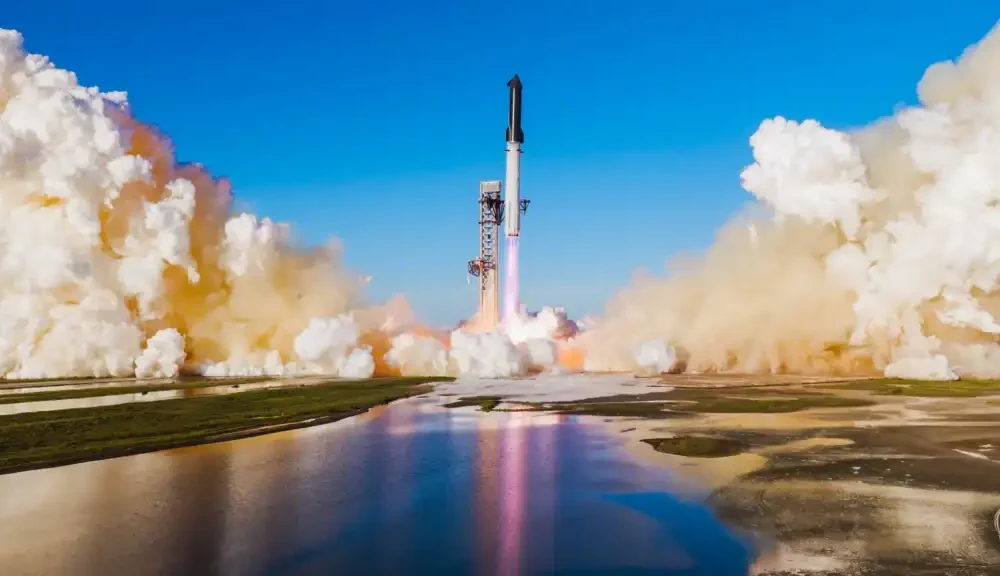
A rocket returning from space, braking above its base, before being captured by two giant arms: SpaceX achieved, on Saturday November 14, 2026, a maneuver never before accomplished with the Starship upper stage. After an orbital flight of more than 22 hours, the vehicle was recovered in Texas by Starbase’s launch tower.
But the mission was not a total success: the first stage Super Heavy, which was also supposed to return to the tower, was lost in the Gulf of Mexico. This distinction is important for understanding what SpaceX has actually demonstrated — and what remains to be proven.
The Essentials
The 15th test flight lifted off on November 13, 2026. The upper vehicle completed 14 orbits around Earth, deployed 26 Starlink V3 satellites, and was captured by the tower’s mechanical arms on November 14 around 22:20, Tunis time.
The Super Heavy booster was not recovered.
How SpaceX Achieved the First Capture of the Starship Vessel
SpaceX’s giant launcher consists of two elements: Super Heavy, the first stage that provides the initial thrust, and Starship, the upper vehicle that continues the flight into space. At liftoff, the assembly stood roughly 124 meters tall, according to the Associated Press.
After separation, the Starship was placed on an orbital trajectory and completed 14 revolutions around Earth, at an altitude of about 265 kilometers, according to the Associated Press. It then performed a deorbit burn, traversed the atmosphere, and slowed down thanks to its engines. As it approached Starbase, it righted itself to position between the tower’s capture arms, nicknamed “chopsticks” (“sticks”).
The capture occurred on November 14, around 21:20 GMT, i.e., 22:20 Tunis time, after roughly 22 and a half hours of mission. Footage of the maneuver was released by SpaceX. The vehicle was suspended from the mechanical arms without needing to land on a traditional landing gear.
Why the First Stage Fell Short
The original plan called for capturing both stages of the launcher. However, the first-stage Super Heavy could not return to the tower. During the descent, its engines shut down too early; the guidance system determined it was not in conditions compatible with a capture and triggered an exit trajectory over the Gulf of Mexico.
The booster was then self-destructed. SpaceX was continuing to examine the causes of the anomaly at the time of the initial communications. It would thus be misleading to say that the entire rocket was recovered or that the problem is definitively explained.
The company had already managed to grab boosters on previous flights: the novelty of November 14 specifically concerns the upper vehicle returning from orbit, a craft subjected to significant heating and atmospheric reentry stresses.
26 Starlink Satellites Put into Orbit: Another Objective Achieved
During the flight, the vessel also deployed 26 new-generation Starlink satellites, designated V3.
SpaceX intends to use these satellites to increase the capacity of its space-based internet network. The company states that each Starlink V3 could provide up to one terabit of network capacity; these are claimed performances by the manufacturer, not an independent measurement of the throughput actually available to each customer.
The deployment and on-orbit checks will be part of the satellites’ commissioning.
Why This Capture Is a Major Step Forward
In conventional launch vehicles, a large portion of hardware is lost or requires complex recovery. The Starship project, by contrast, aims to recover and reuse both of its stages to shorten the time between missions and, in the long run, to reduce certain costs related to manufacturing and operations.
Saturday’s maneuver demonstrates that a vehicle returning from an orbital flight can be guided with sufficient precision to a capture tower. It does not yet demonstrate that a recovered vehicle can be inspected, refueled, and relaunched quickly: true operational reuse will need to be established in future flights. There is, at this stage, no confirmed per-kilogram cost to orbit from this single success.
What This Means for NASA’s Moon Missions
Starship is a key element of NASA’s Artemis lunar program. A variant adapted for crewed landings is expected to serve for transporting astronauts to the lunar surface as part of the Human Landing System.
Saturday’s recovery could contribute to the vehicle’s reliability development, but it does not automatically validate all steps required for a crewed lunar landing: in-orbit refueling, rendezvous between vehicles, long-duration testing, and certifications remain separate tasks.
The Associated Press notes that NASA aims for a crewed return to the Moon as early as 2028 in its presented schedule. This is a program objective, not a guaranteed success date.
What This Achievement Changes — and Does Not Change — for Internet Users
Three Useful Distinctions
Recovery does not yet mean reuse.
The spacecraft returned intact to the tower, but it has not yet flown again. The first stage was lost.
Complete recovery of the launcher remains to be demonstrated on a single flight. The new Starlink satellites do not automatically guarantee lower prices or service opening in Tunisia.
Access and offerings available in each country depend notably on local commercial and regulatory conditions.