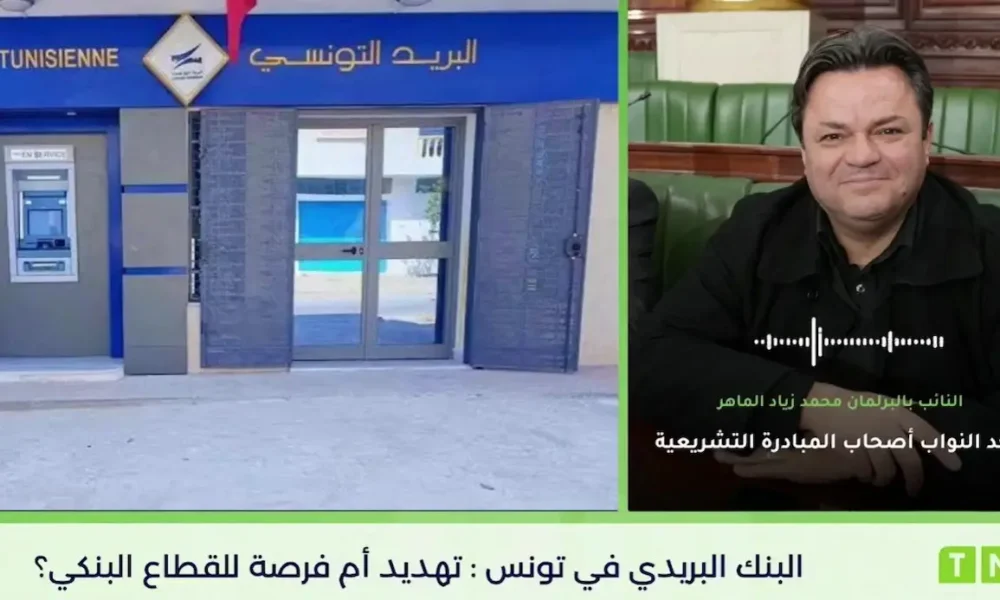
The deputy in the Assembly of the Representatives of the People, Mohamed Zied El Maher, co-initiator of the bill proposing the creation of the postal bank, stated in an exclusive interview to Tunisie Numérique that this project constitutes “an important step toward the digitization of banking services”.
According to him, the initiative could help relieve pressure on traditional banks, in a context marked by a growing need for investment and support for private initiatives.
A project part of the modernization of the financial system
Mohamed Zied El Maher explained that the creation of the postal bank fits into a dynamic of modernizing the Tunisian financial system and broadening access to banking services.
The objective is in particular to facilitate access to financing for groups that currently have difficulty obtaining loans through traditional banking mechanisms.
“It will not compete with banks”
In response to questions raised by some sector actors, the deputy sought to reassure: the postal bank “will not compete with banks”.
He specified that it will be primarily intended for the customers of the Tunisian Post as well as people not covered by banking services.
“The postal bank will not expose banks to major risks. Banks are involved in major investments. Each category has its own customers,” he said.
He added that if, after its creation, the postal bank managed to attract other customer segments, that would be “positive”, because it would strengthen competitiveness and improve the quality of the services offered to users.
A regulatory role for the State in the financial market
The deputy stressed that the initiative does not aim to favor one actor at the expense of another, but to correct the imbalances of the Tunisian financial market.
The proposal is part of, according to him, the will to enshrine a regulatory role for the State in the financial market, particularly in favor of categories marginalized in banking terms.
He stressed that a large portion of Tunisians cannot access credit under the mechanisms currently applied by banks, hence the need to establish a more flexible scheme, adapted to the specificities of these categories.
Integrating the unbanked through the postal network
The postal bank will primarily target people who are not included in the banking system, with the aim of integrating them into the formal financial circuit.
This deployment will rely on the extensive network of the Tunisian Post, present in all regions of the country, thereby guaranteeing effective coverage in both major cities and rural and interior regions.
The project aims in particular:
Artisans
Small manufacturers
Self-employed workers
These categories are among those most in need of accessible financial services tailored to the nature of their activities.