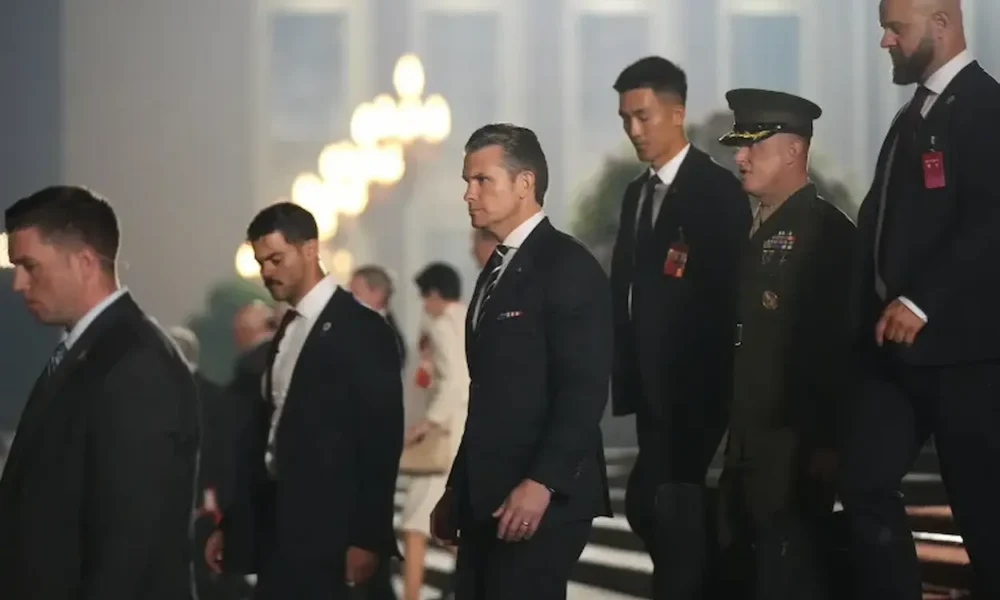
According to the American network CNN, White House officials were warned, before their trip to China with the delegation of U.S. President Donald Trump, about potential cyber risks during their stay in the country. These alerts particularly concerned the possibility of surveillance or hacking of communications and electronic devices.
According to officials cited by CNN, members of Trump’s delegation and his entourage, including Secret Service agents, were equipped with temporary phones and devices with new numbers. They were however warned that these devices could also be exposed to intrusion attempts during their stay in China.
Personal phones left in the United States
According to CNN, most U.S. officials left their personal phones in the United States, or kept them powered off in protective bags aboard government aircraft parked at the airport.
Some members of the delegation also created new accounts on encrypted applications, devoid of personal data or conversation histories, to use them only during the visit.
A U.S. official told CNN that the safety instructions issued to the group stressed a clear principle: any communication made from within China should be considered potentially exposed or likely to be intercepted.
A visit under tight digital surveillance
Donald Trump arrived in China last Wednesday for a visit that continues through this Friday. The trip includes notably a summit with Chinese President Xi Jinping, in the presence of an American delegation consisting of government and security officials, but also leaders of major American companies.
These measures fit what Fox News describes as a genuine “digital lock” accompanying visits by American officials to China. Many of them enter the country with so-called “clean” devices, meaning temporary phones and laptops containing a minimum of data, instead of their usual personal equipment.
According to Fox News, these devices are generally devoid of sensitive information and are not connected to personal accounts, cloud storage services, or the everyday apps used. The aim is to limit the risks of surveillance, hacking, or data collection in an environment Washington regards as particularly cyber-aggressive.
An unwritten rule in the American administration
Current and former officials say that the unofficial rule within the U.S. government is to treat any device entering China — phone, computer or tablet — as well as hotel Internet networks, as potentially vulnerable.
These precautions, though essential for security, also complicate diplomatic work. Exchanges that would normally be sent in seconds via encrypted apps or synchronized devices may have to go through limited channels, or even be transmitted verbally, according to Fox News.
The difficulty is all the greater since the visit does not only involve political leaders. Donald Trump was accompanied by a delegation including heads of major American companies operating at the heart of the economic and technological relationship between Washington and Beijing, among which Apple, Boeing, Qualcomm and BlackRock.
Tougher instructions before even arriving on site
Fox News also cites Bill Gage, a former Secret Service agent, stating that security briefings for American officials begin even before the president’s arrival at the destination. He notes that concerns about digital surveillance are particularly high during trips to China.
Theresa Payton, former White House Chief Information Officer, meanwhile, argues that officials are urged to proceed on the principle that everything they say or do, in person as well as online, may be monitored, and to act accordingly.
The caution is not limited to sending messages or using apps. Even simply charging a phone can become a security issue, due to fears about using unreliable charging equipment that could extract data or install malware.
For this reason, American officials typically carry approved chargers, external batteries, and government-provided accessories.
Peking rejects the accusations
On its side, the Chinese government rejects the accusations of illegal surveillance.
Fox News reports the remarks of Liu Pengyu, the spokesperson for the Chinese Embassy in Washington, who says that privacy is protected by law in China.
He added that the Chinese government places great importance on data protection and privacy, and that it does not ask either companies or individuals to collect or store data in violation of the law.