China has won the tug-of-war that the United States imposed on tariffs; it has won hands down the battle on exports (a $1,190 billion trade surplus in 2025). The last face-off between the two superpowers took place in Beijing, on May 14, 2026. There, it quickly became clear who is at the helm of the rising power and who governs the Empire in decline. The return match will take place next autumn, in Washington. President Xi Jinping will be within a stone’s throw of the midterm elections for which his American counterpart fears the worst, after all the breaches of the pact that bound him to his voters (no war, robust growth, better-paid jobs, controlled inflation, etc.). Another piece of bad news will precede Xi’s visit.
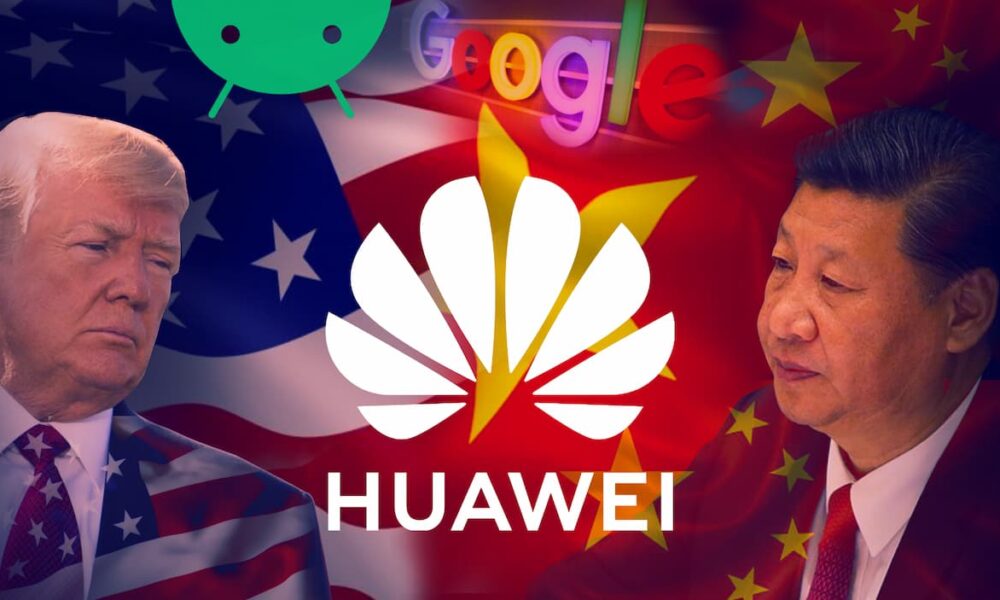
The Chinese company Huawei proclaims: In the next five years it will be able to manufacture state-of-the-art semiconductors, designed to train and power AI systems. If the Chinese are on schedule, this will provide proof that Beijing has leapfrogged the American sanctions that have hit it since 2019, on the grounds that US national security is at risk.
It was President Joe Biden, a well-known foe of China, who had decreed restrictions on access to the technologies needed to design these chips, which are at the heart of a fierce global competition. Huawei’s announcement indicates that the Chinese giant has managed to find an alternative to the mandatory extreme-ultraviolet (EUV) lithography equipment, said to be indispensable for mass-producing 5-nanometer or smaller chips.
Christophe Lesur, director of Cloud Temple, says that this tightening by the Americans produced the opposite effect, boosting Chinese investments. “China is catching up very quickly. In that, they can thank President Trump, who made a war with China one of his mantras. But as access to American technologies has become more complicated, subject to quotas or bans, China had to find solutions and decided to massively fund its industries. It took two years to do what Nvidia did in more than a decade. Instead of having a customer, you have a competitor.”
Huawei’s rise will hurt the American company Nvidia, the world’s leading semiconductor manufacturer. Its boss, Jensen Huang, was indeed in the delegation that accompanied Trump to Beijing. He surely did not suspect that a competitor was preparing this devastating move. China’s other major asset: the refining of rare earths, decisive in the fabrication of nano-chips. Depending on how relations with Washington unfold, Beijing could leverage its exports to strengthen its national companies.