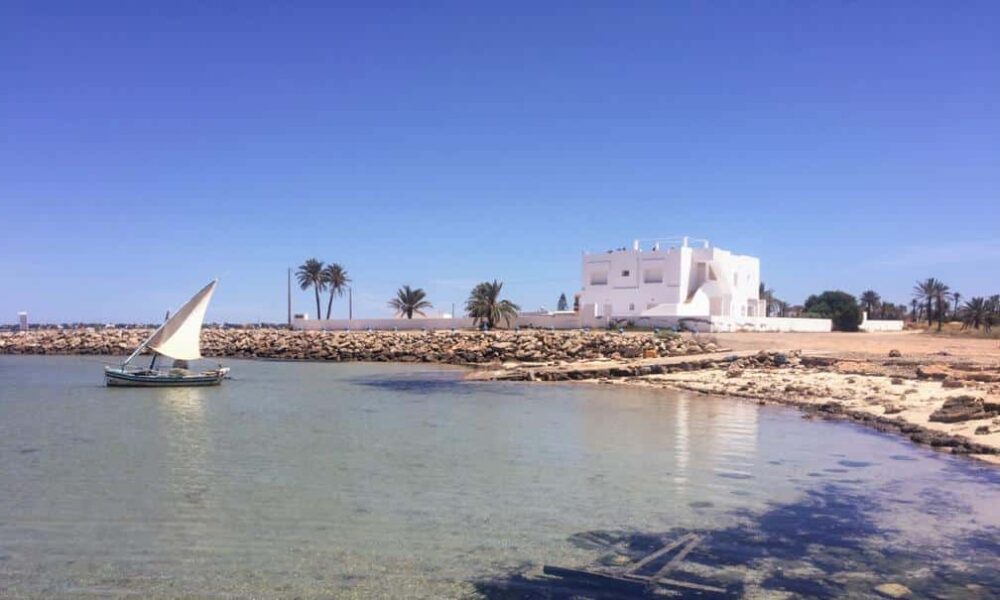
The inaugural meeting of a pilot project aimed at strengthening sustainable management of fisheries resources began this Thursday, November 19, 2026, in the Kerkennah archipelago. The project notably includes the installation of artificial reefs and the reinforcement of participatory governance within the future marine and coastal protected area for the archipelago’s northern islets.
An approach based on the preservation of marine ecosystems
The project is part of the FishEBM MED program, with technical coordination by the Centre for Regional Activities for Specially Protected Areas (SPA/RAC) and funding from the Global Environment Facility.
It aims to establish an ecosystem-based integrated approach to fisheries resource management, while strengthening the participation of local communities in the preservation of marine wealth.
The project includes two complementary components, implemented by the Kantara Save Earth Association and the Association of Kraten for Sustainable Development, Culture and Leisure (AKDDCL).
Artificial reefs to restore marine habitats
The first component focuses on ecological restoration through the installation of artificial reefs.
Several steps are planned, ranging from consultations with fishermen and the conduct of preparatory studies to the fabrication and installation of these structures at marine sites selected in coordination with the various stakeholders.
The objective is to create habitats favourable to marine organisms and to contribute to the preservation of biodiversity.
A scientific biodiversity monitoring system
The second component, implemented by the Association of Kraten for Sustainable Development, Culture and Leisure, concerns monitoring the ecological evolution of the artificial reefs.
It notably provides for:
- the development of a scientific monitoring protocol;
- the organization of field campaigns to collect and analyze data on biodiversity and marine habitats;
- the creation of a mobile space for environmental awareness and education;
- the development of an underwater trail with ecological and educational purposes.
Traditional fishermen at the heart of the project
Special attention is given to involving traditional fishermen in the various stages of project implementation.
Consultation meetings and participatory workshops will bring together fishermen, associations, scientific institutions and public bodies.
This approach aims to valorize local knowledge and the experience of fishing professionals in order to identify solutions suited to the particular characteristics of Kerkennah’s marine ecosystem.
Environmental awareness and education activities will also be directed at women, young people, residents and visitors of the archipelago.
A transferable experience for the Mediterranean
The results of the scientific monitoring should enable evaluating the effects of installing artificial reefs on marine habitats and biodiversity.
They will also help formulate practical recommendations on the sustainability of these interventions and on the possibility of reproducing this approach in other coastal areas of the Mediterranean.
This project extends efforts to strengthen the participatory governance of the future marine and coastal protected area for the northern Kerkennah islets.
It also aims to consolidate cooperation between the Coastal Protection and Development Agency (APAL), local associations, fishermen and the various relevant bodies, in order to reconcile the protection of marine resources, the sustainability of traditional fishing activities and the improvement of living conditions for coastal communities.