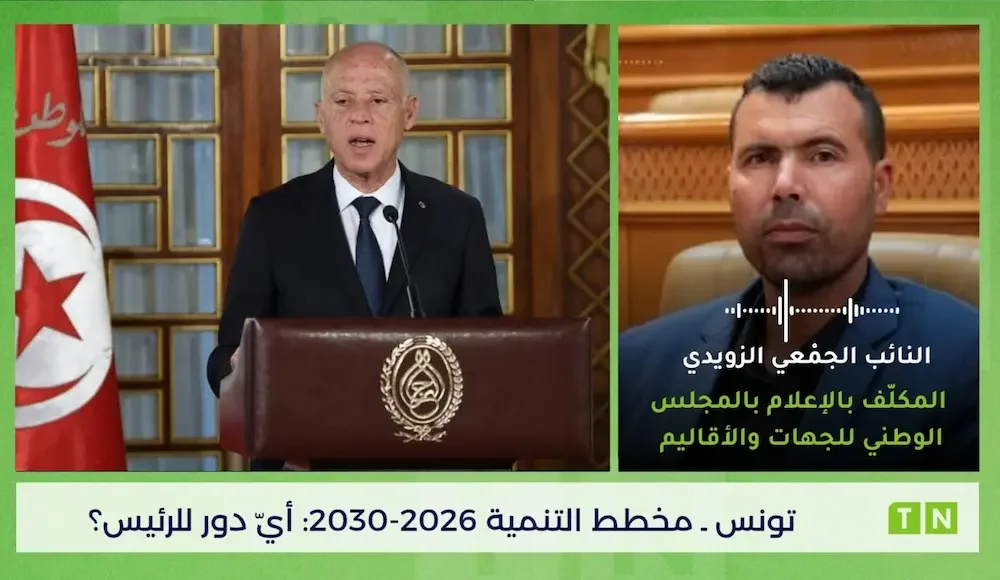
The deputy Jmaï Zouidi, responsible for communications at the National Council of Regions and Districts, stated, in an exclusive interview with Tunisie Numérique, that the development plan 2026-2030 will be transmitted to the Tunisian Parliament, in its two chambers, after its examination and adoption by the Council of Ministers.
He estimated that this step should occur in the coming days. “Procedurally, once the development plan is adopted by the Council of Ministers, it is transmitted to the Tunisian Parliament in its two chambers,” he specified.
The text should thus be submitted to the Assembly of the Representatives of the People and to the National Council of Regions and Districts.
The validation path between the two chambers
Jmaï Zouidi explained that the process provides first for the adoption of the plan project by the Assembly of the Representatives of the People. The text will then be transmitted to the National Council of Regions and Districts, which will continue its review before proceeding to its approval, the necessary step before its entry into force.
In the event of divergences between the two chambers, a joint parliamentary committee will be established. It will be composed of 10 members, five representatives from each chamber, in order to seek a consensual formula.
According to the deputy, if no agreement is reached, the final decision will return to the National Council of Regions and Districts. The vote of its members will then be binding, in accordance with Decree No. 1 organizing the relationship between the two chambers.
Several options for the voting mode
Asked about how the National Council of Regions and Districts will vote on the development plan, Jmaï Zouidi said that several scenarios remain possible.
The vote could cover the entire text, be carried out article by article, or project by project. He nevertheless estimated that the most probable option would be a vote article by article.
He added that the issue has not yet been definitively resolved, because the Council has not yet received the official version of the project. The method will therefore depend on the form in which the text is transmitted, whether it is a document structured in only 3 articles, a set of projects, or a version presented according to the traditional procedure.
The scheduling of projects in the state budgets
Regarding the distribution of projects listed in the development plan across the state budgets for the period 2026 to 2030, and in response to a question about the possible role of the President in setting the programming timetable, Jmaï Zouidi indicated that several projects have already been integrated into the 2026 budget.
He added that other projects will be integrated into the 2027 budget. According to him, this mechanism relies on meetings held at the regional and central levels, bringing together the regional councils and the concerned administrations, in order to identify priority projects and to register them in the appropriate budgets.
No constitutional deadline imposed on the council
The deputy also clarified that no time limit or constitutional deadline is set for the National Council of Regions and Districts to finalize the vote on the development plan.
He explained that, procedurally, the National Council of Regions and Districts and the Assembly of the Representatives of the People will examine the plan in parallel with the Ministry of Economy and Planning, as well as with the various stakeholders from the relevant ministries.
The Assembly of the Representatives of the People will first vote on the development plan, before transmitting the result of its vote to the National Council of Regions and Districts. The latter will then continue the discussions before moving on to its own vote.