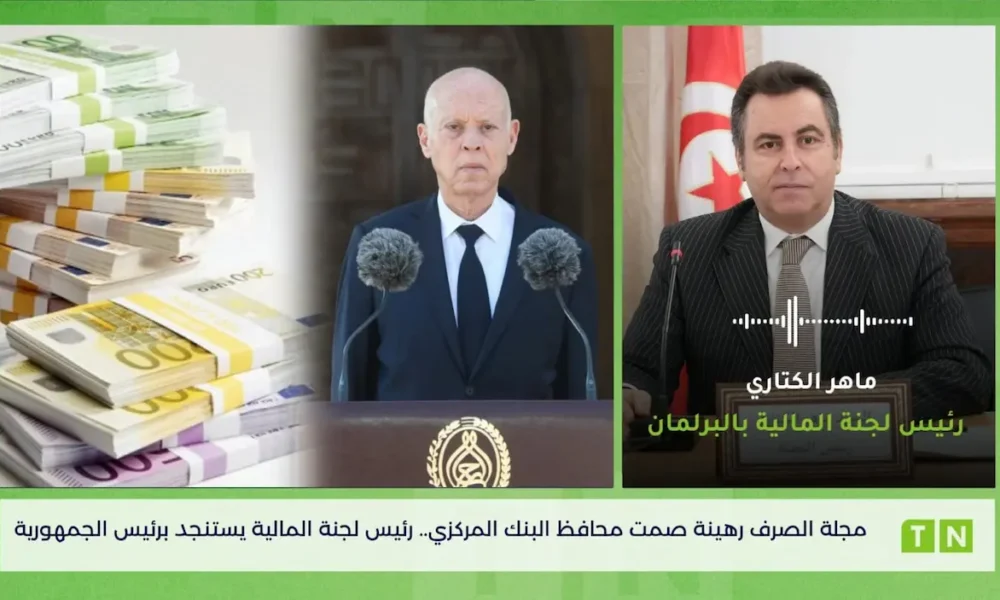
The president of the Finance and Budget Committee in the Assembly of the Representatives of the People, Maher Ketari, has called on the President of the Republic, Kais Saied, to intervene with the Governor of the Central Bank of Tunisia to speed up the examination of the draft of the new Foreign Exchange Code.
In a statement given to Tunisia Numérique, the deputy stated that the text had been blocked for nearly eight months, due, in his view, to the Central Bank’s lack of response to the requests addressed by Parliament.
Unanswered letters
Maher Ketari indicated that the Finance and Budget Committee had repeatedly sought the Governor of the Central Bank’s opinion on the Foreign Exchange Code project.
He nevertheless deplored the lack of interaction with the deputies, saying that the monetary institution should communicate with the representatives of the people on a matter of such importance.
“We wrote to him several times asking him to share his observations on a project as important as the Foreign Exchange Code,” he said.
The deputy also echoed the President’s remarks that the Central Bank is not independent of the State, arguing that its dialogue with Parliament constitutes an institutional obligation.
A text deemed essential for the economy
The head of the Finance Committee stressed that the Central Bank’s opinion was indispensable, given its role in the future implementation of the Foreign Exchange Code.
He recalled that the monetary institution is directly concerned by several provisions of the draft and that it will be called upon to participate in its implementation once the text is adopted.
According to Maher Ketari, economic actors agree on the need to modernize foreign exchange regulation to support investment, facilitate transactions and improve the competitiveness of the Tunisian economy.
An article-by-article discussion envisaged
The deputy said that it was now necessary to begin examining the project article by article within the Finance and Budget Committee.
He however specified that this approach must first be debated among the members of the committee before any final decision.
Maher Ketari acknowledged that deputies could grant the Central Bank extra time to submit its opinion, while warning that the file could not be blocked indefinitely.
« Tunisia is in a race against time »
The parliamentarian stated that Tunisia was engaged in a race against time to implement the reforms necessary to mend its economy.
He estimated that the absence of progress on the Foreign Exchange Code risked making the country lose valuable time, deeming this situation regrettable.
« Tunisia is in a race against time and, with this approach, the Governor of the Central Bank is making us lose that race », he said.
A growth target of 4 %
Maher Ketari finally linked the adoption of the new Foreign Exchange Code to the economic objectives outlined in the future development plan.
According to him, achieving a growth rate of 4 % will require adopting not only a new Foreign Exchange Code but also a new Investment Code.
He stated that these two legislative reforms are essential to strengthen Tunisia’s attractiveness, stimulate investment and support the growth of the national economy.