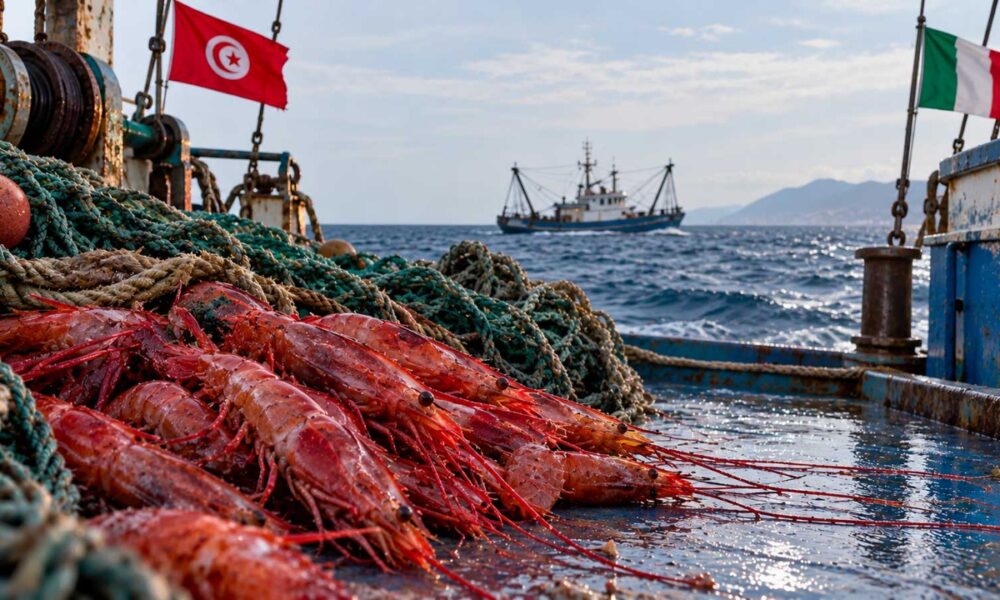
An agreement envisaging an increase in the quota of deep-water red shrimp allocated to Tunisia in the Mediterranean has been officially concluded, on the occasion of the Tunisian delegation’s participation in the work of the 49th session of the General Fisheries Commission for the Mediterranean (GFCM), which is taking place from October 26 to 30 in Rome, Italy.
According to a communiqué from the Tunisian Embassy in Rome, published yesterday on its official Facebook page, this agreement was reached following a series of negotiations and technical meetings with the European Union, in which representatives from the various sectors and ministries concerned from both sides participated.
It should be recalled that the General Fisheries Commission for the Mediterranean, affiliated with the United Nations Food and Agriculture Organization (FAO), applies a mechanism for periodic revision of member states’ quotas every three years. This revision takes into account the balance between the sector’s economic profitability and the preservation of the sustainability of fishing resources and marine ecosystems in the Mediterranean.
At the beginning of October 2026, the Italian authorities issued a note inviting importers to suspend their purchases of Tunisian red shrimp until the end of 2026. They justified this decision by Tunisia exceeding its legal quota by more than 41%. Tunisian exports recorded in the European monitoring system had indeed surpassed 50 tonnes.
Tunisia is seeking, for its part, an upward revision of the production ceiling, arguing that the current quota is based on old historical data that no longer reflect the structural evolution of its deep-sea fishing fleet. This fleet today counts between 70 and 100 modern and well-equipped vessels.
For its part, the European Union ambassador to Tunisia, Giuseppe Perrone, stated in official statements that the European side was fully prepared to continue bilateral dialogue, in a spirit of goodwill, in order to reach a durable settlement.
The discussions conducted in parallel with the work of the Fisheries Commission in Rome aim to update the frameworks of joint stock management plans for deep-sea crustaceans, while ensuring the interests of Tunisian fishers are protected and guaranteeing the environmental protection of this shared marine resource.