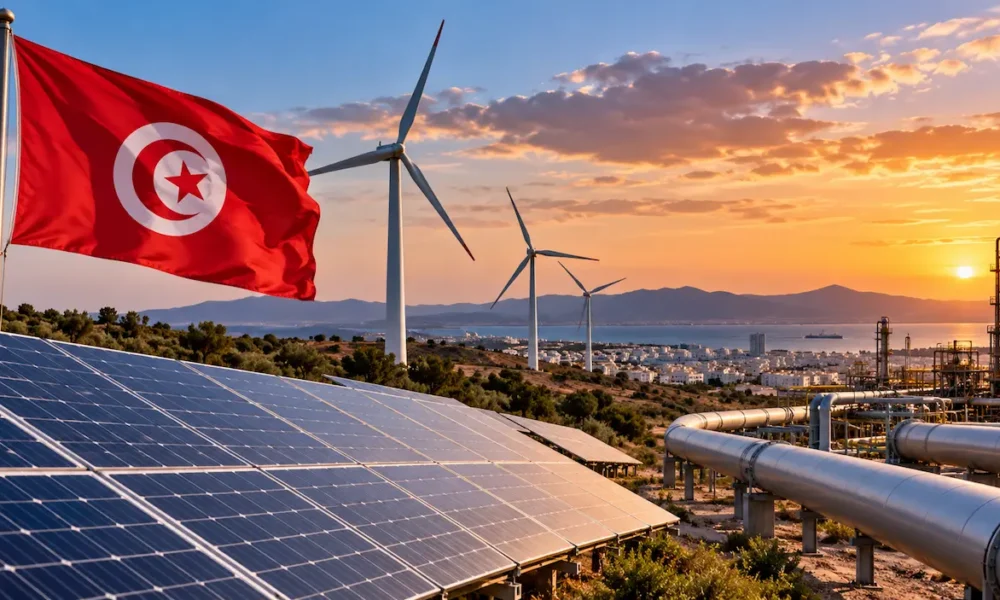
Tunisia has recorded a notable progress in the development of renewable energies, whose contribution to national electricity production has risen from about 2% in 2020 to nearly 10% in 2026. This evolution, however, occurs within a context marked by persistent dependence on energy imports and new geopolitical challenges, according to international energy expert Sami Ben Rejeb.
Speaking on Thursday, October 22, 2026, during the ninth edition of the Tunisian Forum on Energy Issues, held at the headquarters of the Arab Institute of Leaders (IACE), the expert called for a revamp of Tunisia’s approach to energy security.
The Essentials
- Electricity : the share of renewable energies rose from about 2% in 2020 to nearly 10% in 2026.
- Natural gas : between 65% and 70% of Tunisian consumption is covered by direct purchases from Algeria and the in-kind revenues linked to gas transit, according to the data presented at the forum.
- Strategic deadline : the Algerian gas transit contract expires in 2027, with a possible extension until 2029.
- Priorities : diversification of supplies, investments in infrastructure, demand management and development of renewable energies.
A Progress in Renewable Energies in the Face of Supply Challenges
According to Sami Ben Rejeb, the progress of clean energy constitutes a step forward for Tunisia, but it is not sufficient to solve the structural difficulties of the energy sector.
The country must notably face the need to secure its supplies and to reduce its energy autonomy, in an international environment characterized by geopolitical tensions, a reconfiguration of energy flows and an acceleration of the transition toward less carbon-intensive sources.
The expert stressed the necessity of adopting a new energy security strategy, based on diversification of energy sources and supplying countries, improved governance and more efficient management of available resources.
He also stressed the importance of developing partnerships with major international energy companies, while preserving investment and development opportunities offered to local producers.
Shale Gas: An Option to Assess Without Discounting Environmental Risks
Addressing the question of potential shale gas exploitation, Sami Ben Rejeb noted that this possibility could not be considered a solution without a rigorous assessment of its environmental consequences.
He nevertheless called for not excluding this option from the energy debate before studying its technical, economic and ecological aspects.
The expert recalled that some neighboring countries, though endowed with substantial conventional oil and natural gas resources, have been exploring this route since 2015 in collaboration with American companies.
He thus argued for energy decisions based on precise scientific, technical and diplomatic data, as well as an objective assessment of resources, operating costs and the economic and environmental consequences.
Energy Security: Meeting 2027 Needs While Preparing for the Future
For his part, Nidhal Ouerfelli, Director of Strategic Partnerships at the Commissariat for Atomic Energy and Alternative Energies (CEA), emphasized the need to integrate geopolitical transformations into the formulation of Tunisian energy policies.
According to him, Tunisia must adopt a strategic vision that reconciles the urgent measures necessary to cover its energy needs in 2027 with long-term planning.
This approach should notably rest on several axes: the development of renewable energies, the control of energy demand, the diversification of production sources and the strengthening of infrastructure.
Nidhal Ouerfelli also highlighted Tunisia’s geostrategic position between Africa and Europe, considering that it could constitute a significant driver of economic development.
The challenge, according to him, is to move the country’s positioning from being identified as an energy transit territory to that of an investor in infrastructure and energy projects.
Such an evolution could help create greater added value, reduce the energy deficit and strengthen Tunisia’s integration into regional and international value chains.
Algerian Gas: A Dependency of 65 to 70 Percent and a Contractual Deadline in 2027
Tunisia’s dependence on Algerian natural gas is among the main questions raised at the forum.
According to the data presented during the proceedings, direct gas purchases from Algeria and the quantities obtained through the transit levy together cover between 65% and 70% of national natural gas consumption.
The transit of Algerian gas to Europe via Tunisian territory thus constitutes an important geostrategic asset.
However, this advantage faces several difficulties, notably the decrease in volumes of gas transported and the decline in transit-related revenues.
Added to these developments is a major contractual deadline: the transit contract is due to expire in 2027, with a possible extension until 2029, according to the information presented at the forum.
This situation arises as Algeria seeks to strengthen its energy relations, while other Mediterranean countries, notably Morocco and Egypt, aim to consolidate their role as strategic partners of Europe in the fields of energy and infrastructure.
Making Tunisia’s Geographic Position a Lever for Investment
The ninth edition of the Tunisian Forum on Energy Issues aims to analyze the evolution of energy power dynamics in the region and to identify the margins of maneuver available to Tunisia.
The discussions focus in particular on the consequences of the energy strategies of neighboring countries, the European Union, and the main regional players.
The forum also examines the development possibilities offered by renewable energies, infrastructures, electrical and energy interconnections between countries, as well as new industrial sectors.
The objective is to identify priority decisions to be taken in the short and medium term to strengthen energy security and support the country’s economic sovereignty.
Beyond the mere question of supplies, the speakers stressed that energy security constitutes a decisive factor for the competitiveness of enterprises, the attractiveness of investments and the resilience of the Tunisian economy.
In this perspective, accelerating the energy transition, diversifying suppliers and leveraging Tunisia’s geographic position appear as strategic axes for the coming years.