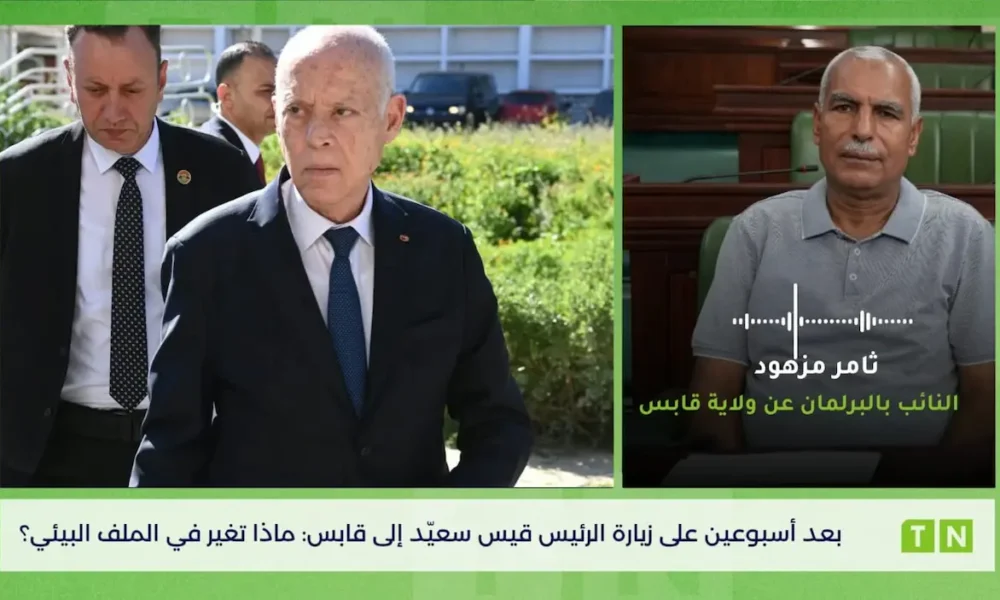
More than two weeks after the visit carried out by the President of the Republic, Kaïs Saïed, in Gabès Governorate on August 10, 2026 to observe the deterioration of the environmental situation and examine the file of the Tunisian Chemical Group, no major progress has yet been visible on the ground, according to Deputy Thameur Mazhoud.
In an interview with Tunisie Numérique, the Gabès representative estimated that the region’s inhabitants are still awaiting concrete measures, particularly regarding the transfer of polluting units.
During his visit, the Head of State had stated that the polluting units would not be put back into service and that only installations that had undergone repairs could operate, stressing the residents’ right in Gabès to live in a healthy environment.
A roadmap still awaited
Thameur Mazhoud indicated that after the president’s visit and the assessment of the environmental situation, nothing had really changed on the ground.
According to him, the inhabitants of Gabès are still waiting for the announcement of a precise plan regarding the transfer of polluting units.
He recalled that during meetings with the Ministers of Health, Environment, and Industry, there had been talk of transferring these units according to a determined strategy.
« We are aware that transferring the polluting units may take several years, but we are asking for the announcement of a clear and precise roadmap», he said.
Polluting emissions and phosphogypsum still at issue
Thameur Mazhoud also reported ongoing toxic emissions as well as the discharge of phosphogypsum into the sea.
According to him, as long as a comprehensive strategy does not address the root causes of the environmental problem, the situation will remain unchanged.
The deputy added that Gabès residents expected strong decisions following the presidential visit, given an environmental crisis that has lasted for several decades.
Gabès South has more than 90,000 inhabitants
Thameur Mazhoud, representing the Gabès South constituency in the Assembly of Representatives of the People, also spoke of the difficulties faced in this delegation, which he describes as the largest in the governorate with more than 90,000 inhabitants.
The area also hosts a university hub with about 15,000 students.
According to the deputy, Gabès South suffers from many infrastructure shortcomings requiring urgent interventions.
Several projects remain blocked
Thameur Mazhoud recalled that requests had been made for additional credits to the Gabès and Métouia municipalities to fund development works and intervention.
Among the pending projects is notably the municipal pool, whose works have been halted since 2018 and have not yet resumed.
He also cited the Gabès Olympic Stadium and the multipurpose sports hall, which, according to him, require intervention by the municipality or the Ministry of Youth and Sports.
Two additional buses for school transport, but an offer deemed insufficient
Regarding school transport, Mazhoud noted a shortage of buses dedicated to transporting students.
According to information from the regional transport company, the fleet is expected to be strengthened this year by two additional buses.
The deputy nevertheless believes this reinforcement is insufficient to ensure school transport under satisfactory conditions.
Gabès South bus station soon to be put into service
Mazhoud also indicated that the Gabès South bus station should come into operation soon.
This infrastructure is expected to improve transport services and reduce pressure on road traffic.
The deputy nevertheless believes that Gabès mainly needs stronger public investment to create more jobs and to foster a transformation of the local development model, which, in his view, remains largely based on polluting industrial activities.
Recurring drinking water outages
Mazhoud also mentioned the frequent interruptions in drinking water supply, which affect Gabès as well as other regions of the country.
He called for strengthening the regional directorate responsible for water extraction and distribution in Gabès with material and logistical resources to enable faster intervention when needed.
Doubling the capacity of the Zarat desalination plant
Among the proposed solutions is increasing the capacity of the Zarat desalination plant from 50,000 to 100,000 cubic meters per day.
Mazhoud also urged the search for new deep boreholes to consolidate the region’s water resources.
The Tunisian Chemical Group urged to resort to desalinated seawater
Finally, Mazhoud called on industrial companies located in the region, and in particular the Tunisian Chemical Group, to reduce their consumption of drinking water.
He proposes that they increasingly use desalinated seawater for their industrial needs to ease the pressure on underground water resources and on the drinking water supply network.