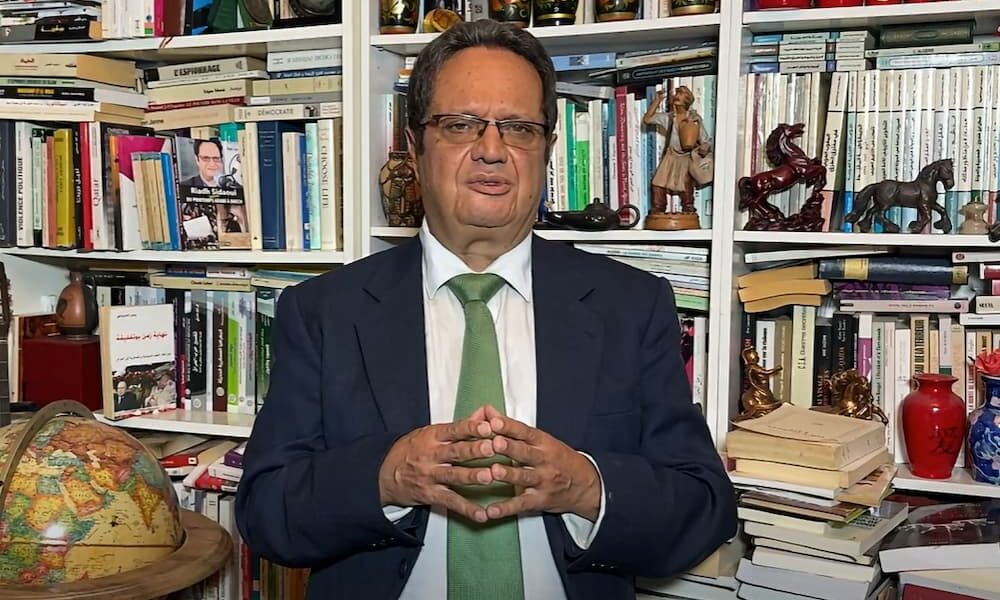
Riadh Sidaoui, director of the Arab Centre for Research and Political and Social Analysis in Geneva, believes that student and union protests in France cannot be separated from a deep economic and social crisis that has accumulated over decades. According to him, the erosion of social gains, rising prices, and the worsening of indebtedness are among the main factors fueling tensions in French society.
In an interview granted to Tunisie Numérique, Sidaoui explained that France is undergoing a “structural” crisis, which goes beyond the current economic conjuncture and is linked, in his analysis, to the distribution of wealth as well as the relations between the working classes and the dominant economic powers.
Debt and inflation at the heart of the French crisis To explain this crisis, Sidaoui cited several economic indicators. According to the figures he advanced, France’s gross domestic product (GDP) would have reached about 2.8 trillion dollars in 2023, while its debt would have surpassed 3.3 trillion dollars.
He considers that this imbalance illustrates the magnitude of the financial pressures facing France. He also indicated that the European Union had issued warnings to Paris regarding its budgetary situation and its level of debt.
Sidaoui also mentioned Chinese investments in French bonds, which he estimated at more than 300 billion dollars, to illustrate the links between the French economy and external financing.
He also linked the worsening crisis to the rise in prices of everyday consumer goods, notably fish, meat, fruits, and vegetables. According to him, the inflation wave began with the Covid-19 pandemic, before intensifying after the outbreak of the Russo-Ukrainian war.
In this context, he recalled the periods during which certain retailers imposed restrictions on the purchase of products, notably oil. These difficulties would then have intensified under the impact of the energy crisis and the rise in gasoline and fuel prices in general, weighing more on households’ purchasing power.
Sidaoui: French society carries a revolutionary legacy In his analysis of the historical and social origins of the protests, Sidaoui noted that French society is characterized, in his view, by a deeply rooted revolutionary tradition within its history.
He believes that the working and popular classes in France have consistently felt that they have been dispossessed of the gains from the French Revolution in favor of what he calls an “oligarchy,” that is, an economic and financial minority made up of powerful industrial and banking actors.
According to his analysis, recurring social movements reflect the persistence of a conflict between the popular categories and these economic powers, in a context where a portion of the French population feels their share of wealth and social gains diminishing.
Social networks disrupt the balance of influence The director of the Arab Centre for Research and Political and Social Analysis in Geneva also examined the role of the media in the transformations experienced by French society.
He believes that dominant economic powers have sought to preserve their influence through traditional media and various attempts to control information flow. However, the ubiquity of the Internet and social networks has made it virtually impossible to have absolute control over the media space.
He notably stressed that young people now have tools that allow them to access information directly and express their opinions outside traditional media channels.
In this regard, Sidaoui cited the positions regarding the war in Gaza, asserting that there is a gap between the orientations reflected by some traditional media and the positions of certain segments of French society that express solidarity with Gaza.
According to him, this gap indicates a retreat in the ability of traditional media to shape public opinion, especially among younger generations.
The protests, a new episode of the social conflict Referring to student and union mobilizations, Sidaoui described the current protests as a “new episode” of the social confrontation between youth and the dominant economic powers in France.
He linked these movements to the historical heritage of the French Revolution, which began in 1789 and was symbolized by the storming of the Bastille on July 14 of that year.
According to his interpretation, certain segments of French society continue to seek to reclaim what they consider to be revolutionary and social gains progressively appropriated by capitalist powers over various historical periods.
He added that the recurrent nature of protests reflects the persistence of social tensions and the lack of answers to the root causes that drive youth and workers to take to the streets.
A retreat of the welfare state despite an advanced protection system Nevertheless, Sidaoui acknowledged that France remains, in his assessment, one of the European countries with the most developed protection and social coverage systems.
He nevertheless believes that this model is undergoing a gradual retreat, alongside the loss of some of the gains and benefits that working classes previously enjoyed.
He described this evolution as a movement toward a more liberal capitalist model, comparable to the American model, noting that economic pressures, inflation, and rising debt contribute to exacerbating social tensions.
According to Sidaoui, the combination of these factors explains the persistence of protests and the widening of social demands, notably among categories of the population that are experiencing a deterioration of their purchasing power and a reduction in their gains.
Redistribution of wealth as a solution to the crisis In conclusion of his analysis, Riadh Sidaoui stressed the need, in his view, to rethink the distribution of wealth within French society to overcome the current crisis.
He argues that the situation requires financial concessions from the most influential economic actors, as well as the adoption of tax policies allowing relief of the burdens carried by poor populations and low-income households.
He stated that wealth redistribution and reducing the tax burden on the least favored categories constitute, in his view, essential levers to address the social imbalances underlying waves of recurring protests in France.