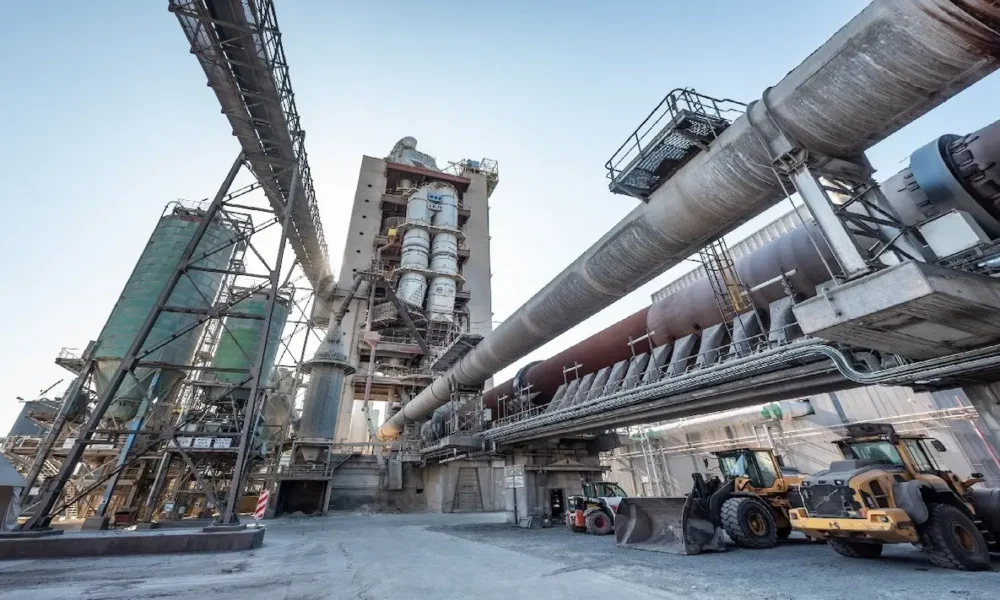
A cement kiln built today will still be in operation in 2050. This sentence, almost discreet in a technical document, reveals the nature of the choice facing Tunisian industrial leaders.
Every major investment undertaken in 2026 is a bet on the price of carbon in 2040. Carbon is no longer a matter for engineers or communications: it becomes a line item on the balance sheet, a condition for market access and soon a credit criterion.
The global context leaves little room. Current policies lead to warming of 2.4 to 2.8 °C, while global emissions are expected to fall by 43% by 2030 and by 60% by 2035 relative to 2019 in order to aim for neutrality by 2050.
Tunisia has responded with its NDC 3.0, which covers the period 2026 to 2035 and aims for a 62% reduction in the carbon intensity of the economy, measured as emissions per unit of GDP, relative to 2010. An unconditional trajectory relies on national resources, while a conditional trajectory depends on international support.
These benchmarks are drawn from the “Guide to Decarbonization for Tunisian Businesses,” published by the United Nations Development Programme (UNDP) within the CBIT project to strengthen capacities and governance of the transparency framework in Tunisia.
The document quantifies the effort: nearly $25 billion for mitigation between 2026 and 2035, of which $21.7 billion goes to energy and $484 million to industrial processes, with an additional $1.25 billion for capacity building and technology transfer.
11%: a modest share, an achievable effort
Of the 150 million tonnes of CO2e avoided cumulatively over the period, industry bears 16.5 million, about 11%. The number that matters is another: 94% of this contribution rests on energy efficiency and renewable energies, levers available today.
Systematic audits, program contracts, cogeneration, waste heat recovery, Organic Rankine Cycles, energy management according to ISO 50001, optimization of compressed air, steam, motors and cooling: these measures show returns on investment of two to five years. Photovoltaic solar, solar thermal and alternative fuels complete the system. The bulk of the effort therefore does not rely on any technological miracle.
Data, the new currency for access to financing