Vietnam and the four EFTA member states signed a trade agreement this Sunday, October 18, 2026, according to the Norwegian government. Its effects will depend on the products and the timeline for implementation.
Which countries are involved?
EFTA, also abbreviated as EFTA in English, brings together Switzerland, Norway, Iceland, and Liechtenstein. It is distinct from the European Union. These four states negotiate trade agreements with external partners as a bloc. The agreement signed with Vietnam therefore concerns their relations with this Asian country: it does not constitute a new agreement between Vietnam and the European Union.
Signature and entry into force: two separate steps
The conclusion of negotiations had been announced by EFTA on July 2, 2026.
In the procedure presented by EFTA, signature is followed by the necessary ratifications before entry into force. For businesses, it is this implementation that allows them to benefit from the new commitments.
The Norwegian communiqué of October 18 does not specify a date for entry into force. The timelines announced for removing duties begin at entry into force, not at signing.
Tariff reductions that vary by product
The Norwegian government provides a concrete example: about half of Norwegian exports to Vietnam will be tariff-free from the moment of entry into force. That proportion is expected to exceed 98% within seven years. These figures concern Norway’s sales to Vietnam, not the entire AELE trade.
Oslo also announces the elimination of duties on Norwegian salmon from entry into force, while the one on mackerel will be phased in over three years.
Thus, the scope of a concession is read product by product and within a specific commercial direction. EFTA’s general framework provides for transition periods depending on the agreements. It also notes that its members do not have a common agricultural policy: basic agricultural products are usually the subject of bilateral arrangements with each state. A percentage announced for the exports of one country to Vietnam cannot therefore be extended to those of the other EFTA members.
Why the origin of goods matters
To benefit from a preferential tariff, a product must meet the origin rules laid out by the applicable agreement. These rules determine the country in which it is considered produced or manufactured. EFTA notes that an accepted origin proof must also accompany the request for preferential treatment.
Thus one must distinguish the country of shipment from the product’s origin. Merely passing a good through a partner country is not enough to confer this origin. For a company using components from multiple countries, the question is whether its production meets the conditions set for the product in question.
Concretely, the tariff advantage depends on both the product, its manufacturing, and the available supporting documents. The mere existence of an agreement between two trading partners does not automatically render all their goods eligible for a reduced duty.
A text that goes beyond the trade of goods
According to EFTA, the negotiated text also covers services, investments, public procurement, intellectual property, small businesses, and sustainable development. It also includes sanitary and phytosanitary measures as well as technical barriers to trade. The opening of trade thus covers several types of rules, whose commitments must be read in their respective domains.
Trade facilitation aims in particular to simplify formalities and speed up customs clearance. It does not mean that sanitary or technical requirements disappear. For an exporter, complying with the destination market’s standards remains a separate issue from the applicable customs duty.
Trade already existed at a substantial scale: EFTA estimates goods trade with Vietnam at 4.8 billion euros in 2025, noting that Swiss data exclude gold. Among the main flows are machines, pharmaceutical products, and fish on the EFTA side, as well as machines, footwear, and clothing on the Vietnamese side.
A point of comparison for Tunisia?
Tunisia already has its own agreement with EFTA. Signed on December 17, 2004, it entered into force progressively in 2005 and 2006, depending on the states involved. This framework covers industrial products, fishing products, and transformed agricultural products.
Tunisian textiles: already feeling pressure
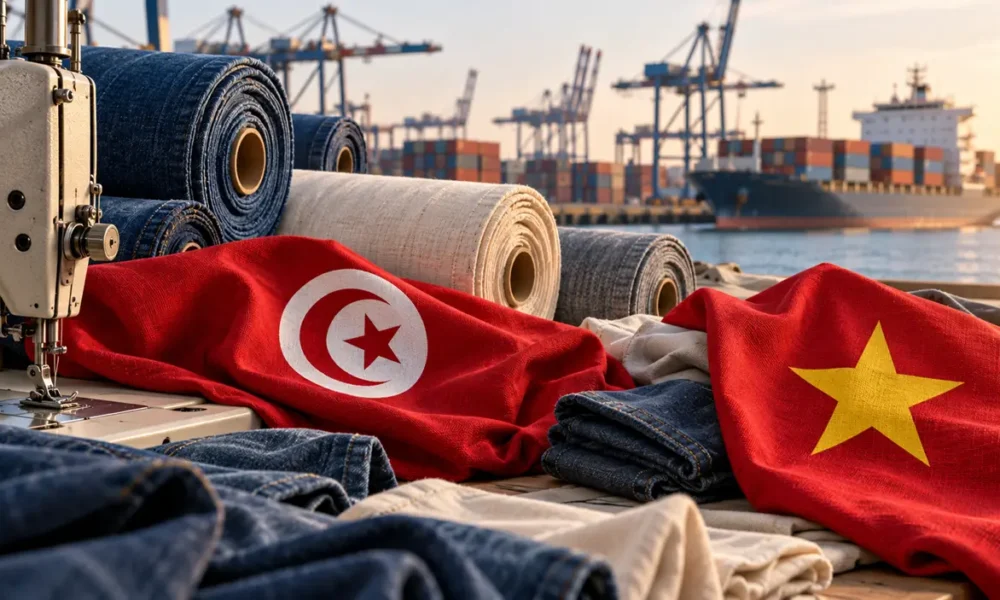
The Tunisian textile sector approaches this new stage in a fragile situation. According to the National Institute of Statistics, exports of the group “textile, clothing, and leather” decreased by 4.7% in the first nine months of 2026 compared with the same period in 2025. This refers to their value in current dinars, not volumes sold. This decline predates the signing of the agreement with Vietnam.
European data also allow comparing the two suppliers on a common market: EU clothing purchases in 2025.
Clothing from Tunisia
€2,158 million
-3.5% compared with 2024.
2.3% of EU clothing purchases from outside the Union.
Clothing from Vietnam
€4,735 million
+11.2% compared with 2024.
5.0% of EU clothing purchases from outside the Union.
These opposing trajectories document a decline in Tunisian sales and a rise in Vietnamese sales on the European market. They do not prove that orders lost by one Tunisian factory have been recovered by a Vietnamese factory: statistics cover product groups, not company contracts.
How competition can affect Tunisian factories
The economic risk primarily concerns prices, margins, and orders. For garments of comparable quality, a buyer looks at the price paid once the product is delivered, including duties and transport. If a competitor’s offer becomes more advantageous, they may request a price reduction from their Tunisian supplier or allocate their orders differently.
A factory can thus keep a client while earning less on each piece. If this pressure lasts, it can reduce its ability to invest; a sustained decline in orders can also affect activity and employment. It is a risk mechanism, whose magnitude depends on the products, contracts, and companies involved.
The social stakes are significant: in its September 2026 sector brief, the Agency for the Promotion of Industry and Innovation records 143,617 jobs in textile-clothing companies employing at least ten people, including 130,988 in fully exporting enterprises. These figures measure the weight of export-oriented employment; they do not constitute an estimate of jobs threatened by the agreement.
EFTA and the European Union: two files to distinguish
In the European Union, Vietnam already benefits from an agreement that entered into force on August 1, 2020. It provides for a gradual removal of duties, with transitions of up to seven years for certain clothing and footwear, subject to origin rules. Preferential trade competition thus already exists. The agreement signed with EFTA does not modify the tariffs applied by France, Italy, or Germany.
In EFTA, situations differ. Switzerland and Liechtenstein have eliminated industrial tariffs, including for clothing, since January 1, 2024, regardless of origin. Iceland had also removed its clothing duties before this new agreement. On these three markets, the signature therefore does not create a new general decrease in clothing duties.
In Norway, Vietnam is among the beneficiaries of the ordinary preferential regime granted to developing countries. This regime retains exceptions for certain textiles. It is on products that remain taxed that the new agreement could improve Vietnamese access after its entry into force and according to the concessions provided and the origin rules applicable. No quantified effect on Tunisian sales can be inferred at this stage.
How Tunisia can defend its orders
A commercial tool already exists on the European side. Derogations explained by the EU delegation in Tunisia allow, for certain garments and within annual quotas, that fabric cutting and sewing suffice to confer Tunisian origin. Planned for five years, with retroactive effect to January 22, 2025, they broaden fabric sourcing possibilities while enabling preferential access.
These quotas do not cap all Tunisian clothing exports to the EU. Products that comply with ordinary origin rules retain duty-free access, regardless of the quantities set for these derogations.
Industrially, a possible response is to pair a competitive price with reliable lead times, consistent quality, and the ability to deliver small batches or rapid replenishments. Proximity to Europe can support this offering if production and logistics keep up. Facing suppliers who also enjoy trade preferences, Tunisia must be able to explain to the buyer what it concretely gains by keeping orders in the country.
The signing of the EFTA–Vietnam agreement does not by itself imply a loss of market share.