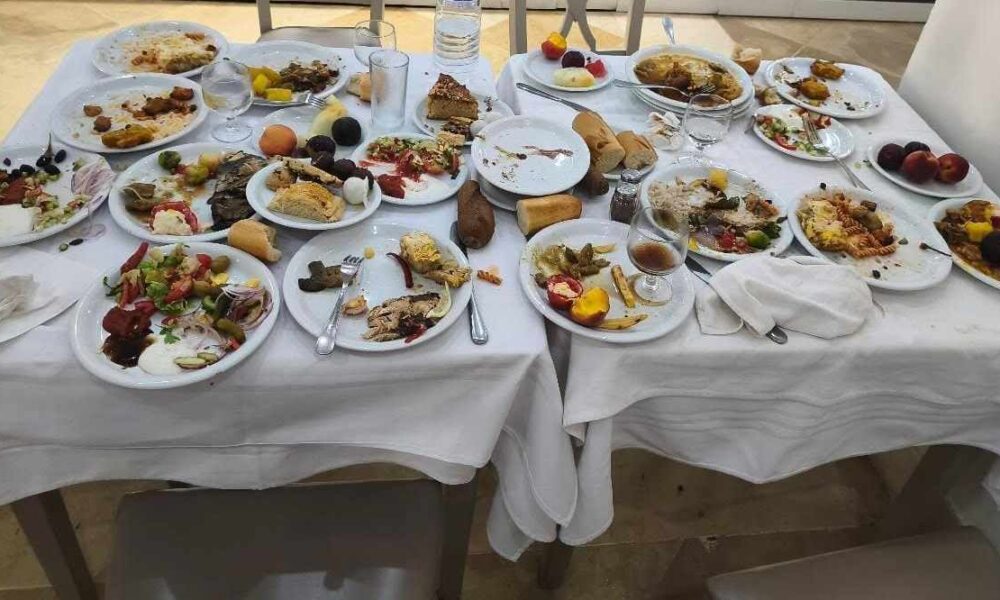
Count them. On the white tablecloth of a Tunisian hotel, barely touched salads, pasta, couscous, abandoned bread, untouched fruit, desserts left almost entirely and several dishes of which only a small portion has been consumed.
In total, the photograph shows 23 plates and serving dishes for only two people.
The scene could have been quickly attributed to passing tourists. The checks conducted by the TN journalist, however, indicate that the table was occupied by two Tunisian customers.
Their nationality matters less than the behavior revealed by this image. When a buffet gives the impression that everything has already been paid, some customers end up confusing the possibility of refilling with the obligation to taste everything.
The Image in One Figure
Twenty-three plates and serving dishes for two diners, many of which still contain barely touched food.
A photograph obviously cannot weigh the leftovers precisely or determine what was subsequently discarded, recovered or sorted. It does, however, document an unusual accumulation of food and raises a question that goes far beyond the case of these two customers.
The Arithmetic of “I Paid”
The all-you-can-eat buffet and the all-inclusive formula sometimes rest in the guest’s mind on an almost athletic logic: since the meal is included in the price of the stay, it should be “made worthwhile.”
Taking food becomes a performance. The table turns into a hunting ground, and leaving after having consumed two reasonable dishes may give the impression of not getting your money’s worth.
We no longer fill our plate because we are hungry, but because we can come back as many times as we want. The eyes become bigger than the stomach, and the small, personal calculation ends up producing a collective loss.
Yet paying for unlimited access to the buffet does not mean you have bought the right to condemn everything you place on a plate to the trash.
A Global Phenomenon, Not a Tunisian Exception
Before turning this photograph into a Tunisian-exclusive lesson, it is necessary to place the phenomenon in its global context.
According to the United Nations Environment Programme’s 2024 Food Waste Index, about 1.05 billion tonnes of food were wasted in 2022 at the household, hospitality and commerce levels.
This amount represents nearly one-fifth of all food available to consumers. Households account for 60% of the total, while the equivalent of more than a billion meals is tossed away daily worldwide.
Food losses and waste cost the global economy nearly $1 trillion per year and generate about 8 to 10% of global greenhouse gas emissions.
The Waste Worldwide
1.05 billion tonnes of food wasted in 2022.
Nearly 19% of the food available to consumers ends up in the waste.
Waste, therefore, is not only a behavior of wealthy countries. Averages observed in high- and middle-income countries differ only slightly. Income alone does not explain this phenomenon: consumption habits, food preservation, and the organization of food service also play a role.
Waste Has Already Been Measured in Tunisian Hotels
The photograph does not necessarily show an isolated anomaly. According to a 2018 study by the National Institute for Consumption, cited in several Tunisian publications, hotels would produce an average of 0.7 kilograms of food waste per day per guest.
Nearly 40% of this waste would consist of bread. These estimates are old, and Tunisia would need updated, regular, and comparable measurements across establishments. They nevertheless show that the problem lies precisely at the intersection of displayed abundance, the all-you-can-eat buffet, and amounts taken that do not match actual appetite.
The lack of recent data is, moreover, a major weakness. Without regular weighing and national indicators, it is impossible to know whether waste is increasing, decreasing, or moving from one type of establishment to another.
Tunisia Throws Away Its Bread First
The Tunisian variant of waste has a particularly painful signature: bread.
According to data from the National Institute for Consumption released in 2026, nearly 900,000 units of bread would be discarded each day in Tunisia, for a loss estimated at about 100 million dinars per year.
The paradox is brutal. The country mobilizes subsidies and foreign currency to ensure its cereal supply, then allows part of the produced bread to end up in the trash of households, restaurants, and hotels.
The Tunisian paradox
Tunisia dedicates public resources and foreign currency to its cereal supply, while bread waste would amount to nearly 100 million dinars per year.
On the photographed table, bread is not absent. Several pieces and small loaves appear to have been taken and then abandoned, as if merely being available stripped them of any value.
Does the Buffet Itself Encourage Excess?
The customers’ responsibility is obvious, but it is not enough to explain the phenomenon.
The buffet is designed as a staging of abundance. It lines up large quantities, multiplies choices, and implicitly pairs the establishment’s generosity with the volume of food presented.
The more immense the offer seems, the more the customer feels they must take advantage of everything. The format thus turns an ordinary dietary decision — choosing what one truly wants to eat — into a fear of missing an opportunity.
Waste then arises from a meeting of two logics: the customer’s desire to maximize their package and the establishment’s need to give a perpetual impression of abundance.
Recognizing this shared responsibility does not excuse individual behaviors. It simply helps avoid an overly simplistic analysis in which two diners bear the burden of a structural problem.
Elsewhere, Awareness Is Not Always Enough
Several countries have begun to move beyond mere moral campaigns.
In China, a 2021 anti-food-waste law allows restaurants to apply a contribution to customers leaving excessive amounts, provided that the rules are clearly posted. It also sanctions establishments that push consumers to order unduly.
In France, restaurants must allow customers who request it to take away unconsumed food. But all-you-can-eat offers are expressly excluded from this obligation: paying for access to a buffet does not mean acquiring everything on display.
These two examples show most of all that an anti-waste policy must differentiate between traditional dining and buffet service. The same rules cannot be applied mechanically to both models.
Who Should Lead the Response in Tunisia?
The answer should not come from a single ministry, but the natural lead should be the Ministry of Tourism, through the Tunisian National Tourism Office.
The ONTT is tasked with developing the sector, regulating and supervising tourist activity. Reducing waste in hotels directly affects the quality of management of establishments, their costs, their image, and the sustainability of the Tunisian destination.
The ministry in charge of the Environment should ensure technical co-management, since the food scraps then become organic waste whose volume must be measured, treated and valorized.
The Ministry of Commerce and the National Institute for Consumption would play important roles in raising awareness among customers and protecting consumers. Their intervention would become essential if Tunisia ever considered regulating a financial contribution for clearly excessive leftovers.
Such a contribution could not be improvised freely by each establishment. It should rest on transparent criteria, be announced before the meal, and not become a way to quietly add charges to the bill.
The Right Institutional Leadership
Lead: Ministry of Tourism and ONTT, for rules applicable to hotel establishments.
Technical co-management: Ministry of Environment, for measuring and managing food waste.
Support: Ministry of Commerce and INC, for awareness, consumer information and any possible regulation of billing.
The Photograph Must Not Become a Tribunal
It would be easy to turn the two customers into symbols of everything that is wrong, to publicly humiliate them or to make their nationality the center of the story.
That would miss the real subject. The photograph is valuable because it makes visible a behavior that everyone has observed: overloaded plates, a few bites eaten, then another round at the buffet.
The two diners should remain anonymous, as should the establishment, unless there is a public-interest reason to identify them. The aim is not to scourge individuals, but to open a debate on collective rules.
This caution does not remove individual responsibility. Taking more than one can eat remains a choice. The buffet allows returning; it does not compel anyone to turn their table into an exhibit of abandoned dishes.
A National Strategy Before Fines
Before deciding whether leftovers should be charged for, Tunisia must begin by precisely measuring the phenomenon in hotels, updating available data and defining a common method.
Without a reliable indicator, a fine risks becoming a mere communication tool. With precise data, it could eventually be part of a broader policy combining prevention, accountability and real waste reduction.
The debate should therefore not be limited to a clash between punishment and awareness. It concerns the capacity of the state, professionals and consumers to assign economic and moral value to food that has become almost invisible amid abundance.
In One Word
Tunisia probably does not need to abolish buffets. It must instead change the implicit rule that accompanies them.
“All-you-can-eat” should mean that the guest may refill when still hungry, and not that they must accumulate plates to feel they have made their stay worthwhile.
This table of 23 plates may be just one scene among many. But it perfectly sums up the paradox: in a country that spends to produce, import and subsidize its food, the temporary abundance of a buffet can sometimes strip it of all value.
What to Remember
Paying for a buffet gives the right to refill. It does not give the moral right to fill 23 plates and abandon a large portion.