The child must fill in the missing quantities and propose several possible distributions.
Mathematically, the activity is relevant: it works on decomposing a number and searching for several solutions. But, before arriving at the calculation, the pupil must imagine how the CNP operates, a distribution center, successive deliveries, and a logistics table. On the last line, the seven-year-old child must propose the number of books for the 3rd and 4th deliveries!! It’s lunatic!
The second textbook shifts completely to a different universe.
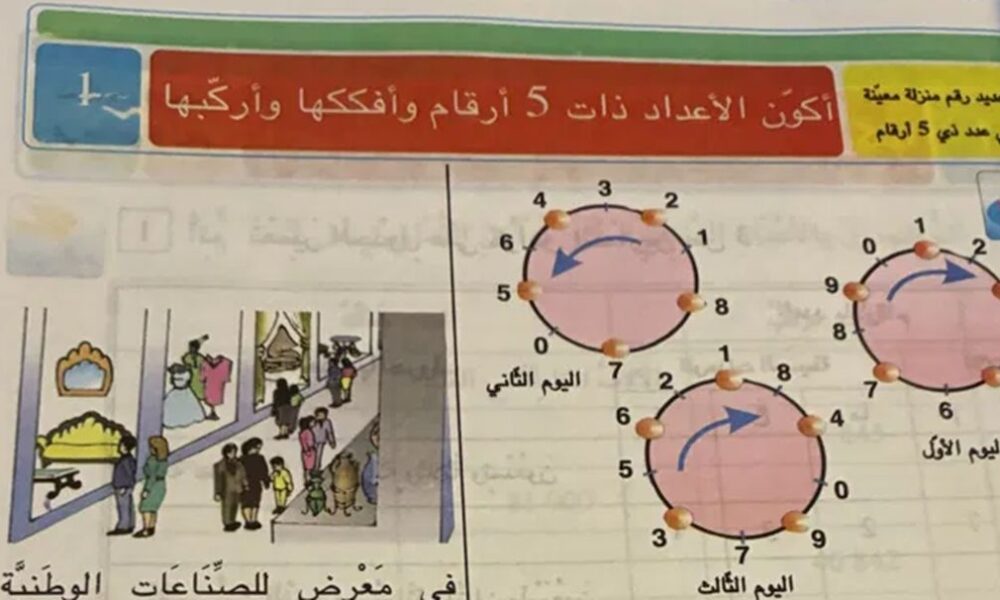
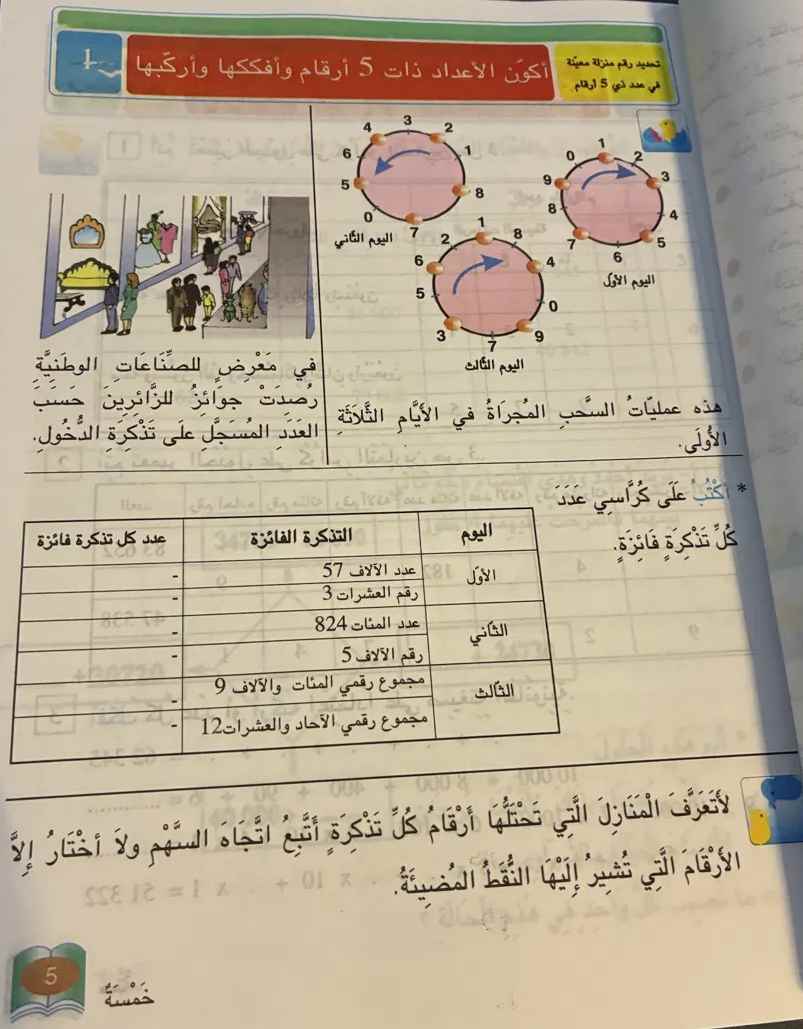
This time, the child finds themselves in a national industries fair where prizes are awarded to visitors according to the number written on their entry ticket.
Three drawing operations are represented by wheels bearing digits from 0 to 9, five illuminated points, and an arrow.
The announced objective, however, is much simpler: to form five-digit numbers, decompose them, and recombine them.
First day: one winning ticket or two winning tickets?
This is where one of the main ambiguities of the page appears.
For the first day, the table gives two conditions:
- the thousands number is 57;
- the tens digit is 3.
A student may reasonably wonder whether these are two clues allowing to find a single ticket, or two different winning tickets.
The answer is that these are indeed two distinct tickets. This information can be deduced from the structure of the table and the Arabic wording indicating the “number of each winning ticket,” but it is not explicitly stated at the start of the exercise.
First day: what to understand
The five selected digits are 1, 3, 5, 7, and 9. By following their order around the wheel, the ticket whose thousands part is 57 is 57 913. Another arrangement yields a ticket whose tens digit is 3: 79 135.
For an adult who has already understood the mechanism, the logic can be reconstructed.
For a child discovering this page, one must understand that the same wheel can be used to produce several numbers, that each line corresponds to a different ticket and that one must choose the correct starting point.
The essential rule comes after the problem
A presentation detail is particularly important: the instruction allowing one to understand the wheels appears at the very bottom of the page, after the illustration and after the table to complete.
It asks the child to follow the direction of the arrow and to keep only the numbers indicated by the illuminated points.
In other words, the student first encounters the device to decode, then discovers the rule that allows reading it.
Trying to coax an answer from a child before giving it can be pedagogically interesting when asking them to discover a mathematical property. Here, however, it is not about discovering a property of numbers: one must understand a graphic convention chosen by the authors of the manual.
“Thousands count” and “thousands digit”: a real mathematical notion
Yet, the core of the lesson includes an important distinction between:
عدد الآلاف : the number of thousands in the number
رقم الآلاف : the digit in the thousands place
In French, this is about distinguishing the number of thousands from the thousands digit.
In the number 57 913, for example :
- the number of thousands is 57;
- the thousands digit is 7.
This is a fundamental distinction in numeration. But, in the exercise, it is tested alongside several other skills that are not directly mathematical.
If the child makes a mistake, several explanations are possible:
- they did not understand “number of thousands”;
- they confused “number” and “digit”;
- they misread the arrow;
- they started at the wrong point on the wheel;
- they did not understand that two different tickets must be sought.
The teacher can therefore hardly know immediately whether the error comes from the mathematical notion itself or from the device used to present it.
When the context uses part of the child’s attention
Cognitive science research has long emphasized the limits of working memory. When a student discovers a notion, they can simultaneously process only a limited amount of information.
Part of the mental effort is useful: recognizing the positions of the digits, performing an addition, or understanding the value of a number.
Another part may come solely from the presentation: understanding a wheel, an arrow, institutional vocabulary or how a fictional scenario works.
This is what research on cognitive load particularly aims to distinguish: when too many elements have to be understood simultaneously, the available attention for the new notion can decrease.
This does not mean that a complex or contextualized exercise is bad. The essential question is when during learning it is proposed.
When mathematics also becomes a language exercise
The difficulty of these two pages is not only graphical. It is also linguistic.
The drawing exercise notably uses the phrasing:
« رُصِدَتْ جوائز للزائرين »
This is a correct formulation in Arabic, but relatively formal for a primary school child. A more direct expression could have conveyed the same information without adding linguistic difficulty.
In the other manual, the child encounters from the beginning :
« قرر المركز الوطني البيداغوجي تزويد أحد مراكز التوزيع… »
Namely: “The National Pedagogical Center has decided to supply one of the distribution centers…”
The vocabulary of institutional logistics thus becomes a preliminary step before calculation.
Yet a pupil can perfectly know how to perform the required operation and fail because they did not understand part of the statement. The final result then measures not only their mathematical competence.
A real-world situation for an adult is not necessarily concrete for a child
The authors clearly seek to place mathematics in real-life situations: distribution of textbooks, exhibition, visitors, tickets and prizes.
But a real-world situation in the adult world is not automatically familiar to a 9- or 10-year-old child.
A child can easily picture a class of 30 students, pencils distributed in several boxes, cards bearing numbers, books placed on shelves, or teams sharing objects.
The operation of a national distribution network for school textbooks or a reward system at an industrial fair is generally much less familiar to them.
Paradoxically, the context presented as “concrete” can thus become more abstract for the child than the number itself.
Why not start with mathematics itself?
The same learning could begin far more directly with five cards:
1
3
5
7
9
First instruction :
« Form a five-digit number whose thousands part is 57. »
Answer : 57 913.
Second instruction :
« Using the same digits, form a number whose tens digit is 3. »
Answer : 79 135.
The mathematical skill practiced remains the same. The difference is that the child’s attention focuses first directly on the positional value of the digits.
The drawing, the winning tickets, or a more complex situation could then be used to verify that the pupil knows how to reinvest the notion in a problem.
The final challenge is nonetheless interesting
Not everything should be rejected in the winning-ticket exercise.
For the third day, for example, one of the conditions requires that the sum of the units digit and the tens digit equals 12.
This information, taken in isolation, allows several possibilities. The child must therefore cross-check it with the digits selected on the wheel and their order to determine the ticket sought.
This time it is a genuine reasoning exercise: several constraints must be combined.
The problem is therefore not the exercise itself, but its place in the progression. It could constitute an excellent challenge after the student has understood numeration and how the device works.
A problem-situation should not obligate the child to guess the rules
Problem-based situations have their rightful place in teaching mathematics. They allow moving beyond mechanical application of an operation and require the pupil to analyze information, choose a strategy, and verify their result.
But there is a difference between finding a mathematical solution and figuring out what the authors of the textbook mean.
Finding several ways to decompose 35 000 develops reasoning.
Understanding why the CNP supplies a distribution center in multiple deliveries is not indispensable for understanding 35 000.
Similarly, determining the tens digit is part of numeration. Understanding a fictional wheel with illuminated points constitutes an additional difficulty created by the teaching aid.
Five simple changes could clarify the exercise
It would not be necessary to remove the drawing game to make the page much more accessible.
- Present the rule for reading the wheels before the table, and not at the bottom of the page.
- Write explicitly: “Each day, two tickets are winning.”
- Give a fully worked example before asking the student to work alone.
- Explain first, with a simple number, the difference between thousands digit and number of thousands.
- Reserve the more complex constraints, such as the sum of two digits, for the end of the activity.
Interesting exercises, but too many layered difficulties?
The observed exercises are not absurd or mathematically incorrect. Several of them actually require genuine reasoning abilities: decomposing a number, distinguishing “digit” and “number,” comparing several possibilities, or combining constraints.
The question concerns more their pedagogical structure.
When the same activity simultaneously asks to discover a mathematical notion, understand unusual vocabulary, decode a graphic convention, and interpret a complex scenario, a child’s error becomes difficult to analyze.
They may then feel that mathematics is difficult, even though they may have perfectly understood the mathematical notion itself.
What to keep in mind
The two analyzed pages work on real mathematical skills and offer interesting reasoning exercises. But they sometimes combine, from the start of learning, a new notion, institutional vocabulary, a complex scenario, and graphic conventions. A clearer progression could consist of first understanding the notion, then applying it, and then using it in a more elaborate problem-situation.
The question remains open :
When a primary-school pupil opens their textbook to discover a new notion, should they start by solving the mathematical problem… or by understanding what the authors expect of them?