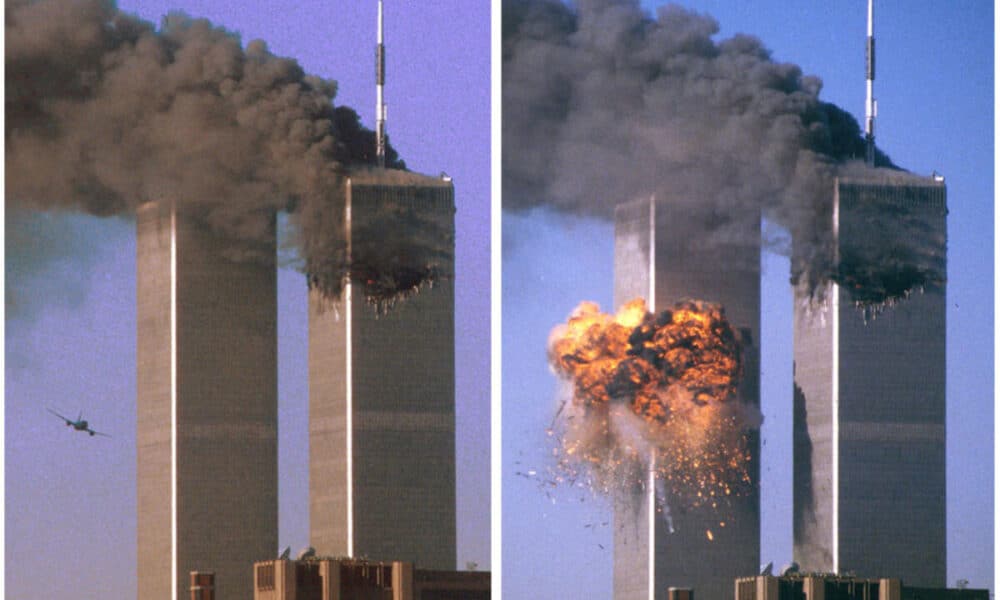
On the occasion of the 25th anniversary of the September 11 attacks, the CIA published 71 declassified documents from the daily intelligence briefings given to American presidents Bill Clinton and George W. Bush and related to the September 11, 2001 attacks, presenting this publication as the most important of its kind to date.
These documents, posted on the agency’s website, cover the period from February 13, 1998 to September 12, 2001 and trace the monitoring by intelligence services of Osama bin Laden and Al-Qaeda, the terrorist group he led and which carried out the attacks, in the years preceding September 11.
Nearly 3,000 people were killed when Al-Qaeda members hijacked planes and slammed them into the World Trade Center in New York, the Pentagon, and a field near Shanksville, Pennsylvania, in 2001.
The oldest memo, titled “Terrorists Seeking WMD Capability” (“Terrorists seeking to equip themselves with weapons of mass destruction”), is dated February 13, 1998.
Among the published documents include notably “Reports That Bin Ladin is Planning Attacks Inside the US” (“Information indicating that Ben Ladin is preparing attacks in the United States”), dated July 3, 1998, “Bin Ladin’s Location and Intentions” (“Bin Ladin’s Location and Intentions”), dated September 10, 1998, and “Bin Ladin Preparing To Hijack US Aircraft and Other Attacks” (“Bin Ladin Preparing To Hijack US Aircraft and Other Attacks”), dated December 4, 1998.
A memo dated September 10, 1998, titled “Bin Ladin’s Location and Intentions,” indicates that Bin Ladin had told his close associates that his preferred option was to strike the United States “on their own soil in Washington,” adding that the same network responsible for the embassy bombings of American embassies in East Africa in 1998 “could fly a plane loaded with explosives toward an American city.”
A memo dated February 13, 1998, titled “Terrorists Seeking WMD Capability,” indicates that Bin Ladin had “agreed to procure chemical, biological and nuclear substances not specified on open markets,” adding that his supporters had previously sought equipment intended, according to reports, to target American military installations in Saudi Arabia.
A memo dated December 4, 1998, titled “Bin Ladin Preparing To Hijack US Aircraft and Other Attacks,” indicates that information suggested preparations by Bin Ladin and his allies for attacks in the United States, notably a hijacking aimed at obtaining the release of prominent al-Qaeda members.
It also cites a source indicating that a cell of air pirates had escaped security checks during a “recent exercise” at an unidentified New York airport.
“The CIA’s most important publication of analyses”
A memo dated December 23, 1999, titled “Terrorism: Diverse Groups Planning Anti-US Attacks,” indicates that the CIA was monitoring threats worldwide, Bin Ladin’s network and the groups allied with him constituting the main source of concern.
What else?
Intelligence reports transmitted to the White House indicated that the Taliban would not expel Bin Ladin.
“The Taliban are unlikely to give up Bin Ladin in exchange for less than full diplomatic recognition and substantial reconstruction aid,” says an intelligence note dated March 26, 2001.
On May 2, 2011, American special forces killed Bin Ladin in Abbottabad, Pakistan, nearly ten years after the 2001 attacks.
President George W. Bush had taken office in January 2001, several months before the September attacks, succeeding Bill Clinton, who had served two terms in the White House.
The CIA director, John Ratcliffe, described these documents as “the most important CIA analysis publication ever produced on 9/11.”
“Americans can now see for themselves the intelligence that preceded that tragic day for our Nation,” Ratcliffe wrote on X.
After the attacks, the United States created a 9/11 Commission, which concluded that systemic failures in communication, imagination, and management within the American government allowed the 9/11 attacks to occur.
The 9/11 attacks served as a catalyst for the “war on terror” waged by the United States, which notably included the invasions of Iraq and Afghanistan and led to the deaths of approximately 4.5 to 4.7 million people, according to the Costs of War project.