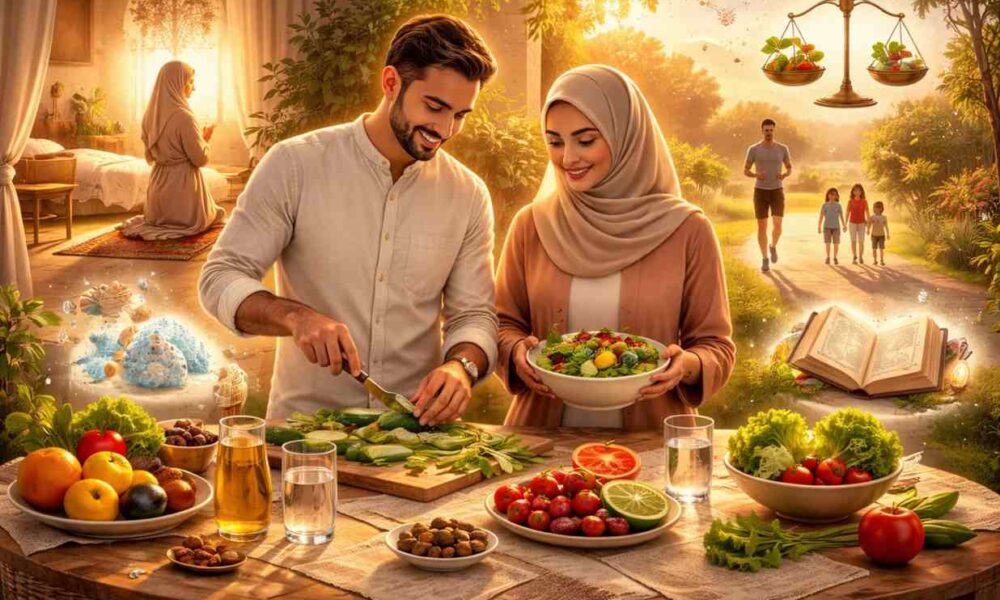
The Qur’an does not treat food as a mere matter of hunger. It treats it as a blessing, as an ethics, and as a discipline. It invites eating what is lawful and good, avoiding excess, avoiding waste, and linking eating to a form of consciousness.
On several of these points, modern science speaks with surprisingly close terms: a healthy diet rests on quality, diversity, moderation, and the safety of foods.
1. Eating what is lawful and good
سورة البقرة – الآية 168
يَا أَيُّهَا النَّاسُ كُلُوا مِمَّا فِي الْأَرْضِ حَلَالًا طَيِّبًا وَلَا تَتَّبِعُوا خُطُوَاتِ الشَّيْطَانِ ۚ إِنَّهُ لَكُمْ عَدُوٌّ مُّبِينٌ
« O people! Eat from what is on earth that is lawful and wholesome. »
The first Qur’anic principle is therefore not quantity, but the moral and symbolic quality of what one consumes. The word ṭayyib refers to what is good, healthy, clean, and suitable.
For its part, the WHO reminds us that a healthy diet rests on varied foods, little or no processed foods, and low levels of free sugars, sodium, and unhealthy fats.
2. Eating with gratitude, not in automatism
سورة النحل – الآية 114
فَكُلُوا مِمَّا رَزَقَكُمُ اللَّهُ حَلَالًا طَيِّبًا وَاشْكُرُوا نِعْمَتَ اللَّهِ إِن كُنتُمْ إِيَّاهُ تَعْبُدُونَ
« So eat of what Allah has provided you that is lawful and good! And be grateful for the blessings of Allah. »
The Qur’an does not separate the act of eating from the inner state. It places food within a logic of gratitude, which breaks with mechanical, impulsive, or ungrateful consumption.
Science, for its part, stresses that eating behaviors and preferences formed early in life often take hold for a long time. In other words, the way we eat matters almost as much as what we eat.
3. Eating and drinking, but without excess
سورة الأعراف – الآية 31
يَا بَنِي آدَمَ خُذُوا زِينَتَكُمْ عِندَ كُلِّ مَسْجِدٍ وَكُلُوا وَاشْرَبُوا وَلَا تُسْرِفُوا ۚ إِنَّهُ لَا يُحِبُّ الْمُسْرِفِينَ
« Eat and drink, but do not commit excess. God does not love the transgressors. »
This is perhaps the most direct verse on how to eat. The Qur’an does not forbid eating or drinking. It sets a boundary: do not fall into excess.
The WHO likewise places moderation among the four central principles of a healthy diet. It particularly recommends limiting free sugars to less than 10% of total energy intake, salt to less than 5 g per day for adults, and reducing unhealthy fats.
4. Not turning religion into unnecessary deprivation
سورة المائدة – الآيتان 87-88
يَا أَيُّهَا الَّذِينَ آمَنُوا لَا تُحَرِّمُوا طَيِّبَاتِ مَا أَحَلَّ اللَّهُ لَكُمْ وَلَا تَعْتَدُوا ۚ إِنَّ اللَّهَ لَا يُحِبُّ الْمُعْتَدِينَ
وَكُلُوا مِمَّا رَزَقَكُمُ اللَّهُ حَلَالًا طَيِّبًا ۚ وَاتَّقُوا اللَّهَ الَّذِي أَنتُم بِهِ مُؤْمِنُونَ
« O believers! Do not declare the good things that Allah has made lawful to be forbidden. And do not transgress. »
« And eat of what Allah has provided you that is lawful and good. »
This passage recalls a fundamental point: the Qur’anic balance is neither overconsumption nor forced asceticism. It is not about harming oneself in the name of piety, nor arbitrarily forbidding what God has permitted.
Modern science comes to a related idea when it explains that a healthy diet may take several forms, but it must always remain adequate, balanced, moderate, and diverse. Health does not rest on brutal deprivation, but on appropriateness.
5. Eating what the earth gives, without wasting
سورة الأنعام – الآية 141
كُلُوا مِن ثَمَرِهِ إِذَا أَثْمَرَ وَآتُوا حَقَّهُ يَوْمَ حَصَادِهِ وَلَا تُسْرِفُوا ۚ إِنَّهُ لَا يُحِبُّ الْمُسْرِفِينَ
« Eat of its fruits when it bears fruit… and waste not, for He does not love the wasteful. »
The Qur’an ties together eating, nature, and responsibility here. We may enjoy the fruits of the earth, but not with a mindset of waste. On this point too, modern reminders are stringent: the WHO recommends at least 400 grams of fruits and vegetables per day for people over 10, while the United Nations Environment Programme notes that roughly 19% of food available for sale, in catering and households, is wasted.
6. Eating well and acting rightly go together
سورة المؤمنون – الآية 51
يَا أَيُّهَا الرُّسُلُ كُلُوا مِنَ الطَّيِّبَاتِ وَاعْمَلُوا صَالِحًا ۖ إِنِّي بِمَا تَعْمَلُونَ عَلِيمٌ
« O Messengers! Eat of what is lawful and good and do good deeds. Verily, I am aware of what you do. »
The verse directly links healthy food and righteous action. As if eating were not only a matter of the stomach, but also of inner coherence. Science does not frame this in spiritual terms, but it confirms that a poor diet is a major risk factor for disease and disability, while a healthy diet helps prevent malnutrition and several non‑communicable diseases, including diabetes, cardiovascular diseases, and some cancers.
7. Enjoying the good things, without crossing the limits
سورة طه – الآية 81
كُلُوا مِن طَيِّبَاتِ مَا رَزَقْنَاكُمْ وَلَا تَطْغَوْا فِيهِ فَيَحِلَّ عَلَيْكُمْ غَضَبِي
« Eat of the good things We have provided for you, and do not transgress therein, lest My wrath should come upon you. »
Here again, the Qur’anic line is clear: enjoyment, yes; overflow, no. Excess, extravagance, the impulse for “more and more” are presented as distortions.
Public health likewise describes contemporary eating disorders as linked to the rise of highly processed products, too high in salt, sugars, and unhealthy fats, as well as to insufficient consumption of fruits, vegetables, and fiber.
8. Forbidden foods: a logic of protection
سورة البقرة – الآية 173
إِنَّمَا حَرَّمَ عَلَيْكُمُ الْمَيْتَةَ وَالدَّمَ وَلَحْمَ الْخِنْزِيرِ وَمَا أُهِلَّ بِهِ لِغَيْرِ اللَّهِ ۖ فَمَنِ اضْطُرَّ غَيْرَ بَاغٍ وَلَا عَادٍ فَلَا إِثْمَ عَلَيْهِ ۚ إِنَّ اللَّهَ غَفُورٌ رَّحِيمٌ
Meaning translation :
« He has only forbidden to you dead meat, blood, the flesh of swine, and that which has been dedicated to other than God. But whoever is compelled by necessity, without desire or transgression, there is no sin on him. »
The Qur’an thus frames certain foods not in a logic of arbitrary restriction, but in a logic of protection and necessity. The verse also introduces a crucial notion: in a time of constraint, the prohibition can be lifted, showing that the preservation of life takes precedence.
From the perspective of modern science, even if it does not speak in terms of licit or illicit, it emphasizes similar principles: certain foods or eating practices carry real health risks when improperly prepared or consumed without precaution (contamination, parasites, intoxication). Medicine also stresses avoiding harmful substances and favoring safe, controlled eating. In other words, behind these prohibitions lies a shared core idea: protecting the body and preventing harm, while allowing for necessity in times of constraint.
Thus, essentially, the Qur’an outlines a true ethics of the plate. It invites eating what is lawful and good, drinking without excess, not turning faith into absurd deprivation, avoiding waste, and making nourishment an act tied to gratitude and responsibility.
Modern science does not speak the language of revelation, but it widely confirms the benefits of a diet based on quality, measured intake, diversity, and the limitation of excesses.