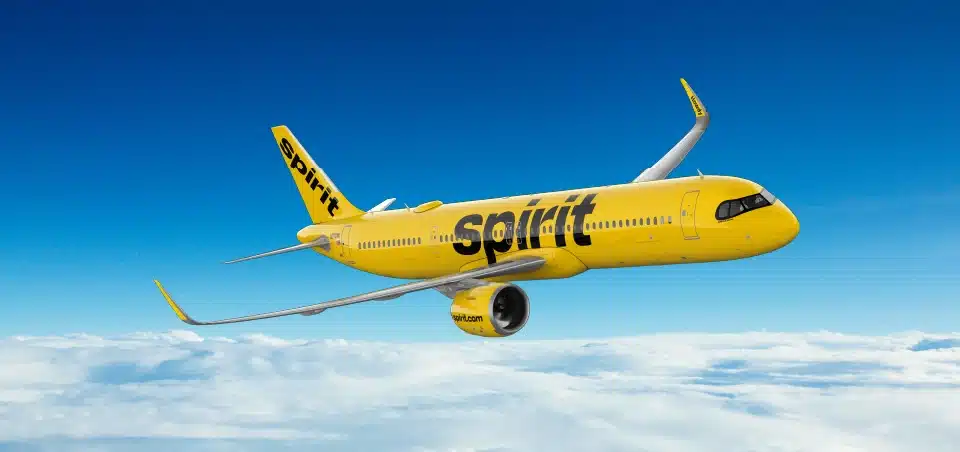
The shock extends far beyond a single airline. The announcement of the immediate halt of operations for Spirit Airlines triggered a real state of alert in the American aviation sector, following the failure of last-minute negotiations between management, creditors and the federal administration.
The company confirmed on Friday evening the cancellation of all of its flights and the launch of a gradual liquidation process, after several months of restructuring attempts following a second bankruptcy filing in less than a year.
In a statement, Spirit Airlines acknowledged that the recent surge in oil prices, combined with other economic pressures, had seriously deteriorated its financial outlook. Lacking additional funding, management says it had “no other choice but to undertake this liquidation,” while promising to reimburse passengers’ tickets.
Immediate mobilization of competing airlines
The domino effect was immediate. Several major American airlines, including American Airlines, United Airlines, Southwest Airlines and JetBlue Airways, quickly announced measures to absorb affected passengers.
Preferential fare offers were put in place, while additional flights were scheduled on Spirit’s busiest routes. Some airlines also activated procedures to repatriate stranded crew members and plan to recruit some of them.
The bankruptcy directly affects the workforce. Around 7,500 employees were still in positions at the end of last year, although the overall impact could involve up to 17,000 jobs according to estimates.
Labor unions did not hesitate to react. The pilots’ union condemned a failure whose cost will be borne by workers and their families, not by the boards of directors.
A political setback for Donald Trump
Spirit Airlines’ collapse also constitutes a setback for President Donald Trump, whose administration had attempted to rescue the company.
A rescue plan of about $500 million was being studied, in the form of convertible bonds that could give the state up to 90% of the equity. But some creditors rejected this solution, sealing the company’s fate.
Transportation Secretary, Sean Duffy, confirmed that passengers would be fully reimbursed, while acknowledging that the final decision rested with the creditors.
Fuel, an accelerator of an old crisis
While the rise in jet fuel prices, amid geopolitical tensions in the Middle East, played a decisive role, it is not the sole culprit.
Analysts estimate Spirit Airlines was already fragile. Since 2020, the airline has accumulated more than $2.5 billion in losses. By 2025, its debt stood at $8.1 billion, for assets estimated at $8.6 billion.
The low-cost business model, once a growth engine, has become harder to sustain in the face of rising costs, competitive pressure and a stalemate over merger plans.
According to aviation expert Richard Aboulafia, the rise in fuel prices has only accelerated an inevitable collapse. An assessment shared by other specialists, who describe a model that has become too fragile in a more unstable environment.
A shockwave for the aviation market
Founded in 1992, Spirit Airlines was one of the pioneers of low-cost travel in the United States. It carried about 28 million passengers between February 2025 and January 2026, making it the ninth U.S. airline.
Its disappearance could have a direct impact on prices. By boosting competition, Spirit contributed to keeping fares low on many routes. Its withdrawal therefore risks pushing ticket prices higher, in a context already marked by rising costs.
Beyond Spirit’s case, the entire industry is now watching the situation closely. The combination of expensive fuel, thin margins and a pressured business model could weaken other players.
The American aviation sector is not collapsing. But with Spirit Airlines’ collapse, it has lost one of its price buffers—and perhaps a warning signal for the future.