The violence that accompanies the majority of France’s major sporting celebrations is not due to chance nor to a single explanation. It reveals an accumulation of social, economic, political, media, and identity tensions.
For Tunisians living in France, the subject is sensitive: they are not responsible for these outbursts, but they can suffer indirect effects in a climate where immigration, security, Islam, the Maghreb and public order are often intertwined.
It is important to recall a fact rarely highlighted: the two matches between Tunisia and Brazil played in France did not give rise to scenes of violence. These encounters were experienced as genuine popular, familial celebrations, largely peaceful, with a relaxed atmosphere even in the security apparatus, where the French CRS riot police themselves appeared less tense than at other large gatherings.
This contrast is important for the subject of this article: it shows that the presence of a Tunisian crowd does not mechanically lead to disorder.
The problem is therefore not an origin, a nationality or a culture, but the combination of a context, an event, an organizing framework, a violent minority and a political climate that sometimes too quickly turns localized facts into a collective accusation.
A real phenomenon, but one not to generalize
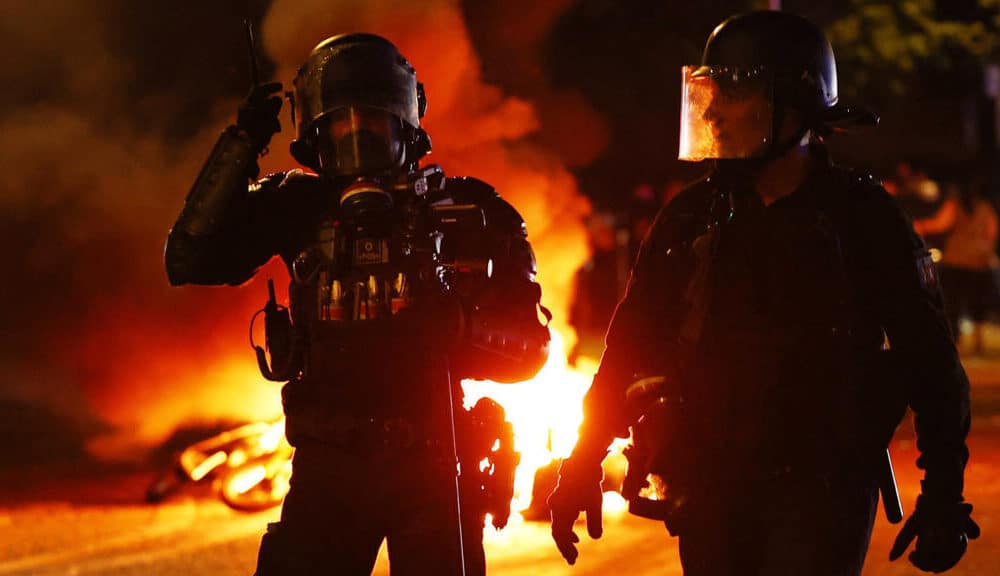
Each big football night in France now seems to carry a double image. On one side, thousands of happy supporters, families, youths, groups of friends, entire neighborhoods celebrating a victory. On the other, scenes of shattered shop windows, burned cars, mortar fire, looting and clashes with the police.
After the PSG celebrations, the tally reported by several international media was heavy: hundreds of arrests, dozens of police and gendarmes injured, shops damaged and an exceptional security mobilization. The year before, the festivities had already been marked by deaths, hundreds of arrests and nearly two hundred injuries.
But it must be said clearly: not all sporting celebrations turn into riots. And not all supporters are, of course, vandals. The majority celebrate, sing, film, share and go home. The problem comes from a minority that transforms a festive gathering into a confrontation, looting or a challenge.
Thus the issue is not to tarnish football or its supporters. It is to understand why, in France, some major moments of collective celebration become so quickly inflammable.
Football is not the cause, but the trigger
Football does not explain everything. It provides mainly the moment, the backdrop and the pretext.
A historic victory, a European final, a title anticipated for years or a match with very high emotional charge creates an exceptional concentration of people in public space. To this are added alcohol, the night, crowded transports, smoke bombs or mortars, the massive presence of security forces, social networks and the group effect.
This cocktail can trigger a rapid shift: a celebration becomes a face-off, then urban disorder. The first incidents attract cameras, phones, onlookers, sometimes opportunists. Violence then becomes part of the spectacle.
So it is not sport itself that produces violence. It is the transformation of a massive popular gathering into a space of tension, without sufficient mediation, with groups ready to use that moment to show off, steal, provoke or confront.
Violence in several forms
To understand the phenomenon, one must distinguish several forms of violence.
First, festive violence: that of excess, alcohol, crowd movements, smoke bombs, fireworks and irresponsible behavior. It is often disorderly, loud, dangerous, but not always organized.
Then there is opportunistic violence: looting of shops, thefts, broken storefronts, burned scooters, items retrieved to be sold. This violence is not ideological. It is utilitarian. It takes advantage of chaos.
There is also anti-police violence: mortar fire, projectiles thrown, insults, filmed provocations. It stems from a conflicted relationship with authority, sometimes longstanding, sometimes ritualized.
Finally, there is symbolic violence: occupying public space, challenging the state, generating images, existing on social networks. For some youths, being seen running in front of the police or taking part in a chaos scene becomes a form of recognition, however absurd it may be.
These violences do not all arise from the same logic. Mixing them up makes understanding harder. Distinguishing them allows for a smarter response.
Sociological causes: young male youth, relegation and defiance of authority
Violence of this type is overwhelmingly carried by young men. This is a central element. Age, gender, group dynamics and the search for status play a major role.
In some urban areas, this dynamic is worsened by heavy social factors: youth unemployment, school dropout, precariousness, a sense of abandonment, a negative image of the neighborhood, frequent police control, low social mobility. Violence does not arise solely from an origin or a religion. It often arises from a place, from age, from a blocked horizon and a conflicted relationship with institutions.
This does not justify anything. Understanding is not excusing. But without this sociological lens, one only sees the images, never the ground that makes them possible.
France has an old problem of social separation between valued urban centers, popular peripheries, relegated suburbs, and degraded territories. When these spaces meet abruptly in the centers of major cities, during a highly publicized event, tension can explode.
Economic causes: frustration and opportunistic looting
The economic dimension is often underestimated. Much violence is not about a political message. It belongs to an economy of opportunity.
A broken storefront, a looted shop, a stolen scooter, cigarettes or bottles recovered: in a dense crowd, some see an opportunity to take. This does not mean poverty excuses theft. But it reminds us that part of urban disorder is linked to precarity, the informal economy and the perception of momentary impunity.
There is also a more diffuse frustration. In a highly consumerist society, where storefronts of luxury, brands and success are omnipresent, some youths at the social margins experience these spaces as exclusionary. The sports celebration then offers, for a few hours, access to a downtown area usually perceived as inaccessible.
Again, one must not romanticize. The looted shopkeeper is not responsible for social inequalities. But ignoring the link between economic frustration and opportunistic violence would be a mistake.
Social networks: when violence becomes content
Social networks have changed the nature of upheavals. Before, a scene of violence often remained local. Today, it is filmed, edited, shared, commented, and imitated.
TikTok, Snapchat, Telegram or X turn the street into a stage. A mortar shot, a car chase, a broken storefront or a police charge become content. For some groups, it is no longer just about taking part in a celebration or an confrontation. It is about producing an image of themselves: brave, dangerous, rebellious, spectacular.
This performance logic increases violence. It pushes to outdo others. It attracts youths who might not have attended without the promise of visibility.
Thus the smartphone is not merely a documentation tool. It sometimes becomes a motor for action.
Maintaining order: containing is not enough
France knows how to mobilize law enforcement in numbers. But the question is whether this mobilization is enough to prevent the tipping point.
French order maintenance often rests on a logic of strong intervention: secure, disperse, apprehend. This strategy can prevent a situation from becoming uncontrollable. But it does not always solve the upstream problem.
The less daily presence there is, less proximity policing, fewer mediators, less fine knowledge of neighborhoods and local dialogue, the more the encounter between youths and law enforcement occurs in a crisis situation. In these conditions, each face-to-face can become an escalation.
The real question is not only: how many officers to mobilize? It is also: how to organize the celebration? Where to channel crowds? How to reduce friction zones? How to control mortars? How to prevent violent groups from joining gathering sites? How to protect businesses without turning the city into a war zone?
A popular celebration is not managed by repression alone. It must be prepared.
The role of political discourse: giving meaning to the images
Politics does not merely comment on the violence. It gives it meaning.
For part of the right and the far-right, these scenes become the proof of an enveloping barbarism, judicial laxity, migration failure or governmental impotence. For part of the left, they reveal social neglect, discrimination, the failure of urban policy or the brutality of order maintenance. For the government, they often call for an authoritative discourse, arrests and firmness.
Each camp selects what confirms its framework. The same event thus becomes three different narratives: crisis of order, social crisis, or crisis of public authority.
The danger is there: the more political discourse simplifies, the less it helps to resolve. If everything is reduced to immigration, we forget social, economic and police causes. If everything is reduced to poverty, we forget personal responsibility and organized crime. If everything is reduced to the celebration, we deny the gravity of the damage.
CNews, BFMTV and the manufacture of national emotion
Continuous news channels play a central role. They do not create the violence. But they shape its perception.
CNews tends to quickly frame this type of event within a security narrative, sometimes identitarian: authority, immigration, barbarization, laxism, police prevented from acting. This framing answers part of the public, but it also hardens the reading of the facts. The violence becomes immediately the symptom of a national, even civilizational, crisis.
BFMTV works differently. Its logic is that of permanent live coverage: repeated images, alert banners, live reports, testimonies, political reactions. The commentary may be less ideological, but the visual effect is powerful. By repeatedly showing the same burned cars, the same broken storefronts, the same clashes, the viewer may feel that the whole country is burning, even if the violence remains localized.
In both cases, a violent minority ends up occupying the entire symbolic space. The peaceful majority disappears. The supporters who celebrated normally do not produce strong images. The families returning home do not produce breaking news.
The media problem is therefore not only what is shown. It is what is made invisible.
Islamophobia and Gaza: a more inflammable social climate
It would be misleading to say that Islamophobia or the Gaza war directly cause violence after sporting celebrations. No mechanical link can be established.
But it would be just as naïve to ignore their effect on the overall climate.
For several years, a portion of French Muslims or those of Maghrebi origin feel caught in a permanent suspicion: suspicion of anti-France sentiment, community suspicion, religious suspicion, security suspicion. The rise of anti-Muslim acts in France reinforces this sense of symbolic insecurity.
The Gaza war has intensified this tension. Many young people from Arab or Muslim families felt that their indignation was less audible, more quickly suspected, or more tightly framed than other forms of mobilization. In the preceding months, the perception of a French stance deemed too favorable to Israel fed this malaise, even though French diplomacy later hardened its stance toward the Israeli government and humanitarian restrictions in Gaza.
These elements do not explain looting or mortar fire. But they contribute to an atmosphere of distrust. A society already tense becomes more inflammable when certain groups feel poorly represented, poorly heard, or constantly pushed into a suspect identity.
We must be precise: Gaza, Islamophobia and the debate about Islam do not by themselves create festive violence. But they feed an emotional and political backdrop in which urban tensions take on an identity dimension more quickly.
France–Algeria, visas and Maghrebi tension
To this tension adds another factor: the crisis between France and Algeria.
Since 2025, relations between Paris and Algiers have sharply deteriorated: reciprocal expulsions of diplomats, tensions around consular passes, pushes back at borders, restrictions or pressures on certain travel regimes. Migration, security, and memory dossiers mix in a highly charged climate.
This crisis concerns Algerians first. Do not confuse Algerians, Tunisians, and Moroccans. Yet in the French public debate, nuance often disappears. The word “Maghreb” becomes a bloc. Tensions with Algiers can then symbolically spill over onto all Maghrebi populations, including Tunisians.
Visa problems aggravate this impression. For several years, Maghrebi nationals have felt growing pressure on procedures: delays, refusals, document requirements, suspicion of non-return, tightening controls. Even when measures target a specific country, they contribute to a general perception: that Franco-Maghrebi relations are colder, more administrative, more wary.
For Tunisians, the risk is indirect but real. As migration issues become central in French politics, ordinary journeys — students, families, entrepreneurs, workers, spouses, visitors — can be affected by a climate of suspicion.
What this means for Tunisians in France
Tunisians living in France are of course not responsible for the violence committed during sporting celebrations. But they can suffer indirect consequences.
The first risk is conflation. In some media or political discourses, images of youths from popular neighborhoods are quickly linked to immigration, the Maghreb, Islam or integration failure. Yet the Tunisian diaspora is far more diverse: students, doctors, engineers, merchants, restaurateurs, workers, executives, entrepreneurs, families established for several generations, binational individuals perfectly integrated.
The second risk is administrative. In a tense political climate, debates on security can weigh on discussions about visas, residence permits, family reunification, naturalization or checks. Tunisians are not necessarily directly targeted by every measure, but they live in the political environment that it creates.
The third risk is psychological and social. Some Tunisians in France may feel identity fatigue: having to prove they are integrated, that they are not responsible for what is shown on the news channels, that they are neither vandals nor extremists nor permanent suspects.
The fourth risk concerns binational youths. They may feel caught between several narratives: legally French, Tunisian by family heritage, often Muslim by culture or religion, but often judged through externally imposed categories.
This is where the media normally play an important role. They must remind that the diaspora is not a problem. It is a human, economic, academic, medical, commercial and cultural richness.
Why this tension is negative for France in the medium term
In the medium term, this tension is bad for France.
First, it undermines social cohesion. Each violent event becomes proof for each camp. Some see it as the failure of immigration. Others as social failure. Others as police failure. The debate goes around in circles.
It then weakens trust in the State. When a sports celebration requires tens of thousands of police and ends with hundreds of arrests, the message sent is that of a state able to contain but not always prevent.
It also fuels electoral polarization. Images of chaos strengthen the harshest discourses. As fear grows, demand for authority rises. The more brutal or poorly understood the response, the more distrust takes root in certain neighborhoods. It’s a dangerous loop.
It also weighs on France’s international image. Paris remains a global, tourist, cultural, and athletic capital. But repeated scenes of violence at major events raise questions about the country’s ability to organize popular gatherings without tipping into confrontation.
What possible responses?
The answer cannot be purely police-based. It must be holistic.
First, we must better organize the celebrations: supervised celebration zones, strengthened transportation, screening of dangerous objects, control of mortars, proactive protection of shops, presence of mediators, clear communication with clubs and supporters.
Next, we must strengthen targeted sanctions. The vandals, looters and attackers must be identified and tried rapidly. Firmness is necessary, but it must target the responsible individuals, not entire categories of the population.
We also need to rebuild daily public presence in neighborhoods: neighborhood police, educators, associations, sports clubs, schools, town halls, mediators. One cannot meet the youths only on riot nights.
Finally, change the way these events are told. The media must show the violence, but also the proportions, the locations, the numbers, the peaceful majority, and the underlying causes. Politicians must name the problems without manufacturing collective enemies and making every Muslim responsible for France’s ills.
Thus, the violence that accompanies certain sporting celebrations in France is not simply a football problem. They are the reveal of a tense, fragmented society, saturated with images, shaped by social issues, immigration, Islamophobia, the Gaza war, diplomatic crises with the Maghreb, and the ongoing battle of media narratives.
For Tunisians in France, the stakes are clear: they must not be confined to images of a violent minority nor to the tensions between Paris and Algiers. Their reality is much broader, more diverse and more productive than what television studios show.
France needs order, but also nuance. It needs security, but also cohesion. It needs to punish the vandals, but also not confuse a minority with an entire youth, an entire diaspora or an entire origin.
Between denial and political exploitation, there remains a difficult path: look at the facts, understand the causes and reject blanket generalizations.