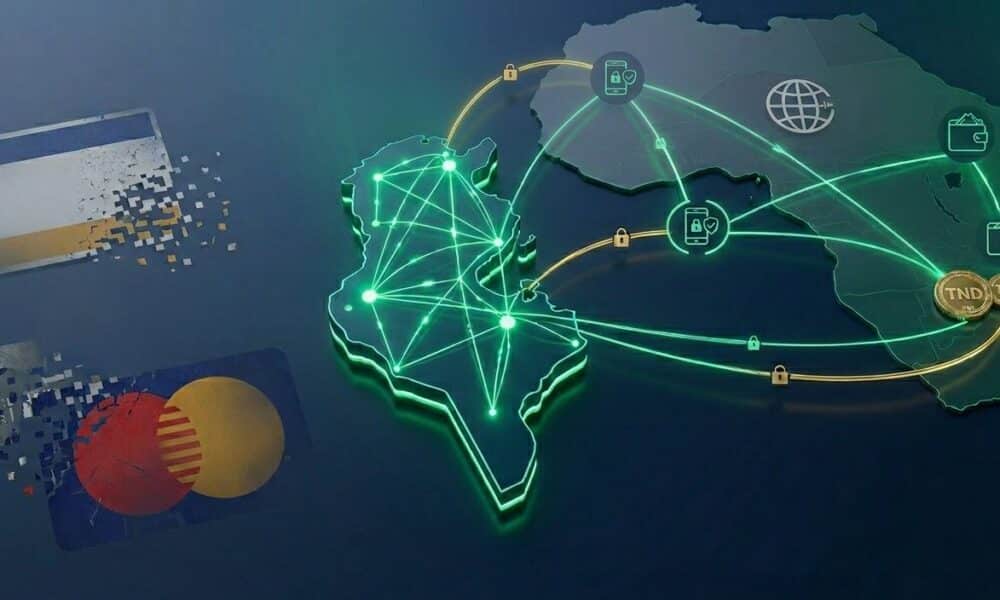
Europe is deploying at scale its sovereign alternative Wero to reduce dependence on American payment giants. In the face of this “European revolution,” the question is acutely posed for Tunisia. The country’s digital transition requires rethinking its national and international payment rails. The European example shows that this is no longer merely financial optimization, but a geopolitical urgency in the face of sanctions as a weapon. In Tunisia, financial sovereignty is at stake.
It is a tectonic shift shaking the world of European finance. Driven by the European Payments Initiative (EPI) and supported by the EuroPA alliance, the Wero payment system has surpassed 55 million registered users in Europe in the first quarter of 2026, of which 72% are in France, compared with 43.5 million a year earlier.
The ambition is now explicit: 130 million users by 2027, as Luxembourg (June 2026), Austria and the migration of the historic Dutch iDEAL expand the network. The Old Continent’s objective is clear: reduce the nearly total dependence on Visa and Mastercard.
If an economic power like the European Union deems vital to build its own account-to-account payment infrastructure, why would Tunisia continue to rely exclusively on foreign intermediaries for its digital transactions?
The invisible but heavy cost of dependence
Today in Tunisia, the majority of card transactions, whether domestic via SMT (Société Monétique de Tunisie) or international, rely on Visa and Mastercard networks. For the user, the gesture is invisible. For the Tunisian economy, it has a cost.
Each transaction generates commissions and interchange fees that, one way or another, end up impacting merchants and consumers. Moreover, in a context of constant pressure on the foreign exchange reserves of the Central Bank of Tunisia (BCT), paying these technological royalties in foreign currency represents a capital flight that could be avoided or at least reduced.
The scale of the market involved is not insignificant. According to BCT Bulletin No. 16 on payments in Tunisia, the card fleet reached 5.875 million in Q1 2026, up 0.4% from December 2025. The total number of card payment operations reached 41 million card payments representing 7,339 million dinars, a 22% rise in value compared with December 2025.
Annually, comparing 2025 to 2024, there is a 6.6% year-on-year increase in the number of cards, for 164.8 million card payment operations representing 29,498 million dinars, a 12.3% rise in value.
It is on this mass of transactions, largely backed by international rails, that the structural cost mentioned above is built.
At the continental level, the scale of the problem is documented: according to Afreximbank, the systematic use of third currencies (dollar, euro) for cross-border payments would cost Africa up to 5 billion dollars per year in foreign exchange, delays and opportunity costs, with more than 80% of cross-border payments by African banks currently routed via foreign correspondent banks. Tunisia is not immune to this logic, on its own scale.
A question of geopolitical sovereignty and data protection
Beyond the purely accounting aspect, the European example shows that payment has become a major geopolitical issue. Whoever controls the payment rails controls a portion of the real economy. By depending on actors like Visa and Mastercard, Tunisia remains exposed to extraterritorial pressures over which it has no control.
Moreover, centralization of Tunisian citizens’ financial data on servers belonging to foreign entities raises a fundamental question of digital sovereignty. A local alternative would allow keeping a tight grip on consumption patterns and internal financial flows.
However, one must nuance the sovereigntist narrative, even in the European case: part of Wero’s technical infrastructure rests on Amazon Web Services servers, which has created a zone of legal uncertainty related to the US Cloud Act, though EPI maintains control of its security model.
The lesson for Tunisia is clear: sovereignty of payment rails is not limited to the brand or governance of the system; it must also be built at the level of hosting and underlying technical infrastructure.
The geopolitical shock: When Europe trembled in the face of American sanctions
If Europe suddenly accelerated the deployment of Wero, it was not merely for economic calculation, but for pure strategic panic. The Old Continent measured the extent of its vulnerability following Washington’s aggressive use of extraterritoriality.
The trigger occurred when the United States imposed unilateral financial sanctions against judges of the International Criminal Court (ICC), including French judge Nicolas Guillou, and brandished threats of banking retaliation against senior political figures such as former minister Bruno Le Maire or former commissioner Thierry Breton, following standoffs over regulating tech giants.
Overnight, European officials found themselves under the threat of a “global banking ban” on their own soil. Their Visa and Mastercard cards were instantly cut off by banks’ overcompliance, terrified by American fines.
Europe then realized a stark truth: its banks had contractually ceded the monopoly of payment infrastructures to American networks, depriving states of the legal and technical capacity to protect their own citizens and leaders.
For Judge Guillou himself, the finding is unequivocal: the only path to European sovereignty is the urgent deployment of Wero, on the non-negotiable condition that all underlying IT infrastructure (servers and cloud) be ripped away from American giants (like AWS).
The lesson for Tunisia is monumental. If major economic powers, G7 members, can see their payment networks paralyzed in a click from Washington following a diplomatic or regulatory dispute, Tunisia is also exposed. Building a sovereign alternative is no longer just a financial optimization strategy: it is a vital national security insurance policy.
Linking the existing: the smart strategy, already underway
Europe did not seek to reinvent everything from scratch. Its strength lay in interconnecting national solutions that were already working well (Bizum in Spain, Bancomat in Italy, Blik in Poland). This is precisely the logic underpinning Wero: replace fragmented devices, Paylib in France, Payconiq in Belgium, Giropay in Germany, with a single, interoperable standard.
Tunisia has comparable foundations, and the movement is already underway:
- The national card processing network managed by SMT (undergoing restructuring, according to the strategic projects announced by the BCT);
- Mobile payments, consolidated by TUNPAY, whose growth is spectacular: 8.4 million mobile transactions in 2025, for 1.769 billion dinars, a rise of 81% in volume and 59% in value year-on-year. In the first quarter of 2026 alone, 2.7 million transactions were made from 477,000 active wallets (+22.2% year-on-year);
- The network of electronic payment terminals (TPE), with a notable 20.3% jump in 2025 to reach 6 billion dinars.
The most revealing signal remains, however, a friction point: the BCT itself notes a 67.1% increase in cash-out operations from digital wallets in Q1 2026, an indicator that some users cash out their digital funds because they cannot spend them directly with enough merchants. This is exactly the adoption challenge that Wero also faces in Europe, where success will depend on merchants’ willingness to integrate the solution before usage becomes widespread.
Regionally, the next step is no longer a hypothesis: it is underway but unfinished. The BCT joined PAPSS (Pan-African Payment and Settlement System) in February 2023, becoming the thirteenth central bank member of this system supported by Afreximbank, the African Union and the secretariat of the AfCFTA, modeled, in its aim of direct settlement in local currencies without going through a third currency, on the same logic as Wero/EuroPA. But institutional membership is not enough: to date, very few Tunisian commercial banks have subscribed to the system, and Tunisia still ranks among countries where no commercial bank is fully operational on the platform. The ball is therefore clearly in the Tunisian banking sector’s court, with supervisory authorities having already paved the way.
The adoption challenge: user experience first
If Tunisia wants to take the leap, the solution must not be carried only by a simple banking patriotism. It must be fluent, instant, bug-free and, above all, cheaper for merchants than current payment terminals (TPE).
The BCT figures already confirm this: three-digit growth in mobile payments shows that the population, especially the youth, is ready to adopt new uses if the UX is right. The real test, as with Wero in Europe, will not be user enrollment, already strongly progressing, but the actual activation rate and merchant acceptance density, the only condition to transform a digital wallet into a genuine substitute for international cards rather than a mere pretext for cash withdrawals.
An opportunity to seize
By drawing on European awareness, Tunisia has the opportunity to transform its financial ecosystem, and in fact has already laid several stones of this edifice: the BCT’s accession to PAPSS, sustained growth of mobile payments, modernization announced for SMT and SIBTEL.
What is still missing, however, is convergence: for commercial banks to join PAPSS as PSPs with TUNPAY, and for merchant acceptance to catch up with user enthusiasm.
Breaking free from dependence on Visa and Mastercard is no longer a utopian protectionism; it is a prudent economic measure and technological modernization, provided that the visible signals are turned into fully operational infrastructure.
By Walid Kooli
University lecturer, expert advisor in ecommerce, strategies and digital transformation of enterprises.