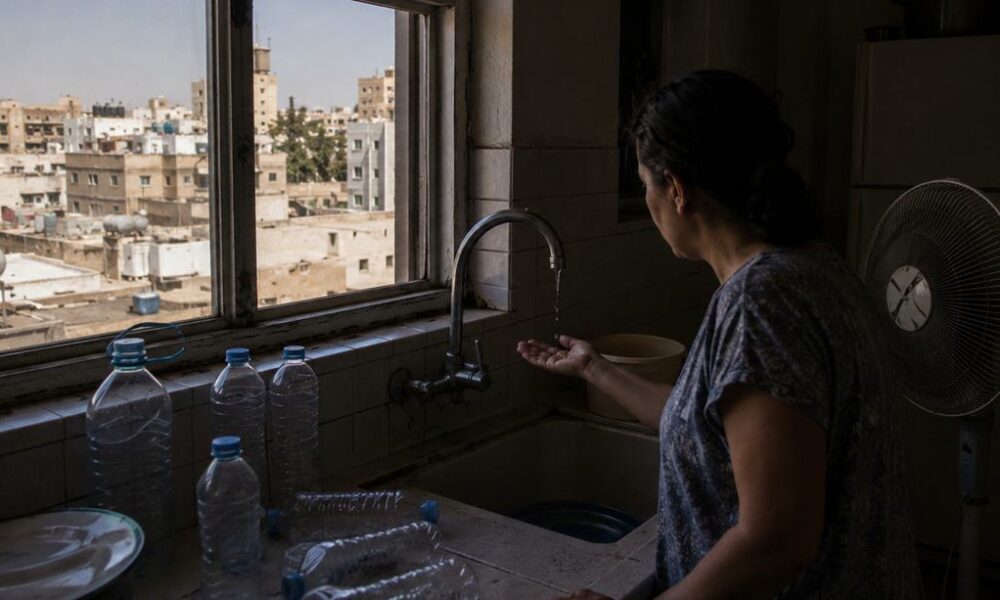
Power outages interrupt the supply. A few minutes or a few hours later, the faucet flow diminishes, water disappears from the upper floors, and sometimes across the entire neighborhood. When electricity returns, lights come back on immediately, but water can remain absent much longer.
This scenario does not necessarily mean that two independent outages occurred. Water and electricity networks are closely linked: to reach homes, water must be captured, treated, pumped to reservoirs, and distributed under sufficient pressure. A large portion of this chain runs on electricity.
According to SONEDE’s CEO, Abdelhamid Mnaja, about 1,500 pumping stations are electrically powered. He also presents the company as STEG’s main client, illustrating the direct dependence of water distribution on the continuity of power supply.
The Essential Link
An electric outage can stop pumps, reduce pressure, and trigger, with a delay, a water outage. The faucet can thus become the delayed victim of the power failure.
From Power Outage to Empty Faucet
When a pumping station stops functioning, water does not always disappear immediately. Water already stored in reservoirs and present in the pipelines continues to circulate temporarily.
But as reserves dwindle, pressure falls. The elevated neighborhoods, the far reaches of the network, and the uppermost floors of buildings are then the first to be affected.
The Five-Step Mechanism
- The power outage stops or slows certain pumps.
- Water already stored continues to feed the network for the time being.
- Reservoir levels and pressure decrease.
- The heights and the top floors lose water first.
- After power returns, pumps must fill the reservoirs and gradually restore pressure.
That is why two neighbors can experience different situations. The ground floor may still receive a trickle of water while the fourth floor gets none. A street downhill may remain supplied while a neighboring district, built higher, suffers a complete interruption.
This difference does not necessarily mean that SONEDE purposefully cut off one area and spared another. It may simply result from insufficient pressure.
Why Does Water Return Slower Than Electricity?
A light bulb comes back on as soon as power is restored. For water, the return is more gradual. Installations must restart, reservoirs refill, and pipes regain sufficient pressure.
Nearby sectors near the installations or at low elevation can thus regain water before distant neighborhoods and higher areas.
A Four-to-Five Hour Benchmark
According to the North regional director for water exploitation and distribution, interruptions related to ordinary outages generally last between four and five hours. This timeframe remains indicative: a major outage or a reservoir heavily depleted can prolong the disruption.
Restoration can also be slowed when many residents immediately fill bathtubs, cisterns, and large containers. This sudden resurgence in consumption uses up part of the water re-circulated before pressure reaches the most vulnerable areas.
Public Network or Building Pump?
In buildings, the outage does not always originate directly from SONEDE. When the public network pressure is not enough to serve the floors, a cistern and a booster pump take over. As soon as the power is cut, this collective pump stops.
Rapid Diagnosis
- Whole neighborhood lacks water: the disruption probably comes from the public network, a pumping station, or a general pressure drop.
- Only the building is affected: check the cistern, booster pump, and its power supply.
- Lower floors have water: pressure is insufficient or the booster pump is no longer functioning.
- Power has returned, but water remains absent in the building: the property manager should check the pump restart and the cistern level.
The property manager should at minimum know the cistern capacity, the state of the booster pump, the restart procedure, and the contact of the technician responsible for maintenance.
Relatively Full Dams: The Crisis Is Not Primarily About Reserves
An important element helps to understand the current disruptions. By mid-June 2026, the Ministry of Agriculture estimated the average fill rate of Tunisian dams at around 60%, a situation described as “very reassuring” by the director-general of dams and large hydraulic works.
The comparison with 2024 is striking: on July 26 of this year, the national rate was only 26.6%.
The Essential Point
Mid-June 2026: around 60% dam filling.
July 26, 2024: only 26.6%.
The current disruptions therefore do not reflect nationwide dam reserves collapsing to the extent seen in 2024. The immediate weak point lies mainly in production, pumping, pressure and delivery to the faucet.
A national rate of 60% does not mean abundance in all regions, nor the disappearance of water stress. Situations remain uneven, notably in some dams in the center of the country, and all stored water is not immediately available for drinking water distribution.
But this data changes the reading of the current crisis: in many areas, water exists in reserve. What falters temporarily is the energy and technical chain tasked with moving it, storing it under pressure, and delivering it to residents.
Heatwave Demands a Double Effort
The extreme heat simultaneously strains both networks. Air conditioners and cooling equipment sharply increase electricity demand. At the same time, water needs rise for drinking, hygiene, cleaning, irrigation and tourist activities.
Producing and distributing more water requires precisely more electricity. Heat thus increases electricity consumption, weakens the supply to pumps and reduces the capacity to distribute water just as demand peaks.
SONEDE prefers to speak of an “adjustment between the available supply and the demand” rather than deliberate cuts. This technical phrasing, however, does not change residents’ experience when water stops flowing.
In the Sahel, a Nighttime Regulation Also Linked to Desalination
Since July 5, 2026, a daily distribution regulation is applied from midnight to 5 a.m. in the governorates of Sousse, Monastir and Mahdia.
This measure is intended to fill reservoirs at night and improve daytime distribution. It is tied to the high summer consumption, but also to the pending completion of the Sousse seawater desalination plant’s technical tests.
This programmed regulation should be distinguished from an outage caused directly by an electrical outage. The two phenomena can occur together and worsen disruptions.
What to Do at Home?
It is reasonable to keep a limited reserve of drinking water when disruptions are announced. Large-scale storage, on the other hand, is counterproductive: if an entire neighborhood fills bathtubs, cisterns, and large containers simultaneously, demand surges and slows the restoration of pressure.
- Keep some bottles for drinking and meal preparation.
- Provide separately a small amount for toilets and cleaning.
- Close taps before leaving the dwelling.
- Do not leave a pump running when the cistern is empty.
- Regularly check the cleanliness of domestic and communal cisterns.
After restoration, water may be temporarily turbid due to sediments displaced by pressure variations. Let cold water run until it clears. If its odor, taste or color remains unusual, it is best not to drink it and report the problem to SONEDE.
One Outage, Two Essential Services Affected
A power outage does not deprive homes only of light, air conditioning or refrigeration. It can also stop pumps, lower pressure and gradually drain reservoirs.
The current situation is not mainly explained by empty dams. With a national rate close to 60% by mid-June, reserves are markedly more comfortable than in 2024. The immediate problem lies primarily in the capacity to produce, pump, and deliver enough water at the moment when heat drives demand to its peak.
What to Remember
Water can continue to flow after an outage thanks to already stored reserves. But when pumps stay off, pressure eventually falls. And even after power returns, several hours may be needed for water to reach the elevated neighborhoods and top floors.