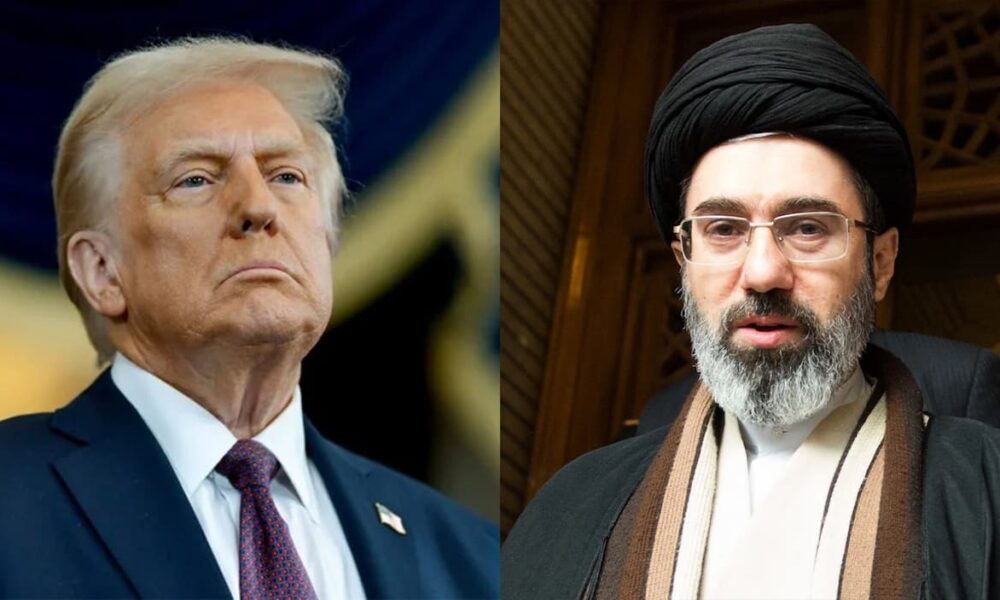
On the 146th day of the war and 37 days after the signing of the memorandum of understanding between Washington and Tehran, the military and economic escalation shows no signs of easing. The United States announced that it had completed a thirteenth consecutive night of strikes against Iran, while Tehran claims to have retaliated against facilities housing American forces in Bahrain and Jordan.
In addition to this military confrontation, a financial battle is now adding itself. U.S. President Donald Trump threatens to use Iranian assets held by Washington to compensate ships and cargoes damaged in the region’s sea lanes. This prospect was denounced by Iranian Foreign Minister Abbas Araghchi, who sees it as a dangerous precedent that could extend the conflict to the international financial system.
A thirteenth night of American strikes
The United States Central Command (CENTCOM) announced that it had successfully concluded a new series of strikes against Iranian military targets. According to its official tally, this was the thirteenth consecutive night of operations against Iran.
The American military says that this campaign aims to reduce Tehran’s ability to threaten civilian mariners and merchant ships moving through the regional waters, notably around the Strait of Hormuz. The latest strikes reportedly ended shortly before 5 a.m. local time.
CENTCOM did not provide a detailed tally of all targets hit, but Iranian media reported explosions in several regions, notably in the south and west of the country.
Four deaths announced by Iranian authorities
The Iranian official agency IRNA reported that the American strikes conducted during the night hit five provinces, causing four deaths and seven injuries.
However, the available information on the exact toll remains fragmented. The Associated Press reported, citing Iranian state media, the death of four people and five injured in a strike near Ahvaz, on the banks of the Karun River.
Explosions were also reported on Qeshm Island, located near the Strait of Hormuz and housing several Iranian naval installations, as well as in the areas of Andimeshk, Omidiyeh and Firouzabad. These tolls and claims about targets hit could not all be independently verified.
Iran says it targeted Bahrain and Jordan
In response to the American operations, the Iranian armed forces announced they had launched Arash-type drones against two bases used by American forces in the region.
Tehran says it targeted fuel depots and locations housing American military personnel at Sheikh Isa Air Base in Bahrain. The Iranian army also says it attacked aircraft hangars and zones housing American soldiers at Al-Azraq base in Jordan.
Bahraini authorities activated their sirens early Friday and urged the population to seek shelter after projectiles were detected. The region has experienced several similar alerts during the week, against a backdrop of geographically widening exchanges of strikes between Washington and Tehran.
The precise results of the operations claimed by Iran were not immediately independently verifiable.
The Iranian army has also warned that any action targeting what it calls Iran’s “legitimate interests” could jeopardize the security and economic interests of other regional countries. This framing directly targets the states hosting American forces or equipment.
Trump wants to make damages paid with Iranian money
The confrontation took on a new dimension after a statement by Donald Trump regarding Iranian assets held or controlled by the United States.
The American president stated that damage to ships, cargoes and other maritime transport-related property could be paid with “Iranian money” held by Washington.
Trump presents this measure as a mechanism to compensate shipowners and operators struck while passing through the Strait of Hormuz or in other areas affected by the conflict. The legal modalities allowing the United States to seize and use these funds remain uncertain, however.
Araghchi denounces an incendiary precedent
The Iranian Foreign Minister, Abbas Araghchi, reacted strongly to this threat.
According to him, seizing the sovereign assets of another state to settle future non-direct claims would constitute a particularly dangerous precedent and could fuel the conflict further.
The head of Iranian diplomacy argues that normalizing this type of confiscation would undermine the security of all sovereign assets held abroad. He warned that once governments consider the seizure of another country’s funds a normal practice, the assets of no state would be truly protected.
For Tehran, the American threat is therefore not only about bilateral confrontation. It could, in this reading, undermine confidence in financial institutions and in the jurisdictions where reserves are stored.
The Houthis open a second maritime front
Tensions have also spread to the Red Sea. The Houthi movement Ansar Allah said it had carried out missile and drone attacks against two Saudi tankers.
Donald Trump threatened the Houthis as well as Iran with a “major military punishment” if attacks on ships continued.
This development poses a double threat to global maritime trade. The Strait of Hormuz remains disrupted by the US-Iran confrontation, while the Bab el-Mandeb strait, linking the Red Sea to the Gulf of Aden, could also be further affected.
Some of Saudi Arabia’s oil exports have been redirected to the Yanbu port on the Red Sea to bypass the difficulties encountered in the gulf. The attacks claimed against tankers in this area nevertheless reduce the effectiveness of this alternative route.
Oil climbs above $100
The multiplicity of attacks on energy routes pushed Brent crude above $100 per barrel, rising more than 6% during the session.
The Speaker of the Iranian Parliament, Mohammad Bagher Ghalibaf, said that the United States had intended to punish Iran, but had ultimately ended up sanctioning themselves by triggering higher energy prices.
For Tehran, the rise in oil shows that military pressure and maritime blockade cannot be imposed on Iran without repercussions for American consumers and for the global economy.
Washington warns its nationals
Facing the risk of an escalation of the conflict, the U.S. State Department has urged American nationals in the Middle East to exercise heightened vigilance.
Washington advises them to prepare for possible flight cancellations, temporary closures of airspace, and other disruption of travel.
Americans outside the Middle East are also encouraged to reconsider travel plans to the region or transits through its major airports. Several airlines have already postponed resuming some flights or cut routes.
London says it is ready to defend itself
The United Kingdom has also raised its level of vigilance after warnings issued by the Iranian Revolutionary Guards to countries allowing American forces to use their bases.
A British government spokesperson said that the armed forces were ready, twenty-four hours a day, to defend the country against any attack.
London says it relies on a combined air defense and missile defense capability drawing on the Royal Navy, the Army and the Royal Air Force, in close coordination with NATO allies.
The British government nevertheless says it wants to avoid being drawn into a broader regional conflict and frames the use of its bases by the United States as defensive operations.
Trump increasingly skeptical about diplomacy
Despite the continued strikes, a portion of the American administration still believes in the possibility of a deal.
According to the Wall Street Journal, American envoys Steve Witkoff and Jared Kushner continue to consider that an agreement with Iranian leaders remains possible. Other advisers to Donald Trump, however, are much more pessimistic about the chances of achieving lasting peace.
The American president himself is said to have become more skeptical about negotiations. An official cited by the paper says Trump now sees no satisfactory option against Iran other than continuing the strikes.
The war, which the American president initially hoped to end within a few weeks, has now entered its fifth month. It is driving up energy prices, causing American military losses, and raising questions within Washington’s own leadership.
A memorandum of understanding emptied of its substance?
The new round of attacks comes as the memorandum of understanding signed in June was supposed to open a negotiation period devoted to the Iranian nuclear program, sanctions, frozen assets, and the administration of the Strait of Hormuz.
Thirty-seven days after its signing, the text appears largely surpassed by the fighting on the ground. Washington and Tehran officially continue to leave open the possibility of a political solution, but military operations, financial threats, and the expansion of attacks to regional bases are progressively narrowing the space for diplomacy.
The question is no longer simply whether the memorandum can be saved. It now concerns whether both sides still have a way out that could prevent the battle around the Strait of Hormuz and the Red Sea from turning into a generalized regional conflict.

Adel Khelifi